Mortgage Documents
Uncovering Hidden Mortgage Document Errors: Why Refinance Fraud is Skyrocketing in 2026
Discover why refinance fraud and loan document errors are surging in 2026, and why even homeowners who are current on their payments must audit their mortgage paperwork.

Disclaimer: This article is strictly for educational purposes and does not constitute legal advice. Always consult with a qualified attorney regarding your specific legal or financial situation.\n\nFor many homeowners, the ultimate marker of financial stability is simply paying the mortgage on time every month. If you are current on your payments, you might naturally assume that your underlying mortgage paperwork is legally sound, properly recorded, and completely free of errors. However, recent data from 2026 paints a very different and alarming picture. The real estate and title insurance industries are currently facing an unprecedented wave of hidden title defects, unverified assignments, and sophisticated refinance fraud.\n\nWhether you are preparing to refinance to take advantage of shifting interest rates, or you simply want the peace of mind that your home's chain of title is secure, conducting a thorough mortgage document review is no longer just a task for distressed borrowers. It is an essential step for every current homeowner. Hidden loan document errors can lurk in your file for years, only to derail a future sale, trigger a lien priority dispute, or leave you vulnerable to predatory lending practices. \n\n## The 2026 Surge in Refinance Fraud and Document Forgery\n\nRecent studies commissioned by title associations have revealed a staggering shift in the real estate landscape: refinance transactions are currently the industry's most dangerous minefield. While conventional wisdom once held that refinances were low-risk because the borrower already owned the home, fraud and forgery claims tied to mortgage refinances have surged. Today, these claims represent over 40% of all title insurer losses and expenses.\n\nThe cost of fighting these issues in court averages over $207,000 per claim—a number that is nearly seven times higher than the cost for all other types of title claims. Why is this happening? As the mortgage industry continues to digitize at a rapid pace, criminals have adapted. Fraudsters are increasingly utilizing synthetic identities, artificial intelligence-generated documents, and forged notary stamps to extract equity from properties. \n\nThese modern mortgage fraud schemes often target homes with significant equity. A criminal might forge a deed, record a fraudulent lien, or impersonate a homeowner to secure a new loan against the property. Shockingly, approximately 40% of these refinance-related losses stem from issues that cannot be identified through standard, superficial public record searches. By the time a homeowner realizes that a fraudulent loan has been taken out in their name, or that their own refinance paperwork contains critical flaws, the legal and financial damage is already done.\n\n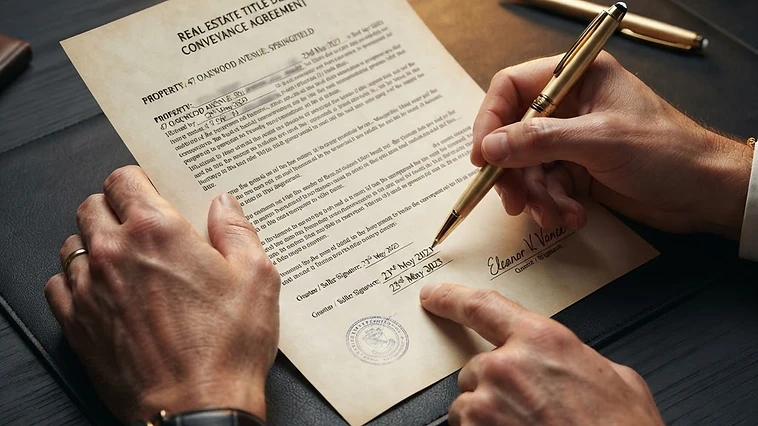 Homeowner conducting a mortgage document review to spot loan document errors.\n\n## Hidden Loan Document Errors You Might Not Notice\n\nEven if you are not the victim of third-party identity theft, your own legitimate loan documents might be riddled with errors. When a loan is originated, sold, securitized, and transferred between servicers, the paperwork must follow strict legal procedures. In the rush to close loans and bundle them for Wall Street, lenders and servicers frequently make severe administrative errors.\n\nSome of the most common loan document errors that go unnoticed by current homeowners include:\n\n* Defective Assignments: When your loan is sold, the mortgage or deed of trust must be properly assigned to the new trust or entity. Often, these assignments are missing, backdated, or signed by individuals who lack the legal authority to do so (a practice notoriously known as "robo-signing").\n* MERS Discrepancies: The Mortgage Electronic Registration Systems (MERS) was created to track mortgage transfers without recording them in county public records. However, MERS records frequently conflict with the actual physical endorsements on the promissory note, creating a break in the chain of title.\n* Notary and Signature Irregularities: A surprising number of mortgage documents feature invalid notary stamps, signatures from notaries whose commissions had expired, or signatures forged by third-party processing companies. \n* Missing Note Endorsements: The promissory note is the document that proves you owe the debt. For a new entity to enforce that debt, the note must be properly endorsed (stamped and signed), much like a check. Missing or blank endorsements can legally complicate who actually holds the right to collect your payments.\n* Inaccurate Servicing Disclosures: Federal law requires strict disclosures when your loan is transferred to a new servicer. Failing to provide accurate accounting, fee schedules, or transfer dates can leave homeowners paying phantom fees disguised as standard escrow or corporate advances.\n\nThese defects are invisible on a day-to-day basis. If you pay your mortgage via an online portal every month, the portal will never alert you to the fact that the entity collecting your money might lack the perfected legal standing to do so.\n\n## The Danger of Proceeding Without a Mortgage Document Review\n\nMany homeowners only discover these loan document errors when they decide to refinance their home. The refinance process requires a new title search and an underwriter's review. If the new lender discovers an unrecorded assignment, a break in the chain of title, or a defective deed of trust, your refinance can be denied or delayed indefinitely until the old title clouds are cleared.\n\nFurthermore, rushing into a refinance without conducting your own mortgage audit can actually strip you of your legal rights. When you sign new refinance paperwork, the new lender uses those funds to pay off the old loan. By doing so, you are effectively ratifying the previous debt. If your original lender committed fraud, violated the Truth in Lending Act (TILA), or overcharged you on hidden fees, paying them off with a new refinance loan often eliminates your ability to challenge their prior illegal actions. \n\nBy conducting a thorough mortgage document review before you apply for a refinance, you ensure that you are not blindly paying off a predatory loan. You also ensure that the new documents you are signing do not contain abusive clauses, such as mandatory arbitration agreements or inflated closing costs that strip the hard-earned equity from your property.\n\n## Protecting Yourself with a Comprehensive Mortgage Audit\n\nA mortgage audit is the process of forensically examining your loan origination documents, closing disclosures, promissory note, deed of trust, and payment history to identify discrepancies. You do not have to wait for a lawyer to initiate this process; homeowners can take proactive steps to gather their own evidence.\n\nFirst, request your complete loan file from your current mortgage servicer. Under the Real Estate Settlement Procedures Act (RESPA), you have the right to send a Qualified Written Request (QWR) or a Request for Information (RFI) to your servicer asking for the life-of-loan history, a copy of the original promissory note, and all assignments. \n\nSecond, visit your county recorder's office (or access their online database) and pull every recorded document tied to your property's address. Compare the county's public records against the documents provided by your servicer. Look closely at the dates. Was an assignment recorded years after the trust that supposedly bought your loan was closed? Are the signatures on the documents consistent, or do they look wildly different from page to page?\n\nBy actively looking for these anomalies, you can spot the warning signs of mortgage fraud, title defects, and securitization failures long before they threaten your homeownership.\n\n## Why Auditing Your Mortgage Paperwork Matters\n\nThe perception that mortgage document errors only matter when a homeowner falls behind on payments is a dangerous myth. As the 2026 data clearly shows, the complex, highly digitized, and often heavily flawed mortgage system leaves every homeowner vulnerable to title defects and refinance fraud. \n\nAuditing your mortgage paperwork matters because it is the only way to independently verify that your chain of title is clean, that your servicer is legally entitled to collect your money, and that your equity is protected from synthetic identity thieves and corporate negligence. Doing this before you refinance or before any future financial hardship strikes gives you the ultimate leverage. It allows you to correct title clouds on your own terms, challenge improper fees, and ensure your new refinance paperwork is pristine.\n\nIf you want to learn exactly how to request your documents, read the fine print, and uncover hidden legal defects in your loan file, the Foreclosure Defense Survival Playbook is your ultimate resource. This comprehensive 530-page educational guide is not just for homeowners facing default. It is the definitive manual for current homeowners who want to master evidence organization, understand complex mortgage documents, and conduct a professional-level mortgage audit. \n\nDon't wait until a title search derails your financial plans or a fraudster attempts to steal your equity. Arm yourself with the knowledge to protect your greatest asset. Order the Foreclosure Defense Survival Playbook today and take total control of your mortgage paperwork.



Order The Playbook
Get the Foreclosure Defense Survival Playbook
530 pages of structured, educational guidance covering mortgage documents, foreclosure procedures, evidence organization, and legal research — the same foundation this article draws from.