Mortgage Documents
Is Your Mortgage File Accurate? How to Spot Hidden Fraud and Loan Document Errors Before You Refinance
Recent court rulings and the rise of AI-generated fraud highlight the urgent need for homeowners to audit their mortgage documents. Discover how to spot hidden errors before you refinance.
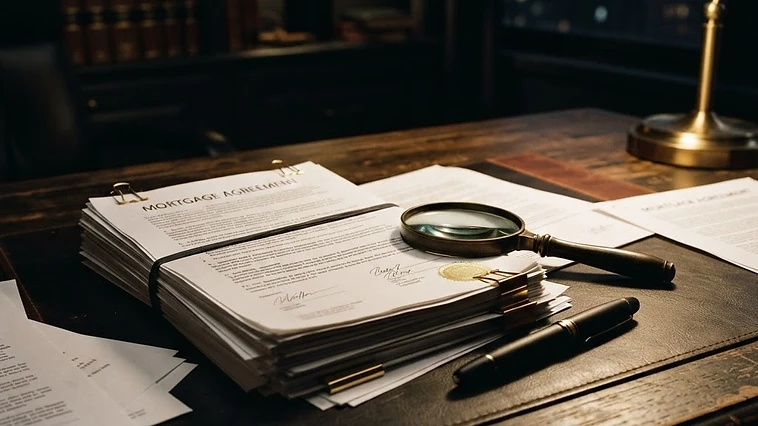
Disclaimer: The following article is for educational purposes only and does not constitute legal advice. Always consult with a qualified attorney regarding your specific legal situation.
If you are like most homeowners, you probably assume that as long as you make your monthly payments on time, your mortgage file is in perfect order. You trust that the bank, the title company, and the closing agents did their jobs correctly. However, the reality of the modern mortgage industry is far more chaotic. Between the rapid buying and selling of loans on the secondary market, the rise of sophisticated identity theft, and the increasing use of artificial intelligence to generate fake financial documents, the integrity of your mortgage file is under constant threat.
Whether you are planning to refinance, take out a home equity line of credit, or simply want peace of mind, conducting a thorough mortgage document review is no longer just for homeowners facing foreclosure. It is a vital protective measure for every current homeowner. In this article, we will explore recent news regarding mortgage fraud, highlight the systemic sloppiness of lenders, and explain why you must scrutinize your refinance paperwork for loan document errors before you sign on the dotted line.
The Illusion of the "Perfect" Mortgage File
When you sit down at a closing table, you are handed a massive stack of papers. You sign your name dozens of times, trusting that the promissory note, the deed of trust or mortgage, the Truth in Lending disclosures, and the various riders are all accurate. But what happens to those documents after you leave the room?
In many cases, your loan is immediately sold. The promissory note is endorsed (transferred) to a new entity, and the mortgage is assigned to a new beneficiary. Sometimes, the loan is bundled with thousands of others and securitized into a trust. During this frantic shuffling of paperwork, mistakes are incredibly common. Signatures are missed, notary stamps are applied improperly, and assignments are either lost or fabricated after the fact.
For homeowners who are current on their payments, these loan document errors remain hidden. The servicer continues to accept your money, and everything seems fine. But the moment you attempt to refinance or sell your home, these hidden defects can suddenly cloud your title, delay your transaction, or expose you to predatory lending practices. This is why a proactive mortgage audit is essential. You cannot rely on the bank to tell you if your paperwork is flawed; you must verify it yourself.
Recent News: AI, Fake Documents, and Mortgage Fraud
If you think mortgage fraud is a relic of the 2008 financial crisis, recent headlines prove otherwise. The landscape of fraud has evolved, becoming more sophisticated and harder to detect.
In October 2026, industry reports highlighted a terrifying new trend: the use of Artificial Intelligence to generate flawless fake financial documents. According to recent coverage, mortgage fraud is getting harder to spot because AI fundamentally changes how financial information is created and verified Mortgage fraud is getting harder to spot – are advisers prepared for the new warning signs? | NZ Adviser. Bad actors are using AI to fabricate pay stubs, bank statements, and tax forms that easily bypass traditional underwriting scrutiny. In response, companies like Ocrolus have had to roll out advanced AI-detection software just to catch tampered and AI-generated bank statements and pay stubs Fraud Detection Now Included For Every Ocrolus Mortgage Customer 302905212.
Furthermore, traditional fraud schemes are still rampant. In October 2026, an ex-mortgage broker was fined $40,000 for an alleged fraud scheme involving electronic signatures and unverified borrower identities Ex-mortgage broker fined $40K in alleged fraud scheme. Regulators found that the broker arranged for electronic signatures and submitted applications without ever meeting the borrowers in person.
Why does this matter to a homeowner who pays on time? Because if lenders and brokers are routinely duped by fake documents and sloppy verification processes, the overall integrity of the mortgage system is compromised. If a bad actor can use fake documents to take out a fraudulent cash-out refinance on a property they don't own—a scheme recently prosecuted by the Queens District Attorney FIVE INDICTED FOR IDENTITY THEFT AND MORTGAGE FRAUD SCHEME IN FLUSHING - OFFICE OF THE DISTRICT ATTORNEY QUEENS COUNTY—then your own title and mortgage file could be vulnerable to unauthorized liens or identity theft.
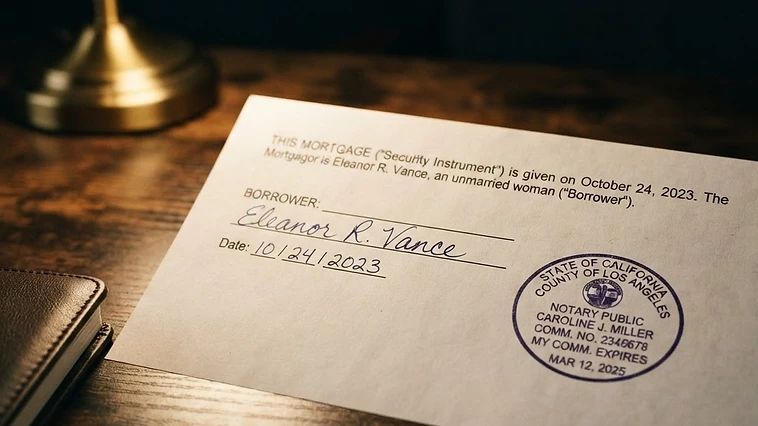 Close-up of a mortgage contract and notary stamp under warm gold lighting

Procedural Sloppiness: Lessons from the Courts
It is not just outright criminals who compromise mortgage documents; the lenders and servicers themselves are often guilty of gross procedural sloppiness. When banks cut corners, homeowners suffer.
A prime example occurred just recently in October 2026, when the Ohio Court of Appeals reversed a foreclosure judgment in the case of Union Home Mortgage Corporation v. Lauren Hinds Ohio Court reverses foreclosure judgment in mortgage case | LAWS.com News. The appellate court found that the mortgage company failed to properly serve one of the defendants. This ruling highlights a critical truth: mortgage companies frequently fail to follow proper legal procedures.
While this specific case involved a foreclosure, the underlying lesson applies to all homeowners. If a lender is careless enough to botch basic legal service in a lawsuit, how careful do you think they were when recording your mortgage assignments, endorsing your promissory note, or calculating your escrow accounts? The answer is: not very. Lenders process millions of documents a year, prioritizing speed over accuracy. This systemic negligence is exactly why you must conduct a mortgage document review before you enter into a new financial agreement like a refinance.
Common Loan Document Errors to Look For
When you sit down to review your refinance paperwork or audit your original loan file, you need to know what you are looking for. A proper mortgage audit involves cross-referencing your documents against county land records and standard legal requirements. Here are some of the most common loan document errors and red flags:
1. Missing or Broken Chain of Title
If your loan was sold, there must be a clear, unbroken chain of assignments recorded in your county's land records. Often, banks skip recording these assignments to save money, relying instead on the Mortgage Electronic Registration Systems (MERS). However, MERS has been the subject of intense legal scrutiny. If the assignments in your file do not match the actual transfers of the promissory note, you have a broken chain of title. This can cause massive headaches if you try to refinance, as the new title company may not be able to verify who actually owns your current loan.
2. Unendorsed Promissory Notes
The promissory note is the actual IOU that you signed. When a loan is sold, the note must be physically endorsed (stamped and signed) to the new owner, much like a check. In many cases, banks lose the original notes or fail to endorse them properly. If your current servicer cannot produce a properly endorsed note, they may not have the legal standing to enforce the debt. While this is a common defense in foreclosure, it is also a critical piece of information for a current homeowner to know.
3. Notary and Signature Irregularities
Robo-signing—the practice of having low-level employees forge signatures or sign thousands of documents a day without verifying their contents—did not disappear after the 2008 crisis. Look closely at the signatures and notary stamps on your mortgage assignments. Are the dates correct? Was the notary actually present when the document was signed? Fraudulent notarizations can render a document legally void.
4. Predatory Terms and Disclosure Violations
When reviewing your refinance paperwork, you must ensure that the lender is not slipping in predatory terms. Check your Truth in Lending Act (TILA) disclosures and Real Estate Settlement Procedures Act (RESPA) statements. Are the fees accurate? Is the interest rate exactly what was promised? Lenders sometimes "pad" closing costs or miscalculate escrow requirements, siphoning thousands of dollars from unsuspecting homeowners.
The Importance of Proactive Defense
Many homeowners believe that if they are not in default, they have no reason to rock the boat. But ignoring your mortgage documents is a dangerous gamble. The financial industry relies on the fact that the average consumer will never read the fine print or double-check the county records.
By conducting a mortgage audit while you are current on your payments, you operate from a position of strength. You have the time and resources to demand corrections, clear up title defects, and ensure that your refinance paperwork is pristine. If you wait until a financial hardship hits and you fall behind on payments, you will be fighting an uphill battle against a servicer that is already moving to take your home.
Furthermore, identifying loan document errors can give you significant leverage. If you discover that your lender violated TILA or RESPA, or that your mortgage was improperly assigned, you may be able to negotiate better terms, force the lender to correct the public record, or even seek damages. Knowledge is power, and in the realm of real estate, your documents are your ultimate source of truth.
Why Auditing Your Mortgage Paperwork Matters
Even if you have never missed a payment, the integrity of your homeownership relies entirely on the accuracy of your mortgage documents. As recent news clearly demonstrates, the mortgage industry is plagued by AI-generated fraud, identity theft, and procedural sloppiness. You cannot afford to blindly trust that your refinance paperwork or your original loan file is free of defects.
Auditing your mortgage paperwork matters because it protects your most valuable asset from hidden fraud, title clouds, and predatory lending. But knowing that you need to review your documents is only the first step; knowing how to review them is the real challenge.
This is where the Foreclosure Defense Survival Playbook becomes your ultimate weapon. This comprehensive, 530-page educational resource is not just for homeowners in distress. It is the must-have guide for any homeowner who wants to understand their mortgage documents, master the art of evidence organization, and learn how to spot the exact fraud, errors, and defects that lenders try to hide. The Playbook teaches you how to conduct a professional-level mortgage audit on your own file, empowering you to hold banks accountable and secure your financial future. Don't wait for a crisis to discover that your paperwork is flawed—order the Foreclosure Defense Survival Playbook today and take control of your mortgage.


Order The Playbook
Get the Foreclosure Defense Survival Playbook
530 pages of structured, educational guidance covering mortgage documents, foreclosure procedures, evidence organization, and legal research — the same foundation this article draws from.