Mortgage Documents
Is Your Mortgage Paperwork Accurate? How to Spot Hidden Fraud and Document Errors Before You Refinance
Recent lawsuits and industry reports reveal a surge in mortgage document defects and title fraud. Learn why auditing your loan paperwork is crucial even if you are current on your payments.
Disclaimer: The following article is for educational purposes only and does not constitute legal advice. Always consult with a qualified attorney regarding your specific legal situation.
Most homeowners believe that as long as they make their monthly payments on time, their mortgage is in perfect standing. You receive your monthly statement, you pay the balance, and you assume the bank has properly recorded your deed, accurately calculated your escrow, and legally secured your promissory note. Unfortunately, the modern mortgage industry is plagued by systemic inaccuracies, missing signatures, unrecorded assignments, and outright fraud.
Even if you are completely current on your payments, hidden loan document errors could be lurking in your file. These defects can cloud your property title, complicate future sales, or expose you to predatory lending practices when you attempt to refinance. In recent weeks, federal lawsuits and industry quality control reports have highlighted just how pervasive these issues remain. This article will explore recent enforcement actions, explain why a thorough mortgage document review is essential, and guide you through the process of auditing your refinance paperwork to protect your greatest asset.
The Rising Threat of Mortgage Fraud and Loan Document Errors
When we think of mortgage fraud, we often picture the 2008 financial crisis. However, recent data proves that document defects and fraudulent schemes are still highly active in the real estate market. According to recent industry quality control reports, mortgage defects remain a persistent issue, with lenders constantly battling errors in loan origination and servicing.
Errors in your mortgage paperwork are not just harmless typos. A missing notary seal, an unrecorded mortgage assignment, or a forged signature can fundamentally alter the legal standing of your property. When loans are bundled and sold on the secondary market—often tracked by electronic registries like MERS (Mortgage Electronic Registration Systems)—the physical paperwork is frequently lost, altered, or improperly endorsed.
For the average homeowner, these loan document errors remain invisible until a critical event occurs, such as a refinance application, a property sale, or an unexpected transfer of mortgage servicing. If your new servicer does not have the accurate, legally required documentation, you could face unjustified fees, escrow miscalculations, or even wrongful foreclosure proceedings down the line.
Recent Headlines: The $14 Million Title and Appraisal Fraud Scheme
To understand how easily mortgage documents can be manipulated, we only need to look at recent federal lawsuits. In September 2026, a major legal battle unfolded when a lender filed a lawsuit over a massive real estate fraud ring. According to the complaint, Ameritrust alleges $14M Baltimore fraud loss in federal lawsuit, involving approximately 90 loans on investment properties.
The lawsuit claims that investors used shell LLCs to purchase properties at low prices and then rapidly flipped them to other shell entities at a 300% markup. To secure financing for these inflated prices, the perpetrators allegedly relied on fraudulent, pre-prepared appraisals and manipulated title reports that intentionally omitted the recent lower-priced transactions.
While this specific case involved investment properties and Debt-Service-Coverage Ratio (DSCR) loans, the mechanics of the fraud are a stark warning for everyday homeowners. The scheme relied heavily on title gaps, pre-packaged fraudulent documents, and a failure of the standard checks and balances that are supposed to protect the integrity of real estate records. If sophisticated lenders can be duped by manipulated title work and appraisal fraud, individual homeowners must be equally vigilant about the accuracy of their own property records.
Why Current Homeowners Must Perform a Mortgage Document Review
If you are paying your mortgage on time, you might wonder why you need to conduct a mortgage document review. The answer lies in the chain of title and the legal enforceability of your loan.
When you originally closed on your home, you signed dozens of pages of complex legal documents. Over the years, your loan may have been sold multiple times. Each time a loan is sold, an Assignment of Mortgage must be properly executed and recorded in your local county land records. If a previous lender failed to record the assignment, or if they used a "robo-signer" to fraudulently execute the document without verifying its contents, your chain of title is broken.
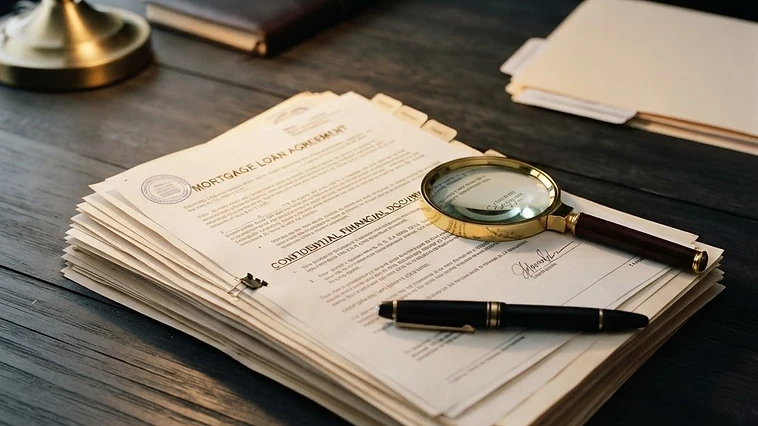
 Close up of a mortgage loan document and notary seal under warm desk lighting

Furthermore, if you are considering refinancing to take advantage of better interest rates or to tap into your home equity, your new lender will scrutinize your property's title. If they discover unreleased liens, missing assignments, or discrepancies in your original loan file, your refinance could be delayed or denied. Worse, if you unknowingly sign new refinance paperwork that rolls over previous predatory fees or illegal charges from your old servicer, you are legally binding yourself to those fraudulent terms.
Conducting a proactive mortgage audit allows you to identify and correct these issues while you are in a position of strength—current on your payments and not facing the immediate threat of foreclosure.
Common Refinance Paperwork Defects to Watch For
When reviewing your mortgage file, there are several specific areas where loan document errors and fraud typically occur. Understanding these common defects is the first step in protecting your property rights.
-
Missing or Fraudulent Assignments: Check your county land records to ensure that every time your loan was sold, a corresponding Assignment of Mortgage was recorded. Look closely at the signatures. During the foreclosure crisis, it was revealed that banks frequently used "robo-signers" who forged thousands of documents a day. If the signature on your assignment looks suspicious or was signed by a known robo-signer, the document may be legally void.
-
Notary and Signature Irregularities: Every mortgage and deed of trust must be properly notarized. Check the dates on your notary acknowledgments. Did the notary actually witness your signature on the date specified? In many cases of mortgage fraud, documents are notarized days or weeks after they were actually signed, or they are notarized by individuals who were not present at the closing.
-
MERS Discrepancies: The Mortgage Electronic Registration Systems (MERS) was created by the banking industry to bypass county recording fees. However, MERS has been at the center of countless legal disputes regarding its authority to assign mortgages. If MERS is listed as the nominee or beneficiary on your deed of trust, you must carefully trace the actual ownership of your promissory note to ensure the entity claiming to own your loan actually has the legal right to collect payments.
-
Appraisal and Title Defects: As seen in the recent Baltimore fraud case, appraisals and title reports can be manipulated. Review your original appraisal to ensure the comparable sales used were accurate and not artificially inflated. Check your title policy for any exceptions or unreleased liens from previous owners that could cloud your ownership.
-
Servicing Disclosure Issues: Federal law requires mortgage servicers to provide specific disclosures when your loan is transferred. If you did not receive a Notice of Servicing Transfer, or if your new servicer's records do not match your payment history, you may be the victim of servicing fraud or gross negligence.
The Mechanics of a DIY Mortgage Audit
Performing a mortgage audit does not necessarily require hiring an expensive forensic accountant or attorney, provided you are willing to put in the time to educate yourself. Start by gathering all of your original closing documents, including your Promissory Note, Mortgage or Deed of Trust, Closing Disclosure (or HUD-1 Settlement Statement), and Title Insurance Policy.
Next, request a complete payment history and a copy of your collateral file from your current mortgage servicer. Under the Real Estate Settlement Procedures Act (RESPA), you have the right to send a Qualified Written Request (QWR) or a Request for Information (RFI) to your servicer, legally compelling them to provide these documents.
Once you have your complete file, compare the documents against your county land records. Look for discrepancies in dates, missing endorsements on the promissory note, and unexplained fees in your payment history. Document every anomaly, no matter how small it may seem. In the world of real estate law, a single missing endorsement or a backdated notary seal can be the key to proving that your loan documents are legally defective.
Why Auditing Your Mortgage Paperwork Matters
Even if you have never missed a payment, the integrity of your mortgage documents is the only thing standing between you and the potential loss of your home. The banking industry has repeatedly demonstrated that it prioritizes speed and profit over accuracy and legal compliance. The recent $14 million fraud scheme in Baltimore is just the latest reminder that the real estate market is still vulnerable to systemic manipulation, appraisal fraud, and title defects.
Auditing your mortgage paperwork matters because it empowers you to take control of your financial future. If you are planning to refinance, a thorough review ensures that you are not carrying over illegal fees or title defects into your new loan. If you ever face a financial hardship in the future, knowing exactly what is in your loan file will give you a massive tactical advantage against aggressive servicers and foreclosure mills.
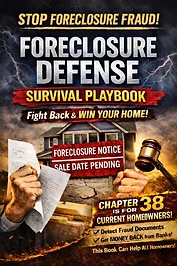
This is exactly why the "Foreclosure Defense Survival Playbook" was created. This comprehensive, 530-page educational resource is not just for homeowners in default—it is the ultimate guide for any homeowner who wants to understand their mortgage documents, organize their evidence, and master the art of legal research. The Playbook teaches you step-by-step how to spot hidden fraud, identify notary irregularities, and expose the loan document errors that banks hope you will never find.
Don't wait until you are facing a crisis or a complicated refinance to discover that your property records are a mess. Equip yourself with the knowledge to audit your own files, hold your servicer accountable, and protect your home. Order the Foreclosure Defense Survival Playbook today and take the first step toward true homeowner security.

Order The Playbook
Get the Foreclosure Defense Survival Playbook
530 pages of structured, educational guidance covering mortgage documents, foreclosure procedures, evidence organization, and legal research — the same foundation this article draws from.