Foreclosure Defense
The 16-Year Foreclosure Victory: How Recent Rulings and Servicing Laws Impact Homeowner Rights
A landmark appellate ruling has reshaped the foreclosure landscape, proving that homeowners who understand mortgage documents and the statute of limitations can successfully defend their homes.

Disclaimer: The information provided in this article is strictly for educational purposes and does not constitute legal advice. Foreclosure laws vary significantly by state. If you are facing foreclosure or are behind on your mortgage payments, please consult with a qualified, licensed attorney in your jurisdiction to discuss your specific legal situation.
For homeowners facing the terrifying prospect of losing their homes, the legal system can feel like an insurmountable, rigged machine. Banks and mortgage servicers have vast resources, teams of lawyers, and a historical advantage in the courtroom. However, recent developments in the legal landscape are proving that when homeowners educate themselves and hold lenders strictly accountable to the law, the tide can turn.
In late June 2026, a landmark appellate court decision sent shockwaves through the mortgage industry, demonstrating exactly why homeowners must scrutinize every single document, date, and action taken by their lender. Combined with ongoing federal crackdowns on mortgage servicing abuses and emerging threats like deepfake fraud, the current environment demands that homeowners become their own best advocates.
This article explores the most recent court rulings, the ongoing battle against servicing abuses, and how understanding your rights can make all the difference in a foreclosure defense strategy.
The 16-Year Fight: How a Recent Court Ruling Changes the Game
Foreclosure cases are rarely swift, but a recent ruling highlighted by legal industry experts illustrates just how long—and how fiercely—these battles can be fought. In late June 2026, an appellate court ruled in favor of a Long Island family, effectively ending a grueling 16-year foreclosure process in the homeowners' favor.
According to a report by Hinshaw & Culbertson LLP, the mortgage holder in this case lost their ability to foreclose because they ran afoul of the statute of limitations. The court's decision relied heavily on the Foreclosure Abuse Prevention Act (FAPA), a state law designed to stop lenders from manipulating legal deadlines. The court affirmed that FAPA applies retroactively and firmly rejected the lender's arguments to bypass it.
Why is this a massive victory for homeowner rights? For years, lenders who realized they had made procedural errors or lacked the proper evidence to foreclose would simply "de-accelerate" a loan. By doing this, they would voluntarily dismiss their own foreclosure lawsuit, effectively resetting the statute of limitations clock, and then refile the lawsuit years later when it was more convenient for them. This kept homeowners in a perpetual state of legal limbo, sometimes for decades.
This recent ruling sends a clear message to the mortgage industry: the clock cannot be endlessly reset. Lenders and servicers are now being forced to diligently track their own timelines and prosecute actions without unnecessary delay, or risk losing their right to foreclose entirely. For homeowners, this underscores the absolute necessity of tracking every single date in their foreclosure timeline.
Understanding the Statute of Limitations and Acceleration Dates
To understand why the recent appellate ruling is so critical, homeowners must understand two fundamental concepts in foreclosure defense: the "acceleration date" and the "statute of limitations."
When you sign a mortgage and promissory note, you agree to make monthly payments over a set period, usually 15 to 30 years. If you fall behind on those payments, the lender does not just sue you for the missed payments; they invoke an "acceleration clause" hidden deep within the fine print of your contract.
Acceleration is the formal legal demand where the lender declares the entire remaining balance of the loan due immediately. The exact date this happens—the acceleration date—is arguably the most important date in a foreclosure case.
 Close-up of a homeowner reviewing a foreclosure notice with a red pen on a dark charcoal desk.
Once a loan is accelerated, the statute of limitations clock begins ticking. The statute of limitations is a strict legal time limit within which a party must file a lawsuit. If the lender accelerates the loan but fails to successfully complete the foreclosure within the statute of limitations (which varies by state, often ranging from 3 to 6 years), they may be permanently barred from foreclosing on the property.
Historically, if a lender realized their paperwork was flawed—perhaps they were missing the original promissory note or had a fraudulent assignment—they would revoke the acceleration to stop the statute of limitations clock from expiring. Recent laws like FAPA, and the subsequent court rulings upholding them, strip lenders of this loophole. If a homeowner can prove the loan was accelerated outside the statute of limitations, they may have a complete defense against the foreclosure.
Mortgage Servicing Abuses and Emerging Fraud Risks in 2026
While courts are cracking down on statute of limitations abuses, federal regulators are simultaneously battling rampant errors and abuses by mortgage servicers. The company you send your monthly payment to is rarely the company that actually owns your loan. Mortgage servicers act as middlemen, and their internal systems are notoriously prone to catastrophic errors.
Servicing abuses often include improperly applied payments, unauthorized forced-placed insurance, inaccurate late fees, and the dreaded "dual tracking." Dual tracking occurs when a servicer pretends to work with a homeowner on a loan modification or loss mitigation plan, while simultaneously pushing forward with foreclosure proceedings behind the scenes.
The Consumer Financial Protection Bureau (CFPB) has repeatedly taken action against servicers for these exact violations. For example, the CFPB has previously penalized major servicers like Fay Servicing for failing to provide mortgage borrowers with the legal protections against foreclosure required by law. Despite these enforcement actions, servicing errors remain a primary driver of wrongful foreclosures.
Complicating matters further is the rise of sophisticated fraud. According to a July 2026 report by the Scotsman Guide, the mortgage industry is currently facing a notable shift in fraud-related risks, including the alarming rise of deepfake fraud and wire fraud. While this primarily affects loan origination, it has severe downstream effects for homeowners in foreclosure. When the chain of title is muddied by fraudulent digital documents, fake assignments, or compromised wire transfers, it becomes incredibly difficult to prove who actually has the legal standing to foreclose on a property.
How to Audit Your Mortgage Documents and Assignments
Given the prevalence of servicing errors, statute of limitations violations, and document fraud, homeowners cannot afford to take their lender's claims at face value. If you are facing foreclosure, you must audit your mortgage documents with a forensic level of detail.
One of the most critical areas to investigate is the "Assignment of Mortgage." Because loans are bought and sold multiple times on Wall Street as mortgage-backed securities, the original lender rarely owns the loan by the time it goes into default. To legally transfer the right to foreclose, there must be a valid, legally executed Assignment of Mortgage recorded in your local county records.
During the 2008 financial crisis, the industry was rocked by the "robo-signing" scandal, where low-level employees forged thousands of signatures on mortgage assignments every day without ever reviewing the documents. While the industry claims to have cleaned up its act, questionable assignments are still routinely filed in courts today.
When auditing your documents, look for:
- Dates that don't make sense: Was the assignment signed years after the trust that supposedly bought your loan was closed?
- Questionable signatures: Does the person who signed the assignment actually work for the company they claim to represent, or are they a known robo-signer?
- Lack of Standing: Does the entity suing you actually have a clear, unbroken chain of title proving they own your specific promissory note?
By demanding discovery and forcing the lender to produce the original, wet-ink promissory note and valid assignments, homeowners can expose fatal flaws in the bank's case. If the bank cannot prove they own the loan, they cannot legally take your home.
Why the Foreclosure Defense Survival Playbook Helps
Navigating the treacherous waters of acceleration dates, statute of limitations defenses, servicing abuses, and fraudulent assignments is incredibly overwhelming. The legal system is complex, and the terminology is designed to confuse the average person. This is exactly why the Foreclosure Defense Survival Playbook was created.
This comprehensive, 530-page educational book is the ultimate resource for homeowners who refuse to be intimidated by the banks. It breaks down complex legal concepts into plain, easy-to-understand language. Inside the Playbook, you will learn exactly how to read your mortgage documents, how to spot the telltale signs of robo-signing and fraudulent assignments, and how to calculate your loan's true acceleration date to see if the statute of limitations has expired.
The Playbook also provides detailed guidance on how to organize your evidence, how to communicate effectively with your mortgage servicer to stop dual tracking, and how to understand the court procedures that lenders use to fast-track foreclosures.
You do not have to face the threat of foreclosure blindly. By educating yourself, you can level the playing field, hold your lender accountable to the strict letter of the law, and fight for your home with confidence. Order your copy of the Foreclosure Defense Survival Playbook today and take the first crucial step toward taking back control of your financial future.

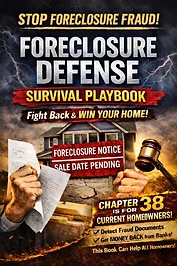
Order The Playbook
Get the Foreclosure Defense Survival Playbook
530 pages of structured, educational guidance covering mortgage documents, foreclosure procedures, evidence organization, and legal research — the same foundation this article draws from.