Foreclosure Defense
Recent Enforcement Actions and How to Defend Against Unlawful Foreclosures
Recent crackdowns on mortgage servicers highlight the importance of understanding your rights. Learn how to identify servicing abuses and defend your home.
Disclaimer: The following article is for educational purposes only and does not constitute legal advice. If you are facing foreclosure, please consult with a qualified attorney in your jurisdiction.
Foreclosures are a terrifying prospect for any homeowner. When you fall behind on your mortgage payments, the threat of losing your home can feel overwhelming. However, recent news and enforcement actions highlight a critical reality: mortgage servicers and banks frequently make mistakes, and sometimes they engage in outright unlawful practices. Understanding your rights and the rules that govern the foreclosure process is your first line of defense.
Recently, federal watchdogs have cracked down on mortgage loan servicers for unlawful foreclosure practices and order violations. These enforcement actions serve as a stark reminder that homeowners must remain vigilant. In this article, we will explore recent developments in mortgage servicing abuses, explain the difference between procedural and substantive defenses, and outline how you can protect your home.
Recent Crackdowns on Mortgage Servicing Abuses
In recent days, the Consumer Financial Protection Bureau (CFPB) and other regulatory bodies have continued to scrutinize mortgage servicers. Reports of enforcement actions against major loan servicers for unlawful foreclosure practices demonstrate that the system is far from perfect [5]. These actions often stem from servicers violating previous consent orders, failing to properly process loss mitigation applications, or engaging in "dual tracking."
Dual tracking is a particularly egregious abuse where a mortgage servicer pursues a foreclosure while simultaneously negotiating with a homeowner on a way to avoid the foreclosure, such as a loan modification [9]. This practice is strictly regulated, yet it remains a common issue. When servicers fail to promptly credit payments, credit payments to the wrong account, or misstate the amount needed to reinstate a mortgage, homeowners suffer [9]. An overstatement of the amount owed can cause a homeowner to give up their home simply because they believe they do not have enough funds to save it.
These enforcement actions prove that homeowners cannot blindly trust the numbers provided by their bank or servicer. You must scrutinize every document, every fee, and every notice you receive.
The 120-Day Rule and Pre-Foreclosure Notices
Before a lender can even initiate a foreclosure, they must follow strict federal and state guidelines. Federal law generally sets a 120-day timeline before a lender can officially start the foreclosure process [1]. This clock begins ticking after your first missed mortgage payment. The purpose of this 120-day period is to grant financially distressed homeowners ample time to resolve their issues, apply for a loan modification, or explore other alternatives to avoid foreclosure.
During this time, homeowners must receive proper notices. For example, the lender is typically required to send a Notice of Default (NOD) and a Notice of Acceleration, which outline the homeowner’s rights and the exact amount owed [1]. If a lender rushes to the courthouse and files a foreclosure lawsuit before this 120-day period expires, or if they fail to send the required pre-foreclosure notices, the homeowner may have a strong procedural defense.
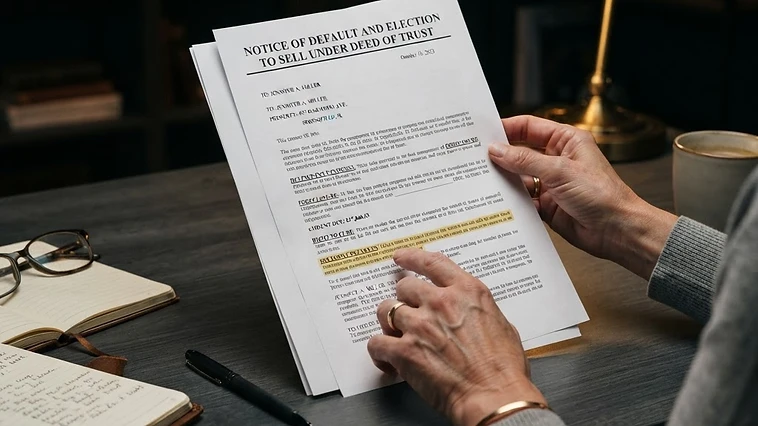 Homeowner reviewing a Notice of Default letter on a desk

Furthermore, under the Real Estate Settlement Procedures Act (RESPA), if your loan is transferred to a new servicer, you must receive notice from your old servicer at least 15 days before the transfer takes effect, and notice from your new servicer no more than 15 days after [9]. Violations of these notice requirements can be used to challenge the foreclosure action.
Understanding Procedural vs. Substantive Defenses
When fighting a foreclosure, defenses generally fall into two categories: procedural and substantive. Failing to raise a certain defense early in the process may waive it, so it is crucial to bring all valid arguments to the court’s attention at the outset [9].
Procedural Defenses are based on the rules that apply to the case. For example, if the foreclosing party did not provide the required pre-foreclosure notices, or if they cannot prove they have the legal standing to foreclose, you have a procedural defense. One of the most common procedural defenses is challenging standing. If the bank or trust filing the lawsuit cannot produce the original promissory note or prove a valid chain of assignments, the court may dismiss the case [9].
Substantive Defenses are based on the specific facts of your case. This includes situations where the mortgage servicer made accounting errors, such as failing to credit your payments, charging unauthorized fees, or proceeding with foreclosure despite an active loan modification agreement [9]. If you can prove that you are not actually in default, or that the amount claimed is wildly inaccurate due to servicer fraud or incompetence, you are raising a substantive defense.
Challenging the Validity of the Mortgage and Standing
Challenging the validity of the mortgage or the conduct of the lender is a cornerstone of foreclosure defense [1]. Homeowners and their advocates must scrutinize the loan documents for errors, material misrepresentations, or fraudulent practices by the original lender, the current servicer, or the trust that claims to own the loan.
In the wake of the 2008 financial crisis, the term "robo-signing" became infamous. While the industry claims to have cleaned up its act, questionable and conflicting mortgage assignments, lost promissory notes, and robo-witnesses who testify without personal knowledge of the business records remain prevalent issues [2].
To win a foreclosure case, the bank must establish that it has a legal right to enforce the mortgage loan agreement, that the homeowner defaulted, and that the bank is entitled to recover the costs [2]. If the bank's evidence is flawed—for instance, if an assignment of mortgage was fabricated or signed by someone without authority—the homeowner can attack the evidence to prevent the bank from obtaining a judgment.
Why the Foreclosure Defense Survival Playbook Helps
Navigating the treacherous waters of foreclosure requires knowledge, organization, and a deep understanding of how the mortgage industry operates. The banks have teams of lawyers working to take your home; you need a comprehensive resource to level the playing field.
This is exactly why the Foreclosure Defense Survival Playbook is an indispensable tool for any homeowner facing financial distress. This 530-page educational book is designed specifically for homeowners who are behind on payments or already in foreclosure. It breaks down complex legal concepts into plain language, helping you understand your mortgage documents, the intricacies of foreclosure procedures, and how to organize your evidence effectively.
Whether you are dealing with a servicer who is dual-tracking your loan, trying to understand how to spot a fraudulent mortgage assignment, or learning how to conduct legal research to support your case, the Playbook provides step-by-step guidance. It empowers you to spot the exact servicing abuses and procedural errors that federal regulators are currently cracking down on. Don't face the banks alone and uninformed. Order the Foreclosure Defense Survival Playbook today and take the first step toward fighting for your home.


Order The Playbook
Get the Foreclosure Defense Survival Playbook
530 pages of structured, educational guidance covering mortgage documents, foreclosure procedures, evidence organization, and legal research — the same foundation this article draws from.