Foreclosure Defense
Recent Court Rulings and CFPB Actions Expose Mortgage Servicing Abuses: What Homeowners Need to Know
Recent appellate court decisions and CFPB enforcement actions highlight critical procedural errors and servicing abuses by mortgage lenders, offering new hope for homeowners fighting foreclosure.

Disclaimer: The following article is for educational purposes only and does not constitute legal advice. If you are facing foreclosure, you should consult with a qualified attorney in your jurisdiction.
When homeowners fall behind on their mortgage payments, the threat of foreclosure can feel overwhelming and insurmountable. Banks and mortgage servicers often project an image of absolute authority, making borrowers feel as though the legal process is a foregone conclusion. However, recent developments in the courts and federal regulatory agencies tell a very different story. Over the past week, appellate courts have handed down significant rulings that expose the procedural sloppiness and financial overreach of mortgage lenders.
From reversing foreclosure judgments due to improper service of process to gutting inflated attorney fee demands, the judicial system is increasingly scrutinizing the actions of banks and their representatives. Simultaneously, the Consumer Financial Protection Bureau (CFPB) continues to uncover rampant mortgage servicing abuses, including illegal fees and dual tracking. For homeowners in foreclosure, understanding these recent events is critical. It highlights the importance of holding lenders to the strict letter of the law and scrutinizing every document filed in a foreclosure case.
Recent Court Rulings Expose Foreclosure Flaws
One of the most fundamental rights a homeowner has in any legal proceeding is the right to be properly notified of the lawsuit against them. This concept, known as "service of process," is a strict procedural requirement. If a bank fails to properly serve a defendant, the court lacks jurisdiction over that individual, and any judgment entered against them is legally void.
This exact scenario recently played out in Ohio. In a significant appellate decision, the Ohio Court of Appeals reversed a foreclosure judgment because the mortgage company failed to properly serve one of the property's co-owners Ohio Court reverses foreclosure judgment in mortgage case. In the case of Union Home Mortgage Corporation v. Lauren Hinds, the trial court had previously granted summary judgment in favor of the lender, assuming all parties had been properly notified. However, upon appeal, the court found that the record failed to establish that the lender had perfected service of process on a co-defendant, nor had that defendant waived the defect.
This ruling is a powerful reminder for homeowners facing foreclosure: procedural defenses matter. Banks process thousands of foreclosures, and in their rush to obtain judgments, they frequently make critical errors. A failure to properly serve a summons and complaint is not just a minor technicality; it is a constitutional due process violation that can stop a foreclosure in its tracks and force the lender to start the process over from the beginning.
Courts Slashing Inflated Bank Attorney Fees
Another major issue in foreclosure defense is the assessment of fees and costs. When a borrower defaults, the mortgage contract typically allows the lender to recover reasonable attorneys' fees incurred in enforcing the note and mortgage. However, "reasonable" is the operative word, and banks often attempt to pass exorbitant and unjustified legal bills onto the homeowner, further inflating the payoff amount required to save the home.
Recently, a New York appellate court took a firm stance against this practice. In a commercial mortgage-backed security (CMBS) foreclosure case, the trustee won the foreclosure but watched the court gut its attorneys' fee demand by more than half CMBS trustee wins foreclosure but court guts its attorneys’ fee demand | Mortgage Professional. The lender had requested approximately $588,000 in legal fees, but the Appellate Division’s Fourth Department affirmed a ruling that slashed the award to $250,000.
The court noted that the rates the servicer agreed to pay its lawyers did not match what the local market actually charges. Furthermore, the court denied the lender's attempt to stack duplicative layers of default interest. The practical takeaway for homeowners is profound: courts are not bound by whatever fee schedule a servicer agrees to pay its lawyers. Even contractually permitted fees must be reasonable and warranted for services actually rendered. Homeowners have the right to demand itemized invoices and challenge inflated corporate advances, property inspection fees, and legal costs added to their loan balance.
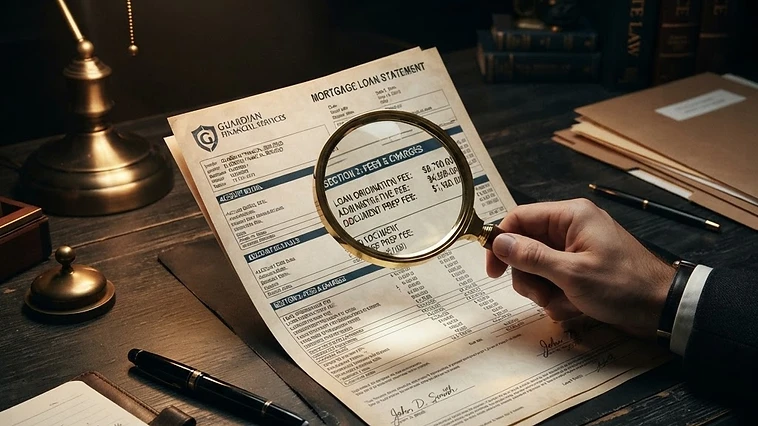 A magnifying glass examining a mortgage statement for hidden fees and servicing errors on a dark charcoal desk.

The CFPB Crackdown on Mortgage Servicing Abuses
While the courts are addressing procedural and fee-related overreach, federal regulators are actively targeting systemic mortgage servicing abuses. The Consumer Financial Protection Bureau (CFPB) has recently highlighted numerous violations of the Real Estate Settlement Procedures Act (RESPA) and Regulation X, which govern how servicers must handle distressed loans.
According to recent CFPB supervisory highlights, examiners have found that mortgage servicers are routinely charging homeowners for property inspections that are explicitly prohibited by investor guidelines (such as Fannie Mae) 18 CFPB Actions in 2024 Aiding Private Consumer Litigants | NCLC Digital Library. Additionally, servicers have been caught assessing late fees that exceed the amounts allowed in the loan agreements, and in some cases, charging late fees even after consumers have entered into loss mitigation agreements.
Perhaps the most egregious servicing abuse is "dual tracking." Dual tracking occurs when a mortgage servicer continues to push forward with foreclosure proceedings while simultaneously reviewing the borrower's application for a loan modification or other loss mitigation option. Federal law strictly prohibits this practice. If a borrower submits a complete loss mitigation application more than 37 days before a scheduled foreclosure sale, the servicer cannot initiate or advance the foreclosure process until the application is fully evaluated and the appeals process is exhausted. Despite these clear rules, CFPB enforcement actions and private litigation reveal that dual tracking remains a persistent threat to homeowners.
Why Procedural Defenses Matter in Foreclosure
When you combine the recent appellate rulings on service of process and attorney fees with the CFPB's findings on servicing abuses, a clear picture emerges: the foreclosure system is fraught with lender errors. For a homeowner, understanding these errors is the key to mounting an effective foreclosure defense.
Many homeowners mistakenly believe that because they missed payments, they have no defense. This is a dangerous misconception. Foreclosure is a strict legal process, and the burden of proof rests entirely on the plaintiff (the bank or trust). The lender must prove that it has the legal standing to sue, that it complied with all pre-foreclosure notice requirements (such as sending a valid Notice of Default), that it properly served the lawsuit, and that the amount it claims is owed is perfectly accurate.
If a servicer has inflated your balance with illegal property inspection fees, or if they are attempting to foreclose while you are under review for a loan modification, these are substantive defenses that can be raised in court. By forcing the bank to prove every element of its case, homeowners can often uncover the leverage needed to negotiate a favorable settlement, a principal reduction, or a sustainable loan modification.
How to Spot Errors in Your Mortgage Documents
To effectively defend against foreclosure, homeowners must become forensic auditors of their own mortgage files. This means requesting a complete payment history from your servicer and scrutinizing every line item. Look for unexplained corporate advances, repetitive property inspection fees, and late fees assessed during periods of forbearance or bankruptcy.
Furthermore, you must demand to see the original promissory note and the chain of assignments. During the 2008 financial crisis, the "robo-signing" scandal revealed that banks were routinely forging signatures and backdating mortgage assignments to rush foreclosures through the courts. While the industry claims to have cleaned up its act, chain-of-title issues still plague older loans and loans that have been sold multiple times into mortgage-backed securitization trusts.
If you are served with a foreclosure complaint, read it carefully. Check the dates on the assignments. Verify that the entity suing you actually owned the loan at the time the lawsuit was filed. If there are discrepancies, these must be raised as affirmative defenses in your formal answer to the court.
Why the Foreclosure Defense Survival Playbook Helps
Navigating the complexities of mortgage documents, court procedures, and legal research can be incredibly daunting for anyone, especially when the roof over your head is on the line. The banks rely on this confusion. They count on homeowners feeling overwhelmed and simply giving up by default. You do not have to be one of them.
This is exactly why the Foreclosure Defense Survival Playbook was created. This comprehensive, 530-page educational resource is designed specifically for homeowners who are behind on payments or already facing foreclosure. It breaks down complex legal concepts into plain, understandable language, empowering you to take control of your situation.
The Playbook teaches you how to decode your mortgage documents, spot the exact types of servicing abuses and inflated fees highlighted by recent court rulings, and organize your evidence effectively. It provides step-by-step guidance on understanding court procedures, conducting your own legal research, and identifying the procedural flaws—like improper service of process or dual tracking—that can stop a bank in its tracks.
Knowledge is your best defense against a system designed to intimidate you. By understanding your rights and learning how to hold your lender accountable to the strict letter of the law, you can level the playing field. Don't let the bank take your home without a fight. Order the Foreclosure Defense Survival Playbook today and equip yourself with the knowledge you need to protect your most valuable asset.


Order The Playbook
Get the Foreclosure Defense Survival Playbook
530 pages of structured, educational guidance covering mortgage documents, foreclosure procedures, evidence organization, and legal research — the same foundation this article draws from.