Foreclosure Defense
Recent Court Rulings and Foreclosure Defenses: How Homeowners Are Fighting Back Against Servicing Abuses
Recent appellate court rulings are reinforcing homeowner protections against foreclosure abuses. Learn how to identify servicing errors and build a strong defense.

Disclaimer: The information provided in this article is for educational purposes only and does not constitute legal advice. If you are facing foreclosure, please consult with a qualified attorney in your jurisdiction.
In recent days, the landscape of foreclosure defense has seen significant developments, particularly regarding how appellate courts are interpreting foreclosure abuse laws and holding mortgage servicers accountable. For homeowners who are behind on payments or already facing foreclosure proceedings, understanding these recent shifts in the legal environment is critical. The legal process of foreclosure has historically favored banks and massive financial institutions, but recent court rulings and heightened scrutiny on servicing abuses are providing homeowners with powerful tools to fight back.
This article explores the latest developments in foreclosure defense, the ongoing issues with mortgage servicing abuses, and how you can organize your evidence to protect your home.
The Rise of Foreclosure Abuse Laws and Recent Court Rulings
Recent legal news has highlighted a growing trend of appellate courts affirming the dismissal of foreclosure cases due to violations of foreclosure abuse laws. For example, recent appellate decisions in states like New York have strictly enforced statutes designed to prevent lenders from manipulating the statute of limitations or engaging in abusive litigation tactics. These rulings underscore a vital point for homeowners: banks must follow the letter of the law, and when they fail to do so, courts are increasingly willing to dismiss their foreclosure actions.
One of the primary ways homeowners are successfully defending against foreclosure is by challenging the foreclosing party's standing. Standing refers to the legal right to initiate a lawsuit. In a foreclosure context, the bank or trust filing the lawsuit must prove that it actually owns your debt and has the legal authority to foreclose on your property.
During the housing crisis, the rampant use of "robo-signing"—where bank employees signed thousands of foreclosure affidavits without verifying the information—exposed massive flaws in how banks handled mortgage documents. While the era of blatant robo-signing has evolved, the underlying issues of sloppy record-keeping, lost promissory notes, and improper assignments remain prevalent today. Recent court rulings continue to emphasize that if a lender cannot produce the original promissory note or prove a clear, unbroken chain of assignments, they may lack the standing to foreclose.
Understanding Mortgage Servicing Abuses and Dual Tracking
Mortgage servicers are the companies that collect your monthly payments, manage your escrow account, and handle loss mitigation requests. Unfortunately, servicing abuses remain a significant problem for homeowners. Recent enforcement actions and consumer complaints highlight ongoing issues with how servicers handle accounts, particularly for borrowers who are struggling financially.
One of the most egregious servicing abuses is "dual tracking." Dual tracking occurs when a mortgage servicer simultaneously pursues a foreclosure while the homeowner is actively negotiating a loan modification or other loss mitigation option. Federal regulations, specifically those enforced by the Consumer Financial Protection Bureau (CFPB), strictly prohibit dual tracking. Under these rules, a servicer generally cannot initiate foreclosure proceedings until a borrower is more than 120 days delinquent, and they must halt foreclosure actions if a complete loss mitigation application is under review.
Despite these regulations, servicers frequently make errors. They may fail to promptly credit payments, apply payments to the wrong account, or miscalculate the amount needed to reinstate a mortgage. An overstatement of the reinstatement amount can be devastating, causing a homeowner to abandon their defense because they falsely believe they cannot afford to save their home. Documenting every interaction, payment, and piece of correspondence with your servicer is essential to uncovering these abuses and building a substantive defense.
The Power of the Promissory Note and Procedural Defenses
When defending against a foreclosure, it is crucial to understand the difference between procedural defenses and substantive defenses. Procedural defenses focus on the rules and regulations the bank must follow to bring the case, while substantive defenses focus on the actual facts of the debt, such as whether you are actually in default.
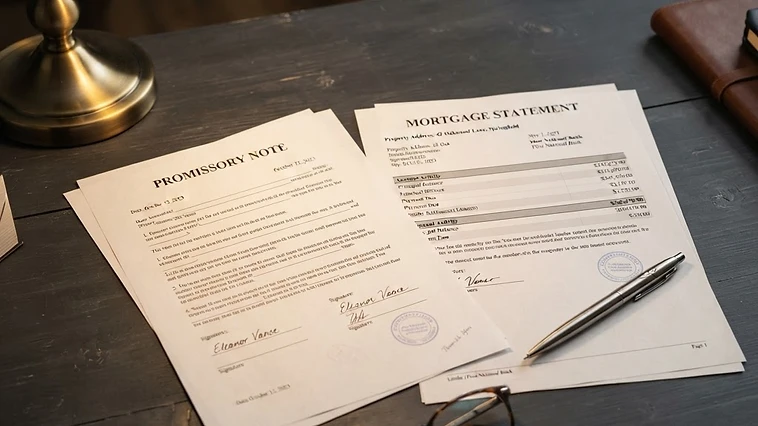 Close-up of mortgage documents and a promissory note on a dark desk under warm light.

A key procedural defense revolves around the promissory note. The promissory note is the actual IOU—the document you signed promising to repay the loan. The mortgage (or deed of trust) is the document that secures the note by placing a lien on your property. In many cases, loans are securitized, meaning they are bundled with thousands of other loans and sold to investors as mortgage-backed securities.
This securitization process often involves the Mortgage Electronic Registration Systems (MERS), a private registry created by the banking industry to track the transfer of mortgages without having to record every transaction in local county land records. However, the separation of the promissory note from the mortgage—a concept known as bifurcation—can create significant legal weaknesses for the foreclosing party. The U.S. Supreme Court has historically held that the mortgage must follow the note. If your note was sold to a securitized trust, but the mortgage was not properly assigned, or if the foreclosing entity cannot prove it holds the original note, you may have a strong defense against the foreclosure.
How Homeowners Can Document and Organize Evidence
Success in foreclosure defense heavily relies on the meticulous organization of evidence. Banks rely on the assumption that homeowners will be overwhelmed by the legal process and will not contest the foreclosure. By actively participating and demanding that the bank prove its case, you shift the balance of power.
To build a strong defense, you must gather and organize all documents related to your mortgage. This includes the original loan origination documents, the promissory note, the mortgage or deed of trust, all monthly billing statements, notices of default, and any correspondence regarding loan modifications or loss mitigation.
You should also request a complete payment history from your servicer. Scrutinize this history for unauthorized fees, improper application of payments, or unexplained charges. Mortgage servicers are notorious for piling on excessive fees—such as property inspection fees, late fees, and corporate advance fees—that may not be permitted under the terms of your mortgage contract or state law. Identifying these discrepancies can form the basis of a substantive defense, proving that the amount the bank claims you owe is inaccurate.
Furthermore, if you have applied for a loan modification, keep a detailed log of every phone call, including the date, time, the name of the representative you spoke with, and a summary of the conversation. Send all documents via certified mail with a return receipt requested so you have proof of delivery. This meticulous record-keeping is your best weapon against a servicer that attempts to illegally dual-track your loan or claims they never received your application.
Navigating the Discovery Process in Foreclosure Cases
If your foreclosure is judicial (meaning it goes through the court system), you have the right to engage in the discovery process. Discovery is the formal legal process of exchanging information between the parties in a lawsuit. This is a critical phase where you can demand that the bank produce the documents they intend to use against you.
Through discovery, you can request the original wet-ink promissory note, the complete chain of assignments, the pooling and servicing agreement (PSA) if your loan was securitized, and detailed records of how your payments were applied. You can also submit interrogatories (written questions the bank must answer under oath) and requests for admissions (statements the bank must admit or deny).
Many foreclosure cases are won or lost during the discovery phase. Banks often struggle to produce the required documents, especially if the loan has changed hands multiple times. If the bank fails to comply with your discovery requests, you can file a motion to compel, asking the judge to order the bank to produce the documents. Continued failure to comply can result in the dismissal of the foreclosure action.
Why the Foreclosure Defense Survival Playbook Helps
Facing foreclosure is one of the most stressful experiences a homeowner can endure. The legal jargon, the aggressive tactics of mortgage servicers, and the sheer volume of paperwork can feel insurmountable. However, you do not have to face this battle alone or uninformed.
The "Foreclosure Defense Survival Playbook" is a comprehensive, 530-page educational resource designed specifically for homeowners who are behind on payments or actively fighting foreclosure. This playbook demystifies the complex world of mortgage documents, foreclosure procedures, and legal research. It provides you with the knowledge you need to understand your rights, identify servicing abuses, and organize your evidence effectively.
Whether you are dealing with a lost promissory note, fighting against illegal dual tracking, or trying to navigate the discovery process, the Playbook offers step-by-step guidance in plain, easy-to-understand language. It empowers you to ask the right questions, demand the right documents, and hold massive financial institutions accountable for their errors and abuses.
Don't let the banks intimidate you into giving up your home without a fight. Equip yourself with the knowledge and strategies needed to level the playing field. Order the Foreclosure Defense Survival Playbook today and take the first crucial step toward protecting your home and your financial future.


Order The Playbook
Get the Foreclosure Defense Survival Playbook
530 pages of structured, educational guidance covering mortgage documents, foreclosure procedures, evidence organization, and legal research — the same foundation this article draws from.