Foreclosure Defense
Recent Court Rulings Expose Mortgage Servicing Abuses and Foreclosure Errors
Recent court decisions and federal reports reveal that mortgage servicers are still making critical errors in foreclosure cases. Learn how to spot these mistakes and protect your home.
Disclaimer: The following article is for educational purposes only and does not constitute legal advice. If you are facing foreclosure, please consult with a qualified attorney in your jurisdiction.
For homeowners facing the terrifying prospect of losing their homes, the foreclosure process can feel like an unstoppable machine. Banks and mortgage servicers often present an aura of invincibility, armed with stacks of complex documents and high-priced legal teams. However, recent court rulings and federal enforcement actions reveal a very different reality: mortgage servicers and lenders are still making critical, case-killing mistakes.
From illegal fee assessments and dual tracking to sloppy evidence and timing failures, the financial industry continues to violate homeowner rights. Understanding these recent developments is crucial for anyone fighting to save their home. By learning how to spot servicing abuses, fraudulent assignments, and procedural errors, homeowners can level the playing field and force banks to prove their claims.
Recent Court Rulings Expose Lender Evidence and Timing Failures
Foreclosure is a strict legal process, and lenders must follow the rules to the letter. When they fail to do so, courts are increasingly willing to dismiss their cases. A recent series of rulings involving major financial institutions highlights how small slips on timing, notices, and servicer affidavits can sink a lender's case.
For example, recent reporting on Deutsche Bank foreclosure cases demonstrates that courts are scrutinizing the exact timing of foreclosure filings and the validity of the evidence presented. In states like New York, where the Foreclosure Abuse Prevention Act has tightened the screws on lenders, banks are finding it much harder to rely on sloppy paperwork. In one notable instance, a bank attempted to file a second foreclosure action while a motion to voluntarily discontinue the first case was still pending. This type of procedural misstep can provide a massive advantage to a homeowner who knows how to spot it.
When a bank files for foreclosure, they must prove they have the legal standing to do so. This means they must produce the original promissory note, a valid mortgage or deed of trust, and a clear, unbroken chain of assignments. If the assignments are backdated, robo-signed, or missing entirely, the bank's legal standing can be successfully challenged. Homeowners must demand strict proof of standing and meticulously review every affidavit submitted by the servicer.
Mortgage Servicing Abuses: Phantom Fees and Rejected Payments
Mortgage servicers are the companies that collect your monthly payments and manage your escrow account. Unfortunately, they are also a frequent source of abuse and incompetence. The Consumer Financial Protection Bureau (CFPB) recently released its Supervisory Highlights, which uncovered numerous, widespread mortgage servicing violations.
According to the CFPB, examiners found that mortgage servicers engaged in unfair, deceptive, and abusive acts or practices (UDAAP). One of the most egregious findings was that servicers were charging homeowners for unnecessary property inspection fees following a delinquency, even when such inspections were strictly prohibited by investor guidelines (such as those from Fannie Mae). Furthermore, servicers were caught assessing illegal late fees that exceeded the amounts allowed in the loan agreements.
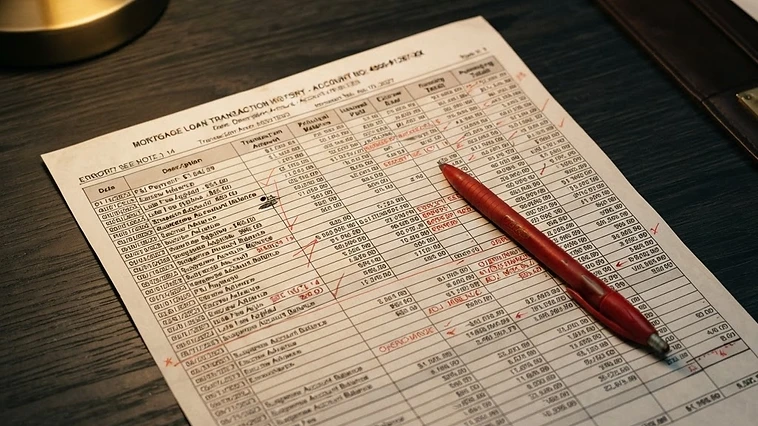 Close-up of a mortgage loan history printout being audited for servicing errors and illegal fees.

These "phantom fees" can quickly inflate a homeowner's balance, making it impossible to catch up on missed payments. But the abuses don't stop at fees. In the recent federal appellate case Freeman v. Ocwen Loan Servicing, LLC, the court examined a situation where a homeowner had successfully cured her mortgage default through a bankruptcy plan. Despite completing her required payments, the servicer inaccurately reported her loan as delinquent and began actively rejecting her monthly payments. This manufactured default led the bank to file a second, unjustified foreclosure action against her.
This case is a stark reminder that homeowners cannot blindly trust the accounting provided by their mortgage servicer. You must keep meticulous records of every payment made, every letter sent, and every phone call recorded.
The Danger of Dual Tracking and Notice Violations
Another major area of abuse is "dual tracking." Dual tracking occurs when a mortgage servicer continues to push forward with foreclosure proceedings while simultaneously evaluating the homeowner for a loan modification or other loss mitigation option. This practice is strictly prohibited by federal law under the Real Estate Settlement Procedures Act (RESPA), specifically Sections 1024.41(f) and (g).
Despite these clear prohibitions, servicers continue to violate the rules. Recent CFPB examinations found that servicers violated Regulation X when they failed to document certain actions in their servicing systems, such as establishing live contact with borrowers before initiating foreclosure.
State laws also provide robust protections against these practices. For instance, under California Civil Code Section 2923.55, a mortgage servicer cannot record a Notice of Default until they have contacted the borrower (or attempted with due diligence) to assess their financial situation and explore foreclosure avoidance options. Recent tentative rulings in California courts show that judges are willing to halt foreclosures when homeowners can prove that the servicer failed to make this mandatory contact. If you are in foreclosure, you must demand a complete log of the servicer's communication records during the discovery process to prove they violated these pre-foreclosure requirements.
How Homeowners Can Spot Fraud and Servicing Errors
Defending against foreclosure requires a proactive, forensic approach to your mortgage documents. You cannot wait for the bank to hand over the evidence; you must actively seek it out and analyze it for errors. Here are the critical steps every homeowner should take:
- Demand a Comprehensive Payment History: Send a Qualified Written Request (QWR) or Request for Information (RFI) to your servicer demanding a complete, line-by-line payment history from the inception of the loan. Look for unexplained corporate advances, property inspection fees, and unauthorized late charges.
- Audit the Chain of Title: Go to your county recorder's office and pull every document recorded against your property. Look at the Assignments of Mortgage. Were they signed years after the trust closing date? Were they signed by known robo-signers?
- Scrutinize the Notice of Default: Did the servicer comply with all state and federal pre-foreclosure notice requirements? Did they attach the required loss mitigation applications? If they missed a single statutory deadline, you may have grounds to file a motion to dismiss.
- Challenge the Affidavits: When the bank files a motion for summary judgment, they will include an affidavit from a servicer employee claiming personal knowledge of your loan records. In many cases, these employees are simply reading from a computer screen and have no actual knowledge of how the records were created. This is hearsay, and it must be objected to in court.
Why the Foreclosure Defense Survival Playbook Helps
Facing a foreclosure lawsuit is overwhelming, especially when you realize that the bank's paperwork is riddled with errors, illegal fees, and procedural flaws. The recent court rulings and CFPB enforcement actions prove that you can fight back and win—but only if you know exactly what to look for and how to present your evidence to the judge.
This is exactly why the Foreclosure Defense Survival Playbook is an absolute necessity for any homeowner fighting to save their property. This comprehensive, 530-page educational guide takes the mystery out of the legal system. It teaches you how to decode complex mortgage documents, spot fraudulent assignments, and audit your payment history for the exact illegal fees the CFPB is currently cracking down on.
Instead of feeling helpless against the bank's attorneys, the Playbook empowers you with the knowledge to understand court procedures, draft effective discovery requests, and conduct the legal research necessary to hold your servicer accountable. Don't let a bank steal your home using sloppy evidence and phantom fees. Order the Foreclosure Defense Survival Playbook today, educate yourself on your rights, and start building a formidable defense to keep your family in your home.


Order The Playbook
Get the Foreclosure Defense Survival Playbook
530 pages of structured, educational guidance covering mortgage documents, foreclosure procedures, evidence organization, and legal research — the same foundation this article draws from.