Foreclosure Defense
Recent Court Battles Expose Mortgage Servicing Abuses: How to Protect Your Home
Recent legal battles highlight ongoing mortgage servicing abuses, including illegal dual tracking and manufactured defaults. Learn how to identify these tactics, organize your evidence, and defend your home.

Disclaimer: The following article is for educational purposes only and does not constitute legal advice. If you are facing foreclosure, you should consult with a qualified attorney in your jurisdiction to discuss your specific situation.
When you fall behind on your mortgage payments, the stress can be overwhelming. Homeowners often assume that the bank or mortgage servicer is operating strictly by the book, following all federal and state laws. However, recent court filings and legal battles across the United States reveal a much darker reality: mortgage servicing abuses, illegal dual tracking, and manufactured defaults are still rampant in the industry.
For homeowners facing foreclosure, understanding these recent developments is not just about staying informed—it is about survival. By learning how servicers manipulate the system, you can better organize your evidence, assert your rights, and mount a formidable foreclosure defense.
The Rise of Mortgage Servicing Abuses in Recent Court Cases
Mortgage servicers are the companies that collect your monthly payments, manage your escrow account, and handle loss mitigation requests (like loan modifications). They are not always the entity that owns your loan; they merely service it. Unfortunately, the financial incentives of mortgage servicing often conflict with the best interests of the homeowner.
Recent legal actions highlight how these conflicts of interest lead to devastating consequences for families. For example, in the recent Seventh Circuit Court of Appeals case Freeman v. Ocwen Loan Servicing, LLC, a homeowner successfully cured her mortgage default through a Chapter 13 bankruptcy plan. Despite completing her payments and curing the pre-petition default, her mortgage servicer, Ocwen, inaccurately reported her loan as delinquent.
Even worse, the servicer began rejecting her regular monthly payments, demanding instead that she pay a massive lump sum to "cure" a default that no longer existed. Because of this erroneous reporting and the servicer's refusal to accept valid payments, the bank initiated a second, entirely unjustified foreclosure action against her.
This case is a textbook example of a "manufactured default." The homeowner did everything right, yet the servicer's internal errors and aggressive tactics pushed her back into the foreclosure pipeline. This type of servicing abuse is not an isolated incident; it happens to thousands of homeowners who are trying to get back on track after a financial hardship.
What is Dual Tracking and Why is it Illegal?
Another egregious servicing abuse currently making its way through the courts is "dual tracking." Dual tracking occurs when a mortgage servicer simultaneously moves forward with foreclosure proceedings while actively reviewing a homeowner's application for a loan modification or other loss mitigation option.
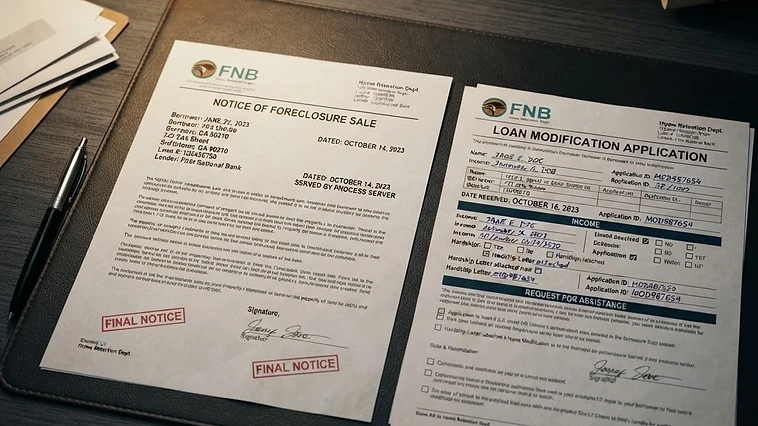 Side-by-side mortgage documents showing a foreclosure notice and a loan modification application, illustrating illegal dual tracking.

In a recent petition to the Supreme Court of the United States (Reese v. Select Portfolio Services), the devastating effects of dual tracking were brought to the forefront. The case involves an elderly, incapacitated widow whose home of 60 years was foreclosed upon. The petition alleges that the servicer, Select Portfolio Services (SPS), engaged in unethical and illegal dual tracking, depriving the homeowner of her due process rights and violating both federal statutes and the California Homeowner Bill of Rights (HBOR).
Under federal law, specifically the Real Estate Settlement Procedures Act (RESPA) and the Consumer Financial Protection Bureau's (CFPB) Regulation X (12 C.F.R. § 1024.41), dual tracking is strictly prohibited. If a homeowner submits a complete loss mitigation application more than 37 days before a scheduled foreclosure sale, the servicer must halt all foreclosure actions. They cannot file for foreclosure, apply for a foreclosure judgment, or conduct a foreclosure sale until they have fully evaluated the application and provided a written decision.
Furthermore, if the servicer denies the loan modification, they must provide specific reasons for the denial and give the homeowner a chance to appeal. In the Reese case, allegations suggest that the servicer illegally filed a Notice of Trustee Sale during the loan modification review and appeal period, effectively pulling the rug out from under the homeowner while pretending to offer help.
How Servicers Manufacture Defaults: The Rejected Payment Trap
One of the most frustrating tactics used by mortgage servicers is the "rejected payment trap." As seen in the Freeman case, this occurs when a homeowner falls behind but then attempts to resume regular payments, or when a homeowner cures a default through bankruptcy, only to have the servicer refuse to accept their money.
Servicers often claim that their internal policies prevent them from accepting anything less than the full past-due amount, plus exorbitant corporate advances, late fees, and attorney fees. By rejecting regular monthly payments, the servicer ensures that the homeowner falls further and further behind. The unpaid interest compounds, the late fees pile up, and the servicer's own legal fees are tacked onto the balance of the loan.
This creates a vicious cycle. The homeowner has the money to make their regular payment, but because the servicer refuses to take it, the account goes deeper into default. Eventually, the servicer uses this artificially inflated default to justify filing a foreclosure lawsuit.
Homeowners must understand that they have rights under the Fair Debt Collection Practices Act (FDCPA) and RESPA to challenge these inaccurate accounting practices. If a servicer is inaccurately reporting your loan as delinquent or refusing to accept valid payments, you must document every attempt to pay and every rejection received.
The Importance of Organizing Your Evidence
When you are up against a multi-billion-dollar financial institution and their army of foreclosure attorneys, your best weapon is a meticulously organized paper trail. Foreclosure defense is heavily reliant on evidence, discovery, and court procedure. If you claim that the servicer engaged in dual tracking or rejected your payments, you must be able to prove it to a judge.
To build a strong defense, homeowners should immediately start compiling a comprehensive foreclosure defense file. This file should include:
- Every piece of correspondence: Save every letter, notice, and statement you receive from the servicer, the bank, or their attorneys. Keep the envelopes, as the postmark date can sometimes prove that a servicer backdated a legally required notice.
- Proof of payment attempts: If you try to make a payment and the servicer rejects it, document it. Keep screenshots of online portals showing the rejection, save returned checks, and keep records of wire transfers that were bounced back.
- Loss mitigation records: Keep a copy of every single page of your loan modification application. Send all applications via certified mail with a return receipt requested so you can prove exactly when the servicer received it. This is crucial for proving dual tracking violations under RESPA.
- Phone logs: Never rely on a servicer's verbal promises. If a customer service representative tells you on the phone that your foreclosure sale is postponed while they review your application, do not believe them until you have it in writing. Keep a log of every phone call, including the date, time, the name of the representative, and exactly what was said.
Federal Protections: RESPA, FDCPA, and the CFPB
Homeowners are not without legal shields. The federal government has enacted several laws designed to protect consumers from the exact types of mortgage fraud and servicing abuses detailed in recent court cases.
The Real Estate Settlement Procedures Act (RESPA): As mentioned earlier, RESPA and its implementing Regulation X are the primary tools for fighting dual tracking. RESPA also gives homeowners the right to send a Notice of Error (NOE) or a Request for Information (RFI) to their servicer. If you believe your servicer has made an accounting error, rejected a valid payment, or failed to properly evaluate your loss mitigation application, you can send a formal NOE. By law, the servicer must acknowledge receipt of your letter within five days and conduct a reasonable investigation to correct the error within 30 days.
The Fair Debt Collection Practices Act (FDCPA): Mortgage servicers who acquire a loan after it is already in default are generally considered debt collectors under the FDCPA. This law prohibits debt collectors from using false, deceptive, or misleading representation in connection with the collection of any debt. Inaccurately reporting a loan as delinquent when a bankruptcy plan has cured the default—as seen in the Freeman case—can be a violation of the FDCPA, entitling the homeowner to statutory damages and attorney's fees.
The Consumer Financial Protection Bureau (CFPB): The CFPB is the federal agency tasked with enforcing these rules. Homeowners facing servicing abuses should file detailed complaints with the CFPB. While the CFPB will not represent you in court, their involvement forces the servicer's executive resolution team to respond to your allegations, often bypassing the low-level customer service representatives who cause many of these issues.
Why the Foreclosure Defense Survival Playbook Helps
Navigating the treacherous waters of mortgage servicing abuses, dual tracking, and manufactured defaults is nearly impossible without a map. The banks rely on the fact that most homeowners do not understand mortgage documents, court procedure, or legal research. They expect you to be intimidated, confused, and ultimately, to give up.
That is exactly why the Foreclosure Defense Survival Playbook is an absolute necessity for any homeowner facing late payments or active foreclosure. This comprehensive, 530-page educational book is designed to level the playing field. It breaks down complex legal concepts—like RESPA violations, defective affidavits, and invalid assignments—into plain, easy-to-understand language.
The Playbook teaches you how to read your mortgage documents like a forensic auditor, spotting the exact errors and servicing abuses that recent court cases have exposed. It provides step-by-step guidance on how to organize your evidence, draft powerful Notices of Error, and understand the rules of discovery and court procedure so you can hold your servicer accountable.
You do not have to be a victim of robo-signing, dual tracking, or bank fraud. Knowledge is your best defense. Equip yourself with the tools, strategies, and education you need to fight back and protect your home. Order your copy of the Foreclosure Defense Survival Playbook today and take the first step toward taking control of your financial future.


Order The Playbook
Get the Foreclosure Defense Survival Playbook
530 pages of structured, educational guidance covering mortgage documents, foreclosure procedures, evidence organization, and legal research — the same foundation this article draws from.