Mortgage Servicing
Mortgage Servicer Abuses Exposed: What the Recent $4.6M Settlement Means for Homeowners
A recent $4.6 million settlement with a major mortgage servicer highlights the ongoing abuses homeowners face. Learn how to spot servicing errors and defend your home.

Disclaimer: The following article is for educational purposes only and does not constitute legal advice. If you are facing foreclosure, you should consult with a qualified attorney in your jurisdiction to understand your specific legal options.
Falling behind on your mortgage is one of the most stressful experiences a homeowner can face. The constant phone calls, the confusing letters, and the looming threat of losing your home can make you feel entirely powerless. But what happens when the company managing your loan—your mortgage servicer—is the one breaking the rules?
Recent enforcement actions prove that mortgage servicers are still making devastating errors that push struggling homeowners closer to foreclosure. Just days ago, California Attorney General Rob Bonta announced a massive $4.6 million settlement with Select Portfolio Servicing (SPS), a major sub-prime mortgage servicer, for violating homeowner protection laws during the COVID-19 pandemic.
This settlement is a massive wake-up call. It proves that servicing abuses, improper fees, and communication failures are not a thing of the past. For homeowners currently fighting foreclosure, understanding these recent enforcement actions is critical. It highlights exactly why you must scrutinize every document, question every fee, and understand your rights under state and federal law.
The $4.6 Million Wake-Up Call: Breaking Down the Recent Settlement
To understand how mortgage servicing abuses happen, we have to look at the facts of the recent $4.6 million settlement with Select Portfolio Servicing. The California Department of Justice launched an investigation into the company's practices and uncovered multiple violations of the Homeowner Bill of Rights (HBOR)—a set of laws specifically designed to protect homeowners facing foreclosure.
According to the investigation, the servicer failed struggling homeowners in several critical ways. First, they failed to provide adequate information about COVID-19 forbearance plans, leaving homeowners in the dark about their options to pause or reduce payments during a global crisis.
Second, the servicer sent inaccurate mortgage statements to borrowers who were already on approved forbearance plans. These statements wrongly threatened that late fees would be charged for missed payments, creating unnecessary panic and confusion.
Finally, the servicer failed to provide a reliable "single point of contact." Under many state and federal laws, homeowners seeking a loan modification or foreclosure alternative are entitled to a dedicated representative who knows their case. Instead, homeowners were left bouncing between different customer service agents, repeatedly explaining their financial hardship, and losing precious time.
As part of the settlement, the servicer must pay $1.6 million in civil penalties and provide $3 million in direct consumer relief to impacted homeowners. While this settlement is a victory for consumer protection, it highlights a terrifying reality: if state investigators hadn't stepped in, thousands of homeowners might have lost their homes due to corporate negligence.
The Ghost of Robo-Signing: Why Document Verification Still Matters
When we talk about mortgage fraud and servicing abuses, it is impossible not to mention the infamous "robo-signing" scandal that erupted after the 2008 financial crisis. During that time, major banks and servicers were caught having employees sign thousands of foreclosure affidavits a month without ever verifying the accuracy of the documents or the amounts owed.
While the massive National Mortgage Settlement of 2012 forced banks to reform their practices, the underlying issues never truly vanished. Today, the "ghost" of robo-signing lives on in the form of sloppy record-keeping, improper assignments of the mortgage, and automated servicing software that prioritizes speed over accuracy.
When your loan is sold from one bank to another, or when the servicing rights are transferred, the data is often migrated in bulk. This is where critical errors occur. A grace period might be erased. A pending loan modification might be ignored. The new servicer might not have the actual, physical promissory note or a valid assignment of the mortgage, yet they will still initiate foreclosure proceedings against you.
This is why you cannot simply take a mortgage servicer's word for it when they claim you owe a specific amount. The burden of proof is on them to demonstrate that they have the legal standing to foreclose and that their accounting is flawlessly accurate.
Common Servicing Errors That Push Homeowners into Foreclosure
Servicing abuses rarely look like a cartoon villain stealing your house. Instead, they look like a series of bureaucratic mistakes, automated errors, and communication breakdowns that slowly drain your resources and your hope. Here are the most common servicing errors that homeowners must watch out for:
1. Misapplied Payments and Prompt Crediting Failures Under federal law, a mortgage servicer must credit your payment on the exact day it is received. However, servicers frequently hold payments in "suspense accounts" if the payment is even a few dollars short, or if they mistakenly believe you are in default. Instead of applying your money to your principal and interest, they let it sit in suspense while charging you late fees.
2. Illegal Dual Tracking Dual tracking is one of the most dangerous abuses in the foreclosure industry. This occurs when a mortgage servicer moves forward with foreclosure proceedings (like scheduling a sheriff's sale) while simultaneously negotiating a loan modification or forbearance agreement with you. Federal rules strictly prohibit dual tracking, but it still happens frequently due to poor communication between the servicer's loss mitigation department and their foreclosure attorneys.
3. Phantom Fees and Inflated Costs Once you fall behind on your mortgage, the servicer will begin adding fees to your account. These can include property inspection fees, corporate advance fees, attorney fees, and late charges. In many cases, these fees are inflated, duplicative, or entirely unauthorized by your original mortgage contract. Over time, these "phantom fees" can add thousands of dollars to your balance, making it impossible to catch up.
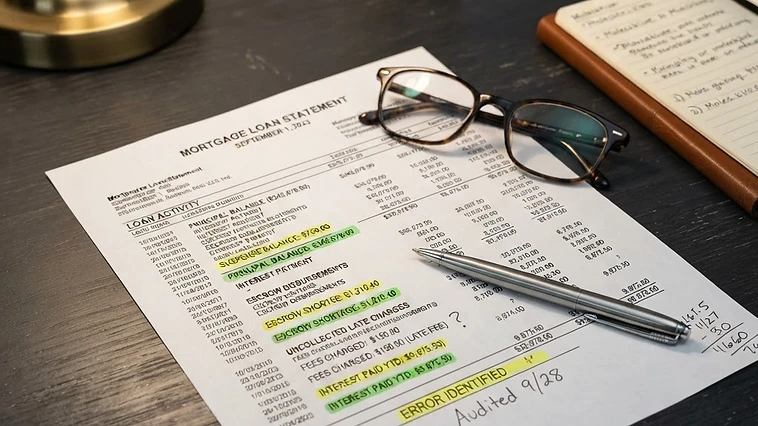 A detailed mortgage loan statement on a dark desk with a pen and glasses, illustrating the process of auditing servicer records for errors.
How to Spot Mortgage Fraud and Servicing Abuses in Your Account
If you suspect that your mortgage servicer is making errors, you must take immediate, documented action. You cannot fight a foreclosure over the phone. Customer service representatives are not equipped to fix systemic accounting errors, and phone calls do not create the legal paper trail you need for court.
Audit Your Monthly Statements Gather every mortgage statement you have received for the past two years. Look for sudden jumps in your principal balance, unexplained fees, or changes in your escrow account. If you were approved for a forbearance or modification, compare the written agreement to the statements you received the following month. Did the servicer honor the agreement, or did they continue to charge late fees like the company in the recent California settlement?
Send a Request for Information (RFI) or Notice of Error (NOE) Under the Real Estate Settlement Procedures Act (RESPA), you have the right to demand answers from your servicer. By sending a formal Request for Information (RFI) or a Notice of Error (NOE) to the servicer's designated address, you legally force them to investigate your account.
They must acknowledge your letter within five days and provide a full response within 30 days. You can use an RFI to request a complete payment history, a copy of your original promissory note, and a breakdown of all fees assessed to your account. If the servicer fails to respond adequately, this becomes powerful evidence in your foreclosure defense.
Demand Proof of Standing If you are in active foreclosure, your defense strategy should include challenging the plaintiff's "standing." Does the entity suing you actually own your loan? Do they have a valid, unbroken chain of assignments from the original lender to the current trust? Many foreclosure cases are dismissed because the servicer cannot produce the original, properly endorsed promissory note.
Your Rights Under State and Federal Foreclosure Laws
Homeowners are not defenseless. Over the past decade, lawmakers have enacted strict regulations to rein in abusive mortgage servicers.
The Consumer Financial Protection Bureau (CFPB) enforces federal mortgage servicing rules that require servicers to provide early intervention for struggling borrowers, maintain accurate records, and evaluate homeowners for all available loss mitigation options before initiating foreclosure.
Additionally, many states have enacted their own Homeowner Bill of Rights. As seen in the recent $4.6 million settlement in California, these state laws provide powerful protections against dual tracking, guarantee a single point of contact, and impose heavy financial penalties on servicers who violate the rules.
When you understand these laws, you transform from a victim into an empowered advocate for your own home. You stop asking the bank for a favor and start demanding that they comply with the law.
Why the Foreclosure Defense Survival Playbook Helps
Fighting a massive financial institution can feel like an impossible battle, especially when they have teams of lawyers and you are trying to save your home on your own. The recent settlements prove that banks make mistakes, break the law, and violate homeowner rights—but they will only be held accountable if you know how to catch them.
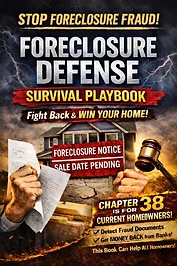
That is exactly why the Foreclosure Defense Survival Playbook is an absolute must-have resource for any homeowner facing late payments or active foreclosure.
This comprehensive, 530-page educational guide takes the mystery out of the legal system. It teaches you how to read and decode your mortgage documents, spot the exact servicing abuses and phantom fees discussed in this article, and organize your evidence like a professional. You will learn how the foreclosure procedure actually works, how to conduct legal research, and how to draft the letters and discovery requests that force servicers to prove their claims.
You do not have to face the threat of foreclosure in the dark. Equip yourself with the knowledge to audit your servicer, protect your rights, and fight for your home. Order the Foreclosure Defense Survival Playbook today and take the first step toward leveling the playing field.

Order The Playbook
Get the Foreclosure Defense Survival Playbook
530 pages of structured, educational guidance covering mortgage documents, foreclosure procedures, evidence organization, and legal research — the same foundation this article draws from.