Mortgage Documents
Is Your Mortgage Paperwork Accurate? The Hidden Risks of Refinance Fraud and Document Errors
Even if you are current on your mortgage payments, hidden document errors and rising refinance fraud could put your home at risk. Learn why auditing your mortgage paperwork is essential.

Disclaimer: The following article is for educational purposes only and does not constitute legal advice. Always consult with a qualified attorney regarding your specific legal situation.
If you are a homeowner who pays your mortgage on time every month, you might assume your loan file is in perfect order. You receive your monthly statements, you make your payments, and your escrow account handles the taxes and insurance. However, recent industry reports and federal enforcement actions reveal a troubling reality: the mortgage industry is currently experiencing a massive surge in document irregularities, forgery, and refinance fraud.
Whether you are preparing to refinance, modifying your loan, or simply organizing your financial records, conducting a thorough mortgage document review is no longer just for homeowners facing foreclosure. It is a critical protective measure for every property owner. Hidden loan document errors, unrecorded assignments, and fraudulent title claims can quietly compromise your property rights.
The Alarming Rise in Refinance Fraud and Forgery
Many homeowners believe that mortgage fraud only happens during the initial purchase of a home or when a borrower defaults. However, recent data indicates that refinance transactions are increasingly becoming the primary target for sophisticated fraud schemes. According to a recent study commissioned by the American Land Title Association (ALTA), fraud and forgery claims tied to mortgage refinances have surged dramatically, now representing over 40% of all title insurer losses and expenses Refinance fraud and forgery claims soar, driving up title insurance losses.
The financial impact of these hidden defects is staggering. The average cost of fraud and forgery claims on refinances has climbed to $207,000, which is nearly seven times higher than other types of claims Refinance fraud and forgery claims soar, driving up title insurance losses. What makes this trend particularly dangerous for current homeowners is that approximately 40% of these refinance-related losses stem from issues that cannot be identified through standard public record searches Refinance fraud and forgery claims soar, driving up title insurance losses.
This means that even if you check your local county recorder's office and everything looks fine on the surface, there could be forged signatures, fraudulent lien releases, or fabricated assignments buried in your loan's history. When you go to sign your new refinance paperwork, these hidden defects can suddenly derail your transaction, cloud your title, or even result in competing claims of ownership against your property.
How Artificial Intelligence is Fueling Fake Mortgage Documents
The threat of mortgage fraud has evolved far beyond simple white-out and forged signatures. In recent years, federal investigators have uncovered widespread schemes utilizing advanced technology to fabricate financial documents. A recent mortgage fraud case highlighted by federal attorneys demonstrated how easily bad actors can deceive lenders and manipulate loan files Mortgage fraud case shows AI's fake-document risk.
In this scheme, conspirators successfully fabricated pay stubs and employment records to push through fraudulent loans that were ultimately backed by government-sponsored enterprises like Fannie Mae and Freddie Mac Mortgage fraud case shows AI's fake-document risk. While this specific case involved borrowers attempting to qualify for loans, it underscores a terrifying reality for existing homeowners: the technology to create flawless, fake legal documents is now widely accessible.
Bank officials and federal regulators are increasingly warning about the ease with which artificial intelligence can generate fake documents that appear entirely legitimate upon standard review Mortgage fraud case shows AI's fake-document risk. If fraudsters can easily generate fake income documents to secure a $305,000 mortgage, they can just as easily fabricate a mortgage assignment, a lien release, or a notarized deed. This technological arms race makes a personal mortgage audit essential. You cannot rely solely on your servicer or a title company to catch sophisticated document manipulation.
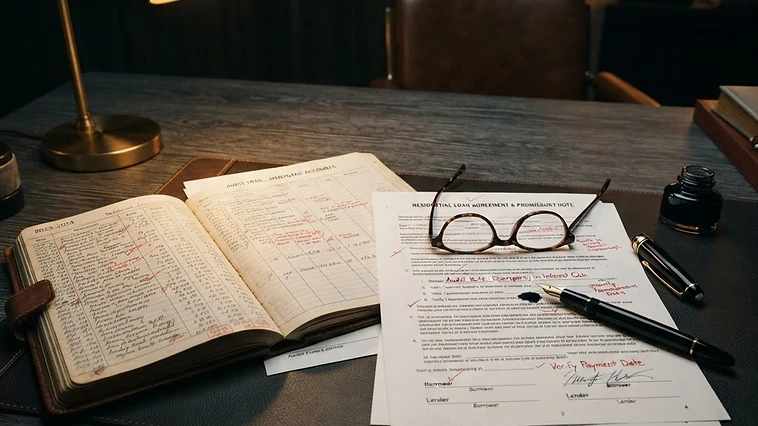 A close-up of mortgage documents being audited on a dark desk with a gold accent light, representing a thorough loan document review.

Common Loan Document Errors Hiding in Plain Sight
Even without malicious fraud, the sheer volume of paperwork involved in the modern mortgage servicing industry leads to rampant loan document errors. Mortgages are frequently bought, sold, and transferred between different trusts, aggregators, and servicers. During these transfers, critical paperwork is often lost, improperly endorsed, or incorrectly recorded.
When conducting a mortgage document review, homeowners should be on the lookout for several common irregularities:
- Missing or Blank Endorsements: Your promissory note is a negotiable instrument. When your loan is sold, the note must be properly endorsed (signed over) to the new owner. Often, notes are left with blank endorsements or lack the necessary chain of title to prove who actually owns the debt.
- MERS Discrepancies: The Mortgage Electronic Registration Systems (MERS) was created to track mortgage transfers without having to record every assignment in county records. However, MERS records frequently conflict with actual physical assignments, creating a clouded chain of title.
- Robo-Signed Documents: While the peak of the robo-signing scandal was over a decade ago, millions of those tainted documents are still sitting in county recording offices today. If your loan originated before 2014, there is a high probability that an assignment or modification in your file was signed by someone who had no legal authority or personal knowledge of the document's contents.
- Incorrect Fee Assessments: Servicers often quietly add unauthorized fees, property inspection charges, or inflated corporate advances to your account balance. Because you are current on your payments, you might not notice these fees until you request a payoff statement during a refinance.
The Importance of a Proactive Mortgage Audit
Waiting until you are in financial distress to review your mortgage paperwork is a dangerous strategy. By the time a notice of default is issued, you are already on the defensive, fighting against strict statutory deadlines. A proactive mortgage audit allows you to identify and correct loan document errors while you still have leverage.
Under federal law, specifically the Real Estate Settlement Procedures Act (RESPA), homeowners have powerful tools to demand information and correct errors. The Consumer Financial Protection Bureau (CFPB) enforces strict error resolution procedures under 12 CFR 1024.35. If you submit a formal Notice of Error to your servicer, they are legally required to acknowledge the request within five days and conduct a reasonable investigation § 1024.35 Error resolution procedures..
Furthermore, you have the right to request specific documentation regarding your loan's history, payment allocation, and ownership. For example, a servicer responding to an asserted error regarding payment allocation may be required to provide a printed screen-capture showing exactly how amounts were credited to principal, interest, and escrow in their internal systems § 1024.35 Error resolution procedures.. Utilizing these federal rights before you refinance ensures that you are not rolling hidden fees or fraudulent balances into a brand-new, 30-year loan.
Why Auditing Your Mortgage Paperwork Matters
Many homeowners mistakenly believe that as long as they make their monthly payments, the underlying paperwork doesn't matter. But your mortgage is likely the largest financial contract of your life. If the chain of title is broken, if the promissory note was improperly endorsed, or if a fraudulent assignment was recorded against your property, your legal rights as a homeowner are compromised.
Even current, on-time homeowners should audit their mortgage paperwork before refinancing or facing a potential future default. You need to know exactly who owns your loan, whether your payments have been accurately applied, and whether the documents a lender or servicer handed you are legally valid.
This is exactly why the "Foreclosure Defense Survival Playbook" is an indispensable resource for every homeowner, not just those facing foreclosure. This comprehensive 530-page educational guide teaches you step-by-step how to conduct a professional-level mortgage document review. You will learn how to decode complex mortgage jargon, spot hidden loan document errors, identify signs of refinance fraud, and organize your evidence like a seasoned legal researcher.
Don't wait for a title nightmare to derail your refinance or for a servicer's accounting error to drain your equity. Take control of your financial future, audit your mortgage paperwork today, and order the Foreclosure Defense Survival Playbook to ensure your home remains truly yours.


Order The Playbook
Get the Foreclosure Defense Survival Playbook
530 pages of structured, educational guidance covering mortgage documents, foreclosure procedures, evidence organization, and legal research — the same foundation this article draws from.