Mortgage Documents
The Hidden Risks in Your Loan File: Why Every Homeowner Needs a Mortgage Document Review Before Refinancing
Recent data shows a massive spike in refinance fraud and forgery. Learn why auditing your mortgage documents is essential even if you are current on your payments.

Disclaimer: The following article is for educational purposes only and does not constitute legal advice. Always consult with a qualified attorney regarding your specific legal situation.
Many homeowners operate under a dangerous assumption: if you pay your mortgage on time every month, your loan file is perfectly accurate and your home is safe. Unfortunately, the modern mortgage industry is a complex web of securitization, digital transfers, and third-party servicing. Even if you have never missed a payment, your loan file could be riddled with hidden defects, unrecorded assignments, or forged signatures.
Recent industry data reveals a shocking surge in mortgage fraud and forgery, specifically targeting refinance transactions. For current homeowners looking to lower their interest rate, tap into home equity, or simply ensure their property rights are secure, conducting a thorough mortgage document review is no longer optional—it is a vital step in protecting your most valuable asset. This article explores the latest trends in mortgage fraud, the hidden loan document errors that could be lurking in your file, and why a comprehensive mortgage audit is essential before you sign any new refinance paperwork.
The Surging Threat of Refinance Fraud and Forgery
When we think of mortgage fraud, we often picture the predatory lending schemes of the 2008 financial crisis or desperate borrowers submitting fake income statements. However, the landscape of mortgage fraud has evolved dramatically. According to a recent Milliman Inc. study commissioned by the American Land Title Association (ALTA), fraud and forgery claims tied to mortgage refinances have skyrocketed. These claims now represent over 40% of all title insurer losses and expenses Refinance fraud and forgery claims soar, driving up title insurance losses.
The financial impact of these hidden defects is staggering. The average cost of fraud and forgery claims on refinances has climbed to $207,000—nearly seven times higher than other claim types. What makes this trend so alarming for current homeowners is that these issues often remain completely undetected until a new transaction occurs. Fraud and forgery cannot always be detected through a simple public records search. They lay dormant in your property's chain of title, waiting to derail your future financial plans.
Industry experts warn that the perception of refinances being "risk-free" is entirely misplaced. As the mortgage industry continues to digitize and rely on remote online notarization, fraudsters have adapted. Whether it is a bad actor filing a fraudulent deed transfer or a systemic error by a loan closing service that failed to properly record a mortgage in the county land records, the burden ultimately falls on the homeowner to untangle the mess. This is why reviewing your refinance paperwork with a critical eye is paramount.
Why Current Homeowners Need a Mortgage Document Review
If you are current on your payments, you might wonder why you should bother looking at your original loan documents. The answer lies in the mechanics of how mortgages are bought, sold, and serviced. When you close on a home, your loan is rarely held by the original lender. It is typically sold to an aggregator, bundled into a residential mortgage-backed security (RMBS), and transferred multiple times.
During these transfers, paperwork is frequently lost, improperly endorsed, or fabricated to cover up administrative sloppy work. If your original lender failed to properly endorse the promissory note, or if the assignment of the deed of trust was never recorded in the county records, the current servicer may not actually have the legal standing to enforce the debt.
While this might not seem like an immediate problem if you are paying on time, it becomes a massive issue when you attempt to refinance or sell your home. A new lender will require a clear chain of title. If your mortgage document review uncovers a break in the chain of title, unreleased prior liens, or missing assignments, your refinance could be denied, or you could be forced to spend thousands of dollars in legal fees to quiet the title. Conducting a proactive mortgage audit allows you to identify and resolve these issues on your own terms, rather than under the strict deadlines of a pending refinance.
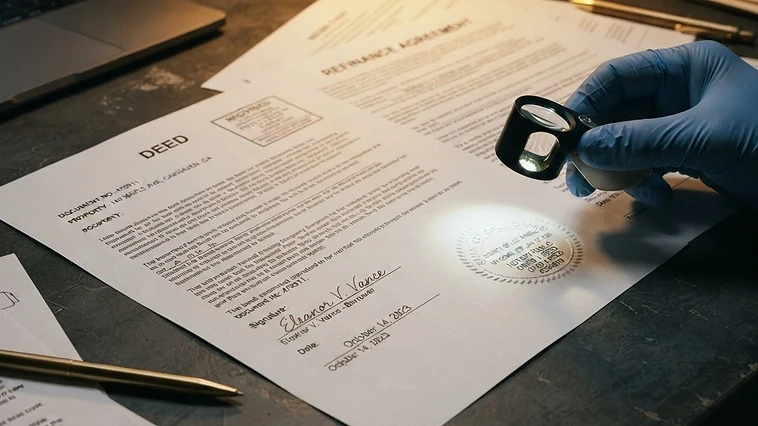 Close-up of mortgage refinance paperwork and a notary seal being inspected for loan document errors.

Common Loan Document Errors Hiding in Your File
When you sit down to audit your mortgage file, you are looking for specific, common loan document errors that plague the industry. These errors range from simple clerical mistakes to outright fraud. Here are some of the most frequent issues found during a mortgage document review:
1. Missing or Defective Assignments: When your loan is sold, an Assignment of Mortgage (or Deed of Trust) must be executed and recorded to transfer the lien rights. In many cases, these assignments are missing entirely, signed by individuals who lack the authority to do so (robo-signing), or backdated.
2. Unreleased Prior Liens: As noted by financial enforcement agencies, prior lenders sometimes fail to release home equity loans or previous mortgages in land record offices after receiving a payoff Mortgage Loan Fraud. This causes the new lender's loan to have a subordinate position and clouds your title, making future refinancing nearly impossible until the old lien is legally discharged.
3. Notary and Signature Irregularities: With the rise of digital closings, notary fraud has become a significant concern. You must verify that the notary seal on your documents is valid, that the notary's commission was active at the time of signing, and that your signature was not forged or digitally altered on subsequent modifications.
4. MERS Discrepancies: The Mortgage Electronic Registration Systems (MERS) was created to bypass county recording fees by acting as a nominee for the lender. However, MERS's involvement often creates a convoluted chain of title. Discrepancies between who MERS claims owns the loan and who actually holds the promissory note are incredibly common and can render refinance paperwork invalid.
The Impact of AI and Document Fabrication
The threat of mortgage fraud has been exponentially magnified by the advent of Generative Artificial Intelligence (GenAI). Legacy detection methods were built for a world where fraudsters submitted paper documents and showed up in person. That world is gone Detecting and Deterring Mortgage Fraud | Proof. Today, bad actors can generate convincing paystubs, bank statements, and even legal property records in minutes using widely available software.
According to recent insights from FTI Consulting, GenAI has increased the level of sophistication and the ease by which fraudsters can create falsified documents Mortgage Fraud: Emerging Risks, Mitigation Strategies. While this is often used by predatory borrowers to secure loans they cannot afford, it is also used by opportunistic scammers targeting vulnerable homeowners. Phantom help scams and foreclosure rescue operations often use fabricated documents to trick homeowners into signing away the deed to their property under the guise of a "refinance" or "loan modification" Mortgage Scams | FDIC.gov.
For the current homeowner, this means you cannot simply trust that a document is legitimate just because it looks official. When reviewing your refinance paperwork, you must cross-reference the data, verify the identities of the parties involved, and ensure that the documents you are signing match the verbal promises made by the broker or lender.
How to Conduct a Basic Mortgage Audit on Your Refinance Paperwork
Protecting yourself requires a proactive approach. A basic mortgage audit involves gathering all of your original closing documents, any subsequent notices of transfer, and your current county land records. Here is a foundational framework for reviewing your file:
First, obtain a complete copy of your collateral file from your current servicer. This should include the original promissory note (with all endorsements), the mortgage or deed of trust, and all assignments.
Second, pull your property's history from the county recorder's office. Compare the county records to the documents provided by your servicer. Does the chain of assignments in the county records match the endorsements on your promissory note? If there is a gap, you have a title defect.
Third, scrutinize the refinance paperwork you are being asked to sign. Ensure that the loan terms, interest rates, and fees match the Loan Estimate you were provided. Look out for predatory terms, such as prepayment penalties or balloon payments, which are often buried in complex legal jargon.
Finally, verify the legitimacy of the individuals handling your transaction. Ensure that the mortgage broker is licensed, that the title company is reputable, and that the notary is properly commissioned. In an era of synthetic identities and deepfake verification, a healthy dose of skepticism is your best defense against mortgage fraud.
Why Auditing Your Mortgage Paperwork Matters
Even if you are perfectly current on your payments, the integrity of your mortgage file is the foundation of your property rights. The recent explosion in refinance fraud, forged documents, and title defects proves that you cannot rely on lenders, servicers, or title companies to catch every error. By the time a hidden defect or fraudulent assignment is discovered during a routine refinance, it is often too late to avoid significant financial loss, delayed closings, or expensive legal battles.
This is exactly why auditing your mortgage paperwork matters. You must take control of your own file, verify the chain of title, and ensure that every signature, endorsement, and recorded document is legally sound.
If you want to learn exactly how to dissect your loan file, spot hidden fraud, and protect your home from predatory practices, the "Foreclosure Defense Survival Playbook" is your ultimate resource. This comprehensive 530-page guide is not just for homeowners in distress—it is an essential manual for any homeowner who wants to understand their mortgage documents, master evidence organization, and conduct a professional-level mortgage audit. Do not wait for a refinance disaster or a future default to discover that your loan documents are defective. Order the Playbook today and secure the knowledge you need to defend your greatest asset.


Order The Playbook
Get the Foreclosure Defense Survival Playbook
530 pages of structured, educational guidance covering mortgage documents, foreclosure procedures, evidence organization, and legal research — the same foundation this article draws from.