Mortgage Documents
The Hidden Risks in Your Mortgage Paperwork: Why Current Homeowners Must Audit Their Loans
Recent studies reveal that refinance transactions carry significant fraud and forgery risks. Learn why auditing your mortgage paperwork is essential even if you are current on your payments.

Disclaimer: The following article is for educational purposes only and does not constitute legal advice. Always consult with a qualified attorney regarding your specific legal situation.
When you pay your mortgage on time every month, it is easy to assume that your loan file is in perfect order. You receive your monthly statements, you make your payments, and your balance slowly decreases. However, recent industry reports and enforcement actions reveal a troubling reality: the mortgage industry is rife with documentation errors, servicing mistakes, and even outright fraud. For homeowners who are current on their payments but considering a refinance or simply wanting peace of mind, conducting a thorough mortgage document review is no longer just a good idea—it is an absolute necessity.
Recent data highlights that the risks are not limited to distressed properties or borrowers facing foreclosure. In fact, a recent study by the American Land Title Association (ALTA) found that fraud and forgery claims account for over 40% of the total cost of refinance-related claims—issues that are often not discoverable through a standard public records search ALTA - Mortgage Refinances Have Significant Fraud Risks, Study Shows. This means that when you sit down to sign your refinance paperwork, you could be inheriting or compounding hidden defects from your original loan origination.
The Rising Threat of Mortgage Fraud in Refinance Transactions
Mortgage fraud is often thought of as a crime committed by borrowers trying to secure loans they cannot afford. However, a significant portion of mortgage fraud is perpetrated by industry insiders, including brokers, title agents, and even notary publics. According to the Financial Crimes Enforcement Network (FinCEN), suspicious activity reports frequently detail instances where borrowers' signatures are forged on loan documents, or where loan closing services fail to properly disburse loan proceeds or pay off underlying property liens Mortgage Loan Fraud.
For a homeowner who is current on their payments, these hidden defects can remain dormant for years. You might not realize that a prior lender failed to release a home equity loan in the land record offices after receiving a payoff, causing title defects that only surface when you attempt to sell or refinance. Or worse, you might discover that your mortgage was never properly recorded in the property land records, leaving the true chain of title in question.
Furthermore, the rise of artificial intelligence has introduced new vulnerabilities into the mortgage ecosystem. Recent reports highlight how much easier it has become for bad actors to create false documents, increasing the risk of sophisticated mortgage fraud schemes Fraud - Latest News. If your original loan documents contain irregularities, or if your servicer has relied on automated systems that generate flawed assignments or endorsements, your property rights could be compromised.
Common Loan Document Errors Hiding in Plain Sight
Even if outright fraud is not present in your file, loan document errors are incredibly common. The sheer volume of paperwork involved in a standard residential mortgage transaction leaves ample room for clerical mistakes, missing signatures, and regulatory violations. When you conduct a mortgage audit, you are looking for these specific discrepancies that could impact your financial standing or legal rights.
One of the most frequent areas of concern involves mortgage servicing errors. The Consumer Financial Protection Bureau (CFPB) continuously monitors servicers for compliance with federal regulations, including the Real Estate Settlement Procedures Act (RESPA) and the Truth in Lending Act (TILA). Common servicing errors include force-placing hazard insurance when the borrower already has an active policy, or mismanaging escrow accounts 3 Common Mortgage Loan Servicing Errors You Can Avoid. If your servicer is making these types of administrative errors, it is highly likely that there are deeper flaws in how your loan file is being maintained.
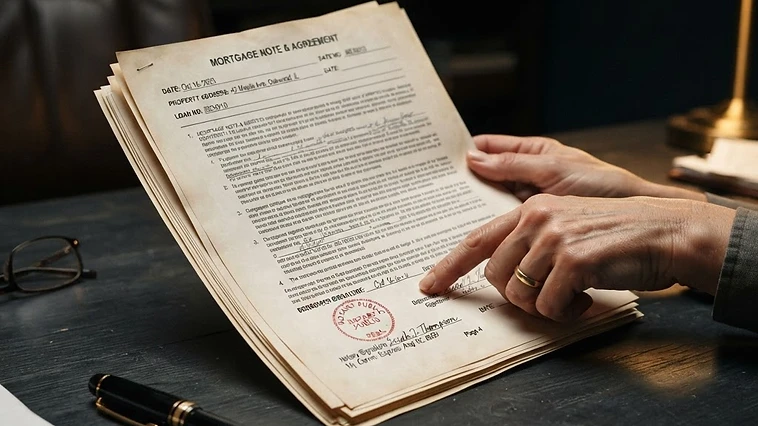 Close-up of a homeowner conducting a mortgage document review on a dark desk.
During a comprehensive mortgage document review, homeowners should pay close attention to the following:
- The Promissory Note: Is the note properly endorsed? Are there unexplained allonges (attachments) that transfer the note to entities you have never heard of?
- The Mortgage or Deed of Trust: Was the document properly notarized? Are the legal descriptions of the property accurate? Was it recorded in the correct county jurisdiction in a timely manner?
- Assignments of Mortgage: If your loan was sold or transferred (which happens to the vast majority of loans), are the assignments properly executed? Do the dates align, or are there retroactive assignments that suggest "robosigning"?
- Closing Disclosures and TRID Compliance: Did your lender accurately disclose the APR, finance charges, and total cost of the loan? Violations of these disclosure rules can sometimes provide homeowners with significant leverage.
Why You Must Audit Your Refinance Paperwork
When interest rates drop or when homeowners need to tap into their home equity, refinancing seems like a straightforward financial decision. However, refinancing a loan that contains fundamental defects can inadvertently "cure" the lender's previous mistakes at your expense. By signing new refinance paperwork, you are essentially agreeing to a new contract that pays off the old, potentially flawed contract.
If your current mortgage contains RESPA violations, predatory lending terms, or fraudulent signatures, you might have legal claims or defenses that could be leveraged to your advantage. Refinancing without first conducting a mortgage audit means you might be leaving money on the table or waiving your right to challenge past abuses.
Moreover, the refinance process itself is fraught with risk. As the ALTA study pointed out, fraud and forgery are actually more common and more costly in refinance transactions compared to purchase transactions. When you refinance, you are relying on a new set of title professionals, appraisers, and closing agents. Ensuring that your new refinance paperwork is pristine is just as important as verifying your old documents.
The Role of MERS and Securitization
No discussion of mortgage document errors is complete without mentioning the Mortgage Electronic Registration Systems (MERS) and the securitization process. Millions of mortgages in the United States are registered with MERS, a private electronic database that tracks servicing rights and beneficial ownership interests in mortgage loans.
While MERS was designed to streamline the buying and selling of mortgage-backed securities, it has also been at the center of countless legal disputes regarding the chain of title and the legal standing of foreclosing entities. Even if you are not in foreclosure, understanding whether MERS is involved in your loan is a critical part of your mortgage document review. If your loan was securitized and sold to a Wall Street trust, the physical promissory note and the mortgage document may have traveled two completely different paths.
Auditing your paperwork helps you determine exactly who owns your loan, who has the right to service it, and whether the chain of title has been broken. This knowledge is power. It ensures that if a dispute ever arises, or if your servicer makes an egregious error regarding your escrow or payment application, you know exactly who to hold accountable.
Why Auditing Your Mortgage Paperwork Matters
It is a common misconception that only homeowners who are behind on their payments need to worry about loan document errors or mortgage fraud. The truth is, the banking industry's systemic documentation issues affect everyone. Whether you are planning to refinance, sell your home, or simply want to ensure that your largest financial asset is protected, conducting a thorough mortgage audit is a vital step in responsible homeownership.
Even current, on-time homeowners should audit their mortgage paperwork before refinancing or facing a future default. Hidden defects, forged signatures, unrecorded assignments, and servicing errors can lurk in your file for years, only to surface when you are most vulnerable. You cannot rely on your lender or servicer to catch these mistakes—they are the ones who made them in the first place.
This is exactly why the "Foreclosure Defense Survival Playbook" is an indispensable resource for every homeowner, not just those in distress. The Playbook teaches you step-by-step how to spot fraud, errors, and defects in the documents a lender or servicer handed you. It empowers you to conduct your own forensic review, organize your evidence, and understand the complex legal landscape of mortgage documentation. Don't wait until a crisis hits or until you sign away your rights in a refinance. Order the Foreclosure Defense Survival Playbook today and take control of your financial future by ensuring your mortgage paperwork is accurate, lawful, and free of fraud.

Order The Playbook
Get the Foreclosure Defense Survival Playbook
530 pages of structured, educational guidance covering mortgage documents, foreclosure procedures, evidence organization, and legal research — the same foundation this article draws from.