Mortgage Documents
The Hidden Risks in Your Loan Files: A Guide to Mortgage Document Review
Even if you are current on your payments, hidden loan document errors and rising refinance fraud could threaten your home's equity. Learn why a proactive mortgage audit is essential.
Disclaimer: The following article is for educational purposes only and does not constitute legal advice. Always consult with a qualified attorney regarding your specific legal situation.
Many homeowners believe that as long as they make their monthly payments on time, their mortgage is in perfect standing. They file away their closing documents in a dusty cabinet and rarely give them a second thought. However, recent enforcement actions, court rulings, and industry reports from July 2026 reveal a troubling trend: a massive surge in mortgage fraud, synthetic identity theft, and critical loan document errors.
Whether you are preparing to refinance, selling your home, or simply organizing your financial files, assuming your mortgage paperwork is flawless can be a costly mistake. Even homeowners who have never missed a payment are discovering that their loan files are riddled with inaccuracies, missing assignments, or fraudulent notary stamps. Before you sign any new refinance paperwork, it is absolutely critical to conduct a thorough mortgage document review to ensure your property rights are fully protected.
The Rising Threat of Refinance Fraud and AI-Generated Documents
The landscape of mortgage fraud is evolving at an alarming pace. In July 2026, federal courts saw guilty pleas in Florida involving sophisticated bank and mortgage fraud schemes that utilized AI-generated fake documents. Criminals are increasingly using artificial intelligence to fabricate income statements, synthetic identities, and even forged property deeds.
Furthermore, recent data from the American Land Title Association (ALTA) reveals a staggering statistic: fraud and forgery now account for approximately 40 percent of total title insurance claim costs associated with refinance transactions. This is double the rate seen in standard purchase transactions. The average cost of fighting refinance fraud in court has skyrocketed to over $200,000 per case.
What does this mean for you, the current, on-time homeowner? It means that the systems used by lenders, title companies, and servicers are under immense stress and are highly susceptible to accepting or generating flawed documents. If a criminal attempts to fraudulently refinance your debt-free property, or if your own lender uses automated systems that generate errors in your refinance paperwork, your home's title could be clouded.
Why Current Homeowners Need a Mortgage Document Review
You pay your mortgage on time every month. You have excellent credit. Why should you care about a mortgage document review? Because the accuracy of your loan file dictates your legal rights to your property.
When you decide to refinance to tap into your home's equity or lower your interest rate, your new lender will scrutinize your property's title history. If your original loan documents contain errors, unrecorded assignments, or notary irregularities, your transaction could be delayed or completely denied.
Moreover, the Consumer Financial Protection Bureau (CFPB) has recently ramped up enforcement actions against major lenders and nonbank direct mortgage lenders for deceptive refinance practices and servicing disclosure issues. If your current servicer has been flagged for predatory practices, there is a high probability that your own account history, escrow calculations, or loan documents contain hidden discrepancies. A proactive mortgage audit allows you to identify and correct these issues on your own terms, long before you are sitting at a closing table under pressure to sign new refinance paperwork.
Spotting Critical Loan Document Errors
What exactly are you looking for during a mortgage document review? The errors can range from simple clerical mistakes to severe legal defects that compromise the enforceability of the loan. Here are the most common loan document errors to watch for:
Misspelled Names and Incorrect Addresses: It sounds trivial, but a misspelled name or an incorrect property address on a Deed of Trust can create a massive headache. If the legal description of your property is missing a single lot number, the mortgage may not legally attach to your home, creating a cloud on the title.
Incorrect Loan Amounts and Terms: Always compare your Promissory Note to your Closing Disclosure. Are the interest rates exactly what you agreed to? Are there hidden prepayment penalties or balloon payments that were not disclosed during the initial application?
 Hands carefully reviewing mortgage refinance paperwork under a warm gold desk lamp.
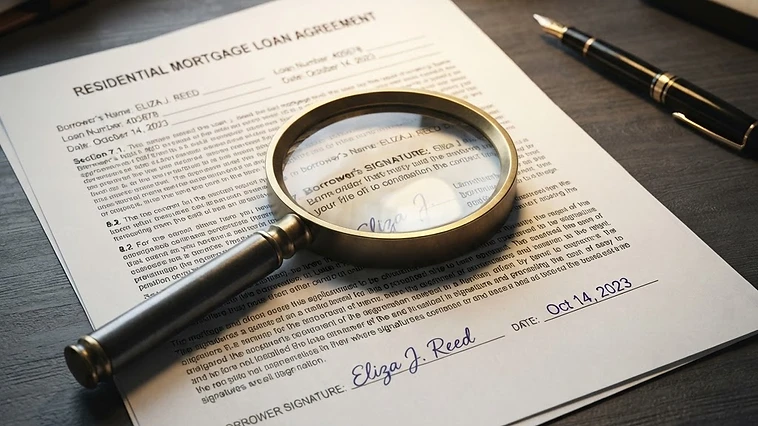
Missing Signatures and Notary Irregularities: Notaries serve as the final checkpoint in a real estate transaction. However, notary fraud and negligence are rampant. Check the notary acknowledgments on your recorded documents. Is the notary stamp expired? Does the location (County and State) match where you actually signed the documents? If a document was notarized in a state you have never visited, that is a massive red flag for mortgage fraud.
MERS Discrepancies: The Mortgage Electronic Registration Systems (MERS) is a private database created by the mortgage industry to track the transfer of servicing rights and beneficial ownership. Often, MERS is listed as the "nominee" for the lender on the mortgage document. However, discrepancies between what is recorded in your local county land records and what is tracked in the MERS database can lead to severe chain-of-title issues.
The Chain of Title and Assignment Problems
Even if you are current on your payments, your mortgage has likely been sold, securitized, or transferred multiple times behind the scenes. Each time the loan changes hands, a legal document called an "Assignment of Mortgage" (or Assignment of Deed of Trust) must be executed and recorded in your local county land records.
During the subprime mortgage crisis, the industry became infamous for "robosigning"—the practice of mass-producing forged or fraudulent assignments to rush foreclosures. While regulations have tightened, assignment problems persist today.
If you are planning to refinance, your new title company will pull a title search. If there is a gap in the chain of assignments—for example, Lender A sold the loan to Lender B, but there is no recorded assignment proving the transfer—Lender B technically does not have a perfected security interest in your property. This can halt your refinance in its tracks. Conducting a mortgage audit to verify your chain of title ensures that the entity currently collecting your payments actually has the legal right to do so.
How to Perform a Proactive Mortgage Audit
Conducting a personal mortgage audit is a proactive step every homeowner should take, regardless of their payment status. Here is how you can begin reviewing your refinance paperwork and original loan documents:
1. Request Your Collateral File: Under the Real Estate Settlement Procedures Act (RESPA), you have the right to send a Qualified Written Request (QWR) or a Request for Information (RFI) to your mortgage servicer. You can request a complete copy of your collateral file, which should include the original Promissory Note, all endorsements or allonges, the Mortgage/Deed of Trust, and a complete payment history.
2. Check County Land Records: Do not rely solely on what the servicer sends you. Visit your local county recorder's office (many have online databases) and search for your name and property address. Download every document recorded against your property. Compare the recorded documents to the copies in your personal files.
3. Review the Closing Disclosure: Look closely at the fees charged during your last closing. Were you charged for title insurance policies that were never issued? Were there excessive origination fees that violate state predatory lending laws?
4. Verify Notary Credentials: If you suspect notary irregularities, you can verify the notary's commission status through your state's Secretary of State website. If the notary was not legally commissioned on the date your documents were signed, the recording of that document may be legally invalid.
By taking these steps, you transition from a passive borrower to an empowered homeowner. You will be able to spot loan document errors and potential mortgage fraud before they derail your financial goals.
Why Auditing Your Mortgage Paperwork Matters
Even if you have never missed a payment and have a perfect relationship with your lender, auditing your mortgage paperwork matters because your home is likely your most valuable financial asset. Hidden loan document errors, broken chains of title, and undetected mortgage fraud can quietly erode your property rights, complicate future refinances, and leave you vulnerable to predatory servicing practices. You cannot afford to blindly trust that the paperwork a lender or servicer handed you is accurate, legally compliant, or free of defects.
This is exactly why the Foreclosure Defense Survival Playbook is an indispensable resource for every homeowner, not just those facing default. This comprehensive, 530-page educational manual is a masterclass in document analysis. It teaches you step-by-step how to dissect your Promissory Note, analyze your Deed of Trust, spot fraudulent notary stamps, and uncover hidden defects in your chain of title.
By learning the exact methods used by forensic auditors and legal researchers, you can confidently review your refinance paperwork, organize your evidence, and ensure your property rights are ironclad. Don't wait for a title nightmare to delay your next financial move or for a servicing error to threaten your home. Order the Foreclosure Defense Survival Playbook today, and take absolute control of your mortgage documents.


Order The Playbook
Get the Foreclosure Defense Survival Playbook
530 pages of structured, educational guidance covering mortgage documents, foreclosure procedures, evidence organization, and legal research — the same foundation this article draws from.