Mortgage Documents
The Hidden Fraud in Your Loan: Why Every Homeowner Needs a Mortgage Document Review Before Refinancing
Recent data shows a sharp increase in refinance fraud and mortgage document errors. Learn why auditing your loan paperwork is crucial even if you are current on your payments.
Disclaimer: The information provided in this article is for general educational guidance only and does not constitute legal advice. Always consult with a qualified attorney regarding your specific legal situation and before making any decisions related to your property or mortgage.
Most homeowners operate under a dangerous assumption: if you pay your mortgage on time every month, your loan documents must be perfectly accurate. You receive your monthly statement, you make your payment, and your balance slowly decreases. It feels like a seamless, error-free system. However, the reality of the modern mortgage industry is far more complex and prone to catastrophic mistakes. Behind the scenes, your mortgage is likely being bought, sold, securitized, and transferred between various financial institutions, servicers, and document custodians.
In this chaotic secondary market, paperwork gets lost, signatures are forged, and critical legal procedures are bypassed. Even if you are completely current on your payments, your mortgage file could be riddled with hidden defects. If you are considering refinancing to take advantage of your home equity or secure a better rate, you are about to sign new legal contracts based on the foundation of your old ones. If that foundation is flawed, you could be unknowingly rolling over fraudulent fees, accepting a clouded title, or waiving your rights to challenge past servicing abuses. This is why conducting a thorough mortgage document review is an absolute necessity for every homeowner, regardless of their payment status.
The Hidden Risks in Your Refinance Paperwork
When homeowners think of mortgage fraud, they typically imagine predatory lending tactics aimed at subprime borrowers or foreclosure rescue scams targeting those in distress. But recent industry data reveals a shocking shift: fraud is increasingly targeting the refinance market, affecting homeowners who are in good standing.
According to a recent industry analysis detailed in Refinance fraud and forgery claims soar, driving up title insurance losses, fraud and forgery are actually more common and significantly more costly in refinance transactions compared to standard home purchases. The study highlights that while purchase transactions face fraud risks, those claims account for just 20% of total losses. In stark contrast, the share of losses for refinances has doubled.
Why is your refinance paperwork so vulnerable? As the mortgage industry rapidly digitizes its closing processes, fraudsters and negligent institutions are finding new ways to exploit the system. The report revealed that approximately 40% of refinance-related losses and expenses stem from issues that cannot even be identified through a standard public records search. This means that simply checking your county recorder's office is no longer enough to guarantee your title is clear. Hidden unrecorded liens, forged reconveyances, and phantom assignments can lurk in your file, waiting to derail your financial future. Defending against these claims is financially devastating; the average cost to defend a fraud or forgery claim in a refinance transaction now approaches $70,000. If you do not catch these issues before you refinance, you may inadvertently inherit a legal nightmare.
Rising Mortgage Fraud and Servicing Errors in 2026
We are currently witnessing a measurable surge in mortgage fraud risk across the United States. According to recent reporting in Mortgage Fraud News and Updates from HousingWire, analytics firm Cotality reported that mortgage fraud risk rose 9.1% in the second quarter of 2026 alone. This increase is driven by a combination of sophisticated digital scams, AI-generated document forgery, and institutional negligence.
But outright fraud by third parties is only half the battle. The institutions managing your loan are frequently making costly administrative mistakes. The Consumer Financial Protection Bureau (CFPB) and various consumer protection agencies have recently intensified their scrutiny of mortgage servicers due to widespread Unfair, Deceptive, or Abusive Acts or Practices (UDAAP).
As highlighted in 3 Common Mortgage Loan Servicing Errors You Can Avoid - Anders, servicers routinely make errors that drain homeowner equity. One of the most egregious loan document errors involves the mishandling of hazard insurance. Servicers are legally prohibited from force-placing expensive hazard insurance on a property if the borrower already has an active policy and an escrow account. Yet, this "mistake" happens constantly. The servicer fails to process the homeowner's insurance documentation, falsely claims the property is uninsured, and force-places a policy that costs three to ten times the market rate. These exorbitant premiums are then quietly added to the homeowner's principal balance or escrow payment. If you do not perform a meticulous mortgage audit, you might refinance these fraudulent, inflated balances into your new loan, paying interest on the servicer's mistake for the next 30 years.
Common Loan Document Errors That Drain Your Equity
Beyond force-placed insurance, there are numerous other loan document errors that can silently siphon your wealth or jeopardize your property rights. Escrow mismanagement is rampant. Servicers frequently miscalculate property tax and insurance disbursements, leading to artificial escrow shortages. When a shortage is declared, your monthly payment increases. If you blindly trust the servicer's math, you are overpaying.
 Close-up of hands conducting a mortgage document review on a dark desk with gold lighting.
Another critical area of concern involves the Mortgage Electronic Registration Systems (MERS). MERS was created by the banking industry to bypass traditional county recording fees by tracking mortgage transfers electronically. However, the MERS system is notorious for inaccuracies. When your loan is sold from one trust to another, the assignment of the deed of trust must be properly executed and recorded. In many cases, these assignments are "robo-signed" by individuals who have no actual knowledge of the transaction, or they are backdated to cover up broken chains of title.
If your chain of title is broken, the entity claiming to own your loan might not actually have the legal standing to enforce it. While this is a well-known defense in foreclosure cases, it is equally vital for current homeowners to understand. If you refinance a loan with a broken chain of title, the original, true owner of the debt could theoretically emerge years later, claiming they were never paid off. Ensuring that your assignments are legally sound is a non-negotiable step in protecting your home.
The Anatomy of a Comprehensive Mortgage Document Review
So, how do you protect yourself? You must conduct a comprehensive mortgage document review before you even apply for a refinance. This is not a cursory glance at your monthly statement; it is a forensic examination of the legal instruments that govern your property.
First, you must examine the Promissory Note. This is the actual IOU that you signed at closing. You need to verify who currently holds the original note and whether it has been properly endorsed (stamped) to the current trust or investor. Missing endorsements or fraudulent stamps are massive red flags.
Second, review the Deed of Trust or Mortgage. This is the document that gives the lender the right to foreclose if you default. Ensure that the legal description of your property is 100% accurate. Even a minor typographical error in the legal description can cloud your title and halt a refinance in its tracks.
Third, audit your payment history and escrow account. Request a complete, life-of-loan transaction history from your servicer. Calculate the application of every single payment. Did the servicer apply your payments to principal and interest correctly, or did they siphon funds into unauthorized "corporate advances" or "property inspection fees"? Servicers frequently charge homeowners for drive-by property inspections that either never happened or were entirely unnecessary because the loan was current.
Finally, scrutinize your Closing Disclosure (CD) and Truth in Lending Act (TILA) disclosures from your original closing. Were you overcharged for title insurance? Were the APR calculations accurate? If there are severe TILA violations in your original paperwork, you may have leverage to demand corrections or restitution before you agree to a new refinance contract.
Why Auditing Your Mortgage Paperwork Matters
Your home is likely your most valuable financial asset, yet most homeowners spend more time researching a new car purchase than they do reviewing the legal contracts that bind their property. Auditing your mortgage paperwork matters because the financial industry operates on volume, not precision. Errors, overcharges, and outright fraud are baked into the system as the cost of doing business. But it is your equity that pays that cost.
Even if you have never missed a payment, you cannot afford to be complacent. A proactive mortgage audit is your first line of defense against institutional incompetence and hidden fraud. Before you sign a new stack of refinance paperwork, you must verify that the old stack was legally sound, mathematically accurate, and free of defects.
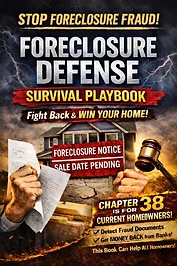
This is exactly why the Foreclosure Defense Survival Playbook is an indispensable resource for every homeowner, not just those facing financial distress. This comprehensive 530-page educational guide pulls back the curtain on the mortgage industry. It teaches you how to read complex mortgage documents, how to spot the telltale signs of forgery and robo-signing, and how to organize your evidence like a seasoned auditor. By understanding the rules of court procedure, legal research, and evidence discovery outlined in the Playbook, you empower yourself to hold lenders and servicers accountable. Don't wait for a crisis to discover that your loan documents are flawed. Order the Foreclosure Defense Survival Playbook today, take control of your financial future, and ensure your property rights are permanently protected.

Order The Playbook
Get the Foreclosure Defense Survival Playbook
530 pages of structured, educational guidance covering mortgage documents, foreclosure procedures, evidence organization, and legal research — the same foundation this article draws from.