Mortgage Documents
The Hidden Dangers in Your Mortgage Documents: A Homeowner's Guide to Refinance Fraud and Loan Errors
Recent reports show a massive spike in refinance fraud and title defects. Learn why auditing your mortgage documents is crucial even if you are current on your payments.
Disclaimer: The following article is for educational purposes only and does not constitute legal advice. If you need legal assistance, please consult a qualified attorney in your jurisdiction.
If you are a homeowner who pays your mortgage on time every month, you might assume that your loan file is in perfect order. You receive your monthly statements, you make your payments, and your balance slowly decreases. However, recent industry reports and enforcement actions reveal a troubling reality: the mortgage industry is rife with documentation errors, title defects, and sophisticated fraud schemes that can jeopardize your property rights.
Whether you are considering a refinance, reviewing your current mortgage paperwork, or simply want to ensure your loan file is accurate, conducting a thorough mortgage document review is essential. Recent data from the American Land Title Association (ALTA) and Milliman highlights a shocking surge in refinance fraud and forgery claims, proving that even current, on-time homeowners are at risk. In this article, we will explore the hidden dangers lurking in your loan file and explain why a proactive mortgage audit is your best defense.
The Alarming Rise in Refinance Fraud and Forgery
Many homeowners believe that fraud only happens during the initial purchase of a home or when a borrower falls into foreclosure. However, recent industry analysis shows that refinance transactions are increasingly targeted by bad actors. According to a recent report by ALTA and Milliman, refinance fraud and forgery claims have soared, driving up title insurance losses significantly. In fact, fraud and forgery are now more common and more costly in refinance transactions compared to purchase transactions.
Why is this happening? As the mortgage industry continues to digitize and rely on electronic records, fraudsters have adapted. The report revealed that approximately 40% of refinance-related losses and expenses stem from issues that cannot be identified through a simple public records search. This means that hidden defects—such as forged signatures, fraudulent deed transfers, and unrecorded assignments—can easily slip past standard automated checks.
For the current homeowner, this presents a massive risk. If you are preparing to sign new refinance paperwork, you might unknowingly be rolling over existing title defects or loan document errors into a new, larger loan. Worse, you could be targeted by predatory refinance schemes that strip your home equity through inflated appraisals or hidden fees. This is why a comprehensive mortgage document review is not just for borrowers in default; it is a critical financial health check for every homeowner.
Common Loan Document Errors Hiding in Plain Sight
When you sit down at the closing table, you are handed a mountain of paperwork. Most borrowers sign where they are told without reading the fine print. Years later, when the loan is sold, transferred, or securitized, the errors made at that closing table can compound into massive legal headaches.
Here are some of the most common loan document errors that a mortgage audit can uncover:
1. Missing or Defective Assignments When your mortgage is sold from one lender to another, an "Assignment of Mortgage" or "Assignment of Deed of Trust" must be properly executed and recorded in the county land records. Frequently, these assignments are missing, signed by unauthorized individuals (robo-signing), or recorded years after the actual transfer took place. If the chain of title is broken, it can cloud your property's title and complicate future refinance efforts.
2. MERS and Chain of Title Issues The Mortgage Electronic Registration Systems (MERS) was created to track the ownership of mortgages and bypass county recording fees. However, the use of MERS has led to widespread confusion and documentation errors. A thorough review of your refinance paperwork should include verifying whether MERS was involved in your loan and whether the transfers recorded in the MERS system match the physical documents filed in your county.
3. Servicing and Escrow Mistakes The Consumer Financial Protection Bureau (CFPB) frequently flags mortgage servicers for unfair and deceptive practices. Common errors include miscalculating escrow accounts, failing to properly credit payments, and illegally force-placing hazard insurance when the borrower already has a valid policy. These servicing errors can artificially inflate your loan balance, meaning you could be overpaying when you go to refinance.
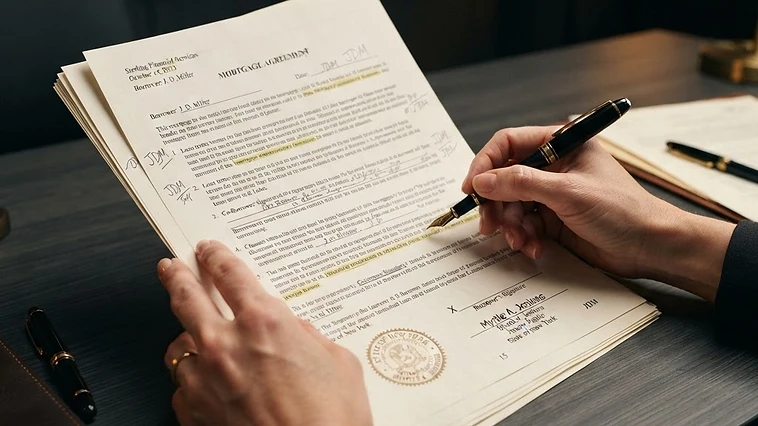 Close-up of a homeowner conducting a mortgage document review on a dark desk.

How AI and Forgery are Complicating Mortgage Fraud
The digital age has brought convenience to the mortgage industry, but it has also introduced new vulnerabilities. Recent reports in the mortgage sector highlight the growing risk of artificial intelligence being used to generate fake documents. Fraudsters are now capable of creating highly convincing fake employment records, income statements, and even forged notary stamps using advanced AI tools.
While much of this AI-driven fraud is focused on loan origination, it also impacts the integrity of the public record. If a fraudulent document is recorded against your property—such as a fake release of lien or a forged deed—it can severely disrupt your ability to refinance or sell your home.
Furthermore, notary irregularities remain a persistent issue. During the housing crisis, "robo-signing" became a household term as banks hired low-wage workers to forge millions of signatures on mortgage documents. While regulations have tightened, notary fraud and signature irregularities still occur. A meticulous mortgage audit involves scrutinizing the signatures, dates, and notary stamps on your documents to ensure they align logically and legally.
The Importance of a Proactive Mortgage Audit
If you are current on your payments, you have the luxury of time. You are not facing an imminent foreclosure sale, which means you can conduct a mortgage document review without the pressure of a ticking clock.
Auditing your mortgage paperwork involves gathering your original closing documents, your complete payment history, and the publicly recorded documents from your county recorder's office. By comparing these three sets of data, you can identify discrepancies.
For example, does the principal balance on your monthly statement match the amortization schedule from your original closing? Are there unexplained fees or corporate advances added to your payoff quote? Is the entity currently servicing your loan actually legally authorized to do so based on the recorded assignments?
Identifying these loan document errors before you apply for a refinance gives you leverage. If your current lender has clouded your title or mismanaged your escrow account, you can demand corrections—or even financial restitution—before you agree to pay off the loan with a new lender.
Why Auditing Your Mortgage Paperwork Matters
Even if you have never missed a payment, the integrity of your mortgage file is paramount. The recent surge in refinance fraud, title defects, and servicing errors proves that no homeowner is immune to the systemic issues plaguing the mortgage industry. You must audit your mortgage paperwork before refinancing or facing a future default to ensure that the documents a lender or servicer handed you are legally sound, accurate, and free of hidden fraud.
This is exactly why the "Foreclosure Defense Survival Playbook" is an indispensable resource for every homeowner. Across its 530 pages, the Playbook provides a deep, educational dive into understanding complex mortgage documents, tracking the chain of title, and organizing evidence like a pro. It teaches you step-by-step how to spot the exact fraud, errors, and defects that banks hope you will overlook. Don't wait until a minor paperwork error becomes a major legal crisis. Order the Foreclosure Defense Survival Playbook today, take control of your financial future, and ensure your home remains truly yours.


Order The Playbook
Get the Foreclosure Defense Survival Playbook
530 pages of structured, educational guidance covering mortgage documents, foreclosure procedures, evidence organization, and legal research — the same foundation this article draws from.