Mortgage Documents
Is Your Mortgage Paperwork Accurate? How to Spot Hidden Fraud and Loan Document Errors
Even if you are current on your payments, hidden errors and fraud in your mortgage documents can derail a future refinance or expose you to legal risks.
Disclaimer: The following article is for educational purposes only and does not constitute legal advice. Always consult with a qualified attorney regarding your specific legal situation.
If you are like most homeowners, you pay your mortgage on time every month, file your paperwork away in a drawer, and rarely think about the fine print. You might assume that because your payments are current, your loan documents are perfectly accurate and legally sound. However, recent federal crackdowns and industry reports reveal a disturbing trend: the mortgage industry is rife with documentation errors, compliance failures, and outright fraud.
Whether you are preparing to refinance, reviewing your estate plans, or simply organizing your financial life, conducting a thorough mortgage document review is a critical step. Hidden loan document errors can complicate a future sale, derail a refinance, or even expose you to predatory lending practices. In this educational guide, we will explore recent enforcement actions, the surge in mortgage defects, and why every homeowner should perform a mortgage audit on their refinance paperwork.
The Hidden Risks in Your Refinance Paperwork
When interest rates shift, homeowners rush to refinance. Unfortunately, this rush often leads to sloppy underwriting and systemic errors. According to recent industry data, the mortgage critical defect rate recently surged, experiencing its biggest quarterly jump in four years. A report highlighted in Refinances lead to early-year surge in mortgage defects noted that the critical defect rate jumped 23.9%, with refinance loans producing a significant portion of these critical defects.
What does a "critical defect" mean for you? It means that the lender or servicer made a fundamental error in calculating your assets, analyzing your income, or documenting the loan. The data shows that calculation and analysis findings have skyrocketed, meaning lenders are having difficulty correctly interpreting the financial information they collect.
For a homeowner, these loan document errors can manifest as incorrect principal balances, miscalculated escrow accounts, or improper interest rate adjustments on adjustable-rate mortgages. If you are relying on flawed refinance paperwork, you might be paying more than you legally owe, or your loan might be out of compliance with federal lending standards.
Recent Federal Crackdowns on Mortgage Fraud
It is easy to assume that mortgage fraud only happens to other people or only involves borrowers lying on their applications. However, recent federal indictments show that industry insiders—including loan officers and real estate brokers—are frequently the architects of these schemes.
In October 2026, the Department of Justice announced charges against two individuals in Houston for allegedly submitting fraudulent financial documents to multiple mortgage lenders. As detailed in Two Charged in Mortgage Fraud Scheme Involving Falsified Financial Documents, the defendants allegedly created fake pay stubs, W-2 forms, and bank statements to push through unqualified loans.
Similarly, in September 2026, a federal grand jury indicted four individuals in a sweeping $7.3 million mortgage fraud scheme targeting FHA and VA programs in Texas and Oklahoma. According to the report Grand jury indicts 4 in sweeping $7.3 million mortgage fraud scheme targeting FHA and VA programs, a mortgage loan officer allegedly submitted falsified documents as part of official loan applications, knowing the information was fabricated.
While these specific cases involve fraud to obtain loans, they highlight a broader, systemic issue: the paperwork moving through the mortgage industry is not always verified, accurate, or legally compliant. If industry professionals are willing to fabricate W-2s and bank statements, it begs the question of how carefully they are handling your legitimate refinance paperwork, assignments of mortgage, and title transfers.
Common Loan Document Errors to Look For
Even if your loan was originated without any intentional mortgage fraud, clerical errors and compliance failures are incredibly common. When you sit down to conduct a mortgage audit of your own files, there are several key areas where defects typically hide.
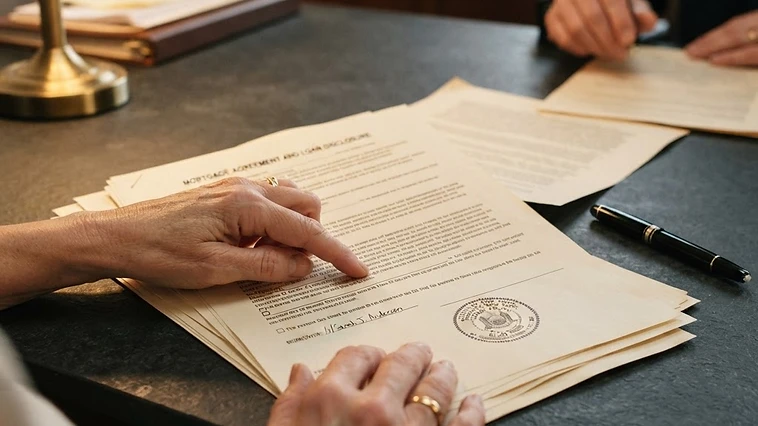 Close-up of a homeowner reviewing mortgage refinance paperwork for document errors and fraud.

First, examine your promissory note and mortgage (or deed of trust). Are the signatures correct? Are the dates consistent across all documents? In many cases, documents are backdated or notarized improperly. A notary stamp that was applied when you were not physically present is a major red flag and a violation of state laws.
Second, look at the chain of title and assignments. If your loan was sold from your original lender to a new bank or securitized into a trust, there must be a clear, legally recorded assignment of the mortgage. Often, these assignments are missing, fabricated, or signed by "robo-signers" who have no actual authority to transfer the documents. If the chain of title is broken, the current servicer may not have the legal standing to enforce the debt.
Third, review your closing disclosures and Truth in Lending Act (TILA) statements. Calculation errors are rampant. If the lender miscalculated your Annual Percentage Rate (APR) or failed to disclose certain fees, you might have grounds to challenge the validity of those charges.
Finally, be aware of servicing errors. Consent orders from state regulators frequently cite mortgage servicers for excessive per diem interest charges, recordkeeping violations, and unlicensed processing. If your servicer is misapplying your payments or charging unauthorized fees, a thorough mortgage document review is the only way to catch it.
How a Mortgage Document Review Protects You
Many homeowners believe that as long as they are not facing foreclosure, they do not need to worry about the accuracy of their loan documents. This is a dangerous misconception.
Imagine you decide to sell your home or refinance to take advantage of better interest rates. During the title search, the title company discovers a defect in your deed, an unrecorded assignment, or a lien that was never properly released by a previous servicer. Suddenly, your transaction is stalled, and you are forced to spend thousands of dollars on legal fees to quiet the title and fix errors that your lender made years ago.
By conducting a proactive mortgage audit now, you take control of your financial and legal standing. You can request your complete collateral file from your servicer—including the original note, all assignments, and the payment history—and scrutinize it for loan document errors. If you find discrepancies, you can demand corrections while you are in a position of strength, rather than scrambling to fix them during a stressful refinance or a sudden financial hardship.
Furthermore, understanding your documents protects you from predatory practices. If a servicer attempts to force-place insurance on your property or claims you missed a payment, having a meticulously audited file allows you to push back with hard evidence.
Why Auditing Your Mortgage Paperwork Matters
Even if you have never missed a payment and have excellent credit, you cannot blindly trust that your lender or servicer has maintained your files accurately. The recent surge in critical mortgage defects and federal indictments for mortgage fraud prove that the industry is prone to severe, systemic errors. You must be your own advocate.
Auditing your mortgage paperwork matters because it is the only way to ensure that the contract tying you to your largest financial asset is legally sound. Before you sign new refinance paperwork or in the event you ever face a future default, you need to know exactly what is in your file.
This is where the Foreclosure Defense Survival Playbook becomes an indispensable tool for every homeowner. You do not need to be in foreclosure to benefit from this 530-page educational resource. The Playbook teaches you step-by-step how to read complex mortgage documents, how to spot hidden fraud and defects, and how to organize your evidence like a professional. By ordering the Playbook today, you empower yourself with the knowledge to audit your own loan, hold your servicer accountable, and protect your home from the hidden dangers lurking in your mortgage paperwork.


Order The Playbook
Get the Foreclosure Defense Survival Playbook
530 pages of structured, educational guidance covering mortgage documents, foreclosure procedures, evidence organization, and legal research — the same foundation this article draws from.