Mortgage Documents
The Hidden Dangers in Your Loan Files: Why Every Homeowner Needs a Mortgage Document Review
Recent federal fraud indictments highlight the growing risk of falsified mortgage documents. Learn why current homeowners must audit their refinance paperwork.
Disclaimer: The following article is for educational purposes only and does not constitute legal advice. Always consult with a qualified attorney regarding your specific legal situation.
When you pay your mortgage on time every month, it is easy to assume that your loan file is in perfect order. You receive your monthly statements, you make your payments, and your balance slowly decreases. However, the reality of the modern financial system is far more complex. Behind the scenes, loans are bought, sold, securitized, and transferred. During these transitions, critical paperwork is often lost, improperly assigned, or even fraudulently altered. For current homeowners who are considering a refinance or simply want to ensure their property rights are secure, conducting a thorough mortgage document review is an absolute necessity.
Recent federal enforcement actions and industry reports have highlighted a disturbing trend: mortgage fraud and loan document errors are not relics of the 2008 financial crisis. They are happening right now, often utilizing sophisticated new technologies. Even if you are completely current on your payments, hidden defects in your refinance paperwork or original loan file could jeopardize your title, complicate future sales, or expose you to predatory lending practices.
Recent Mortgage Fraud Cases: A Wake-Up Call
If you think mortgage fraud only happens to distressed borrowers, recent news proves otherwise. In October 2026, federal prosecutors in Houston unsealed an 11-count indictment charging two individuals with a massive mortgage fraud scheme targeting FHA loans. According to the Office of Inspector General, Department of Housing and Urban Development, the defendants allegedly submitted fraudulent financial documents to multiple mortgage lenders over a four-year period, putting the FHA insurance program at risk of nearly $5.9 million in losses.
This case, investigated jointly by the FBI, the FHFA-OIG, and HUD-OIG, underscores how easily falsified documents can slip through the cracks of major financial institutions. But the threat does not stop at traditional document forgery. According to recent industry analysis, Mortgage fraud is getting harder to spot due to the rise of generative AI. Fraudsters can now mass-produce highly convincing, falsified income and asset documents that bypass traditional detection methods.
For the everyday homeowner, this means the integrity of the mortgage system is constantly under threat. If bad actors can successfully inject fabricated documents into the banking system, what guarantees do you have that your own loan file—handled by dozens of third-party servicers and document custodians over the years—is entirely accurate and legally sound?
The Hidden Risks in Your Refinance Paperwork
Many homeowners only discover loan document errors when they attempt to refinance or sell their property. When you apply for a new loan, the new lender will conduct a title search and review the existing chain of title. If there are discrepancies in your original paperwork, the refinance process can grind to a halt.
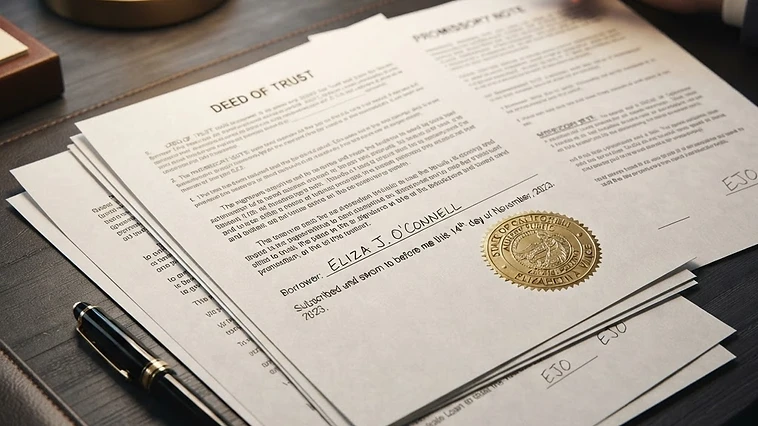 Close up of mortgage refinance paperwork and a notary seal on a dark desk

One of the most common issues discovered during a mortgage document review is a defective title. As noted by legal experts discussing The Challenges of a Defective Title, title defects can range from missing legal descriptions to undischarged mortgages. An undischarged mortgage occurs when a previous loan was paid off, but the lender failed to properly record the release or satisfaction of mortgage in the county records. To the outside world, it looks like you still owe that debt, which creates a massive cloud on your title.
Furthermore, the assignment of your mortgage—the document that transfers the right to collect your debt from one bank to another—is a frequent source of errors. During the securitization boom, millions of mortgages were transferred using the Mortgage Electronic Registration Systems (MERS). The rapid, automated nature of these transfers often resulted in missing assignments, forged signatures (robo-signing), and improper notarizations. If your mortgage was sold multiple times, there is a significant chance that the chain of assignments is broken.
How to Conduct a Basic Mortgage Audit
If you are planning to refinance, or if you simply want peace of mind, you should perform a preliminary mortgage audit of your own files. You do not need to be behind on your payments to demand transparency from your lender. Here are the critical steps to reviewing your mortgage paperwork:
-
Request Your Complete Loan File: Contact your current mortgage servicer and request a complete copy of your collateral file, including the original promissory note, the mortgage or deed of trust, all assignments, and your payment history. Under federal law, you have the right to request information about your loan through a Qualified Written Request (QWR) or Request for Information (RFI).
-
Verify the Chain of Title: Visit your county recorder's office (many have online databases) and pull every document recorded against your property. Compare the recorded assignments with the letters you received from your servicers over the years. Does Bank A's transfer to Bank B match the public record? Are there any mysterious entities claiming an interest in your home?
-
Scrutinize Signatures and Notary Seals: Look closely at the signatures on your assignments and loan modifications. Do the signatures look identical across different documents, or do they vary wildly? Are the notary dates consistent with the dates the documents were supposedly signed? Notary irregularities are a massive red flag for document fabrication.
-
Check for Undischarged Liens: Ensure that any previous mortgages, home equity lines of credit (HELOCs), or contractor liens that you have paid off are officially recorded as satisfied or released.
Protecting Yourself from Predatory Refinance Tactics
When you decide to refinance, you are essentially paying off your old mortgage and creating a brand new one. This process generates a mountain of new refinance paperwork. It is crucial to review these new documents with a forensic eye.
Predatory lenders often use the refinance process to strip equity from your home by burying exorbitant fees, prepayment penalties, or unfavorable terms deep within the contract. Always compare your initial Loan Estimate with the final Closing Disclosure. Ensure that the loan terms, interest rate, and closing costs match what you were promised. Do not let the pressure of the closing table force you into signing documents you do not fully understand.
Remember, a court recently ruled that borrowers cannot void a mortgage after acquiring proper title based on equitable estoppel. This means that once you sign those documents and accept the loan proceeds, you are legally bound by the representations you made. You cannot easily undo a bad refinance after the fact. The time to catch loan document errors is before the ink dries.
Why Auditing Your Mortgage Paperwork Matters
Even if you are current on your payments and have excellent credit, auditing your mortgage paperwork is a vital step in protecting your most valuable asset. The financial industry has repeatedly demonstrated that it prioritizes speed and profit over document accuracy. From missing assignments and incurable title defects to outright mortgage fraud, the risks hidden in your loan file are real.
Before you sign another stack of refinance paperwork, or before a future financial hardship ever puts you at risk of default, you need to know exactly what is in your file. You need to know who actually owns your loan, whether your title is clear, and whether the documents your servicer relies upon are legally valid.
This is exactly why the "Foreclosure Defense Survival Playbook" is an indispensable resource for every homeowner, not just those facing distress. This comprehensive, 530-page educational guide teaches you step-by-step how to read complex mortgage contracts, how to spot hidden fraud and notary irregularities, and how to organize your evidence like a professional. It empowers you to conduct a thorough mortgage document review so you can hold your lender accountable. Don't wait for a paperwork error to derail your financial future—order the Foreclosure Defense Survival Playbook today and take control of your mortgage.


Order The Playbook
Get the Foreclosure Defense Survival Playbook
530 pages of structured, educational guidance covering mortgage documents, foreclosure procedures, evidence organization, and legal research — the same foundation this article draws from.