Mortgage Documents
Is Your Mortgage Paperwork Accurate? How to Spot Hidden Fraud and Document Errors Before You Refinance
Even if you are current on your payments, hidden errors and fraud in your mortgage documents can jeopardize your property rights. Learn how to audit your paperwork today.

Disclaimer: The following article is for educational purposes only and does not constitute legal advice. Always consult with a qualified attorney regarding your specific legal situation.
Many homeowners operate under a dangerous assumption: if you pay your mortgage on time every month, your loan file must be in perfect order. You trust that the bank, the title company, and the closing agents did their jobs correctly. But what happens when you decide to refinance, sell your home, or simply request a copy of your loan file, only to discover glaring inaccuracies?
In today's rapidly evolving real estate market, a proactive mortgage document review is no longer just for homeowners facing foreclosure. It is a vital financial health check for anyone holding a mortgage. Recent federal indictments and industry reports reveal a shocking surge in mortgage fraud, document fabrication, and systemic recording errors. Even if you are completely current on your payments, your refinance paperwork or original loan file could be riddled with loan document errors that jeopardize your property rights, inflate your costs, or cloud your title.
The Hidden Risks in Your Refinance Paperwork
When you sit down to sign refinance paperwork, you are essentially paying off your existing mortgage and creating an entirely new one. This process involves a mountain of documentation, from the Promissory Note and Deed of Trust to Closing Disclosures and title insurance policies. Unfortunately, the sheer volume of paperwork creates ample opportunity for errors and, in some cases, outright fraud.
Recent enforcement actions highlight just how pervasive these issues have become. In late October 2026, federal authorities charged individuals in a massive Texas FHA fraud case involving falsified loan documents that exposed the Federal Housing Administration to nearly $6 million in potential losses Texas FHA fraud case: Recheck 2019-23 loans for fake income. This case illustrates a terrifying reality for the everyday homeowner: mortgages originated years ago may still carry severe, undetected document fraud risks. If the professionals originating the loans are cutting corners or fabricating income and asset documents, what other corners are being cut in the recording and assignment of your mortgage?
For the current homeowner, the risk isn't necessarily that you committed fraud, but that you are the victim of institutional sloppiness or predatory lending practices. When loans are sold and securitized on the secondary market, the accompanying paperwork is often rushed. Signatures are sometimes forged or "robo-signed," notary stamps are applied improperly, and critical assignments are lost. If you attempt to refinance a loan that has a broken chain of title, you could face significant legal hurdles, delays, and unexpected costs.
How AI and Technology Are Fueling Mortgage Fraud
We are entering a new era of financial crime where technology is making it increasingly difficult to separate authentic documents from fabricated ones. Generative Artificial Intelligence (GenAI) has dramatically lowered the barrier to entry for fraudsters. According to a recent report by FTI Consulting, fraudulent documents can now be easily and quickly mass-produced with results that are almost undetectable using traditional methods of scrutiny Mortgage Fraud: Emerging Risks, Mitigation Strategies | FTI.
This technological shift has forced the mortgage industry to adapt rapidly. In October 2026, financial technology companies like Ocrolus began rolling out advanced fraud detection software to all their mortgage customers specifically to identify tampered and AI-generated bank statements, pay stubs, and tax forms Fraud Detection Now Included For Every Ocrolus Mortgage Customer 302905212.
While these tools are designed to protect lenders, homeowners must be equally vigilant. If bad actors are using AI to fabricate income documents to push through unqualified loans, it is not a stretch to see how these same technologies could be used to fabricate mortgage assignments, lien releases, or deed transfers. Home title fraud and deed fraud—where a property deed is transferred illegally without the knowledge of the true owner—are on the rise. A thorough mortgage audit is your first line of defense against these sophisticated threats.
Common Loan Document Errors to Look For
When conducting a mortgage document review, you are looking for discrepancies that could affect the enforceability of the loan or the clarity of your property title. Here are some of the most common loan document errors that current homeowners discover during a routine audit:
-
Incurable Title Defects: A title defect is any irregularity that clouds the title to your property. This could be an unreleased prior mortgage, a mechanic's lien, or a missing assignment in the chain of title. As noted by industry experts, incurable title defects that break the chain of title can completely derail a refinance or home sale Mortgage Fraud: Emerging Risks, Mitigation Strategies | FTI.
-
Missing or Fraudulent Assignments: When your mortgage is sold from one bank to another, an "Assignment of Mortgage" (or Deed of Trust) must be properly executed and recorded in your local county records. During the housing crisis, millions of these assignments were fabricated, backdated, or "robo-signed" by individuals who had no legal authority to do so. This practice has not entirely disappeared. If your loan has been sold multiple times, verifying the chain of assignments is critical.
-
Notary and Signature Irregularities: Take a close look at the signatures and notary stamps on your original closing documents. Are the dates consistent? Was the notary actually present in the state where the document was signed? Fraudulent notarizations are a massive red flag that the document may not be legally binding.
-
MERS Discrepancies: The Mortgage Electronic Registration Systems (MERS) was created by the banking industry to bypass local county recording fees when loans are bought and sold. However, MERS has been at the center of countless legal battles regarding its authority to assign mortgages or initiate foreclosures. If MERS is listed as the nominee or beneficiary on your Deed of Trust, your mortgage audit must include a deep dive into how and when MERS transferred your loan.
-
Predatory Refinance Terms: If you are currently reviewing refinance paperwork, compare the new Loan Estimate and Closing Disclosure against your original documents. Look out for junk fees, undisclosed yield spread premiums, or prepayment penalties that were not clearly explained. Predatory lenders often bury these toxic terms deep within the fine print.
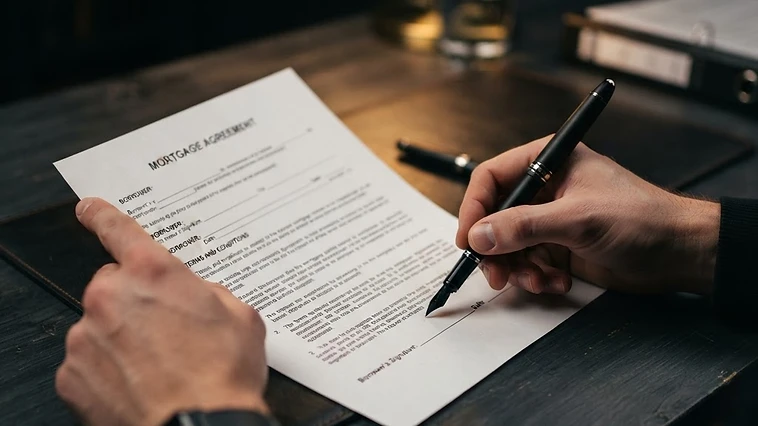 Close-up of hands reviewing mortgage documents with a pen on a dark desk

Conducting a Personal Mortgage Document Review
So, how do you actually perform a mortgage audit on your own file? It begins with gathering every single piece of paper related to your home loan. You cannot rely solely on the online portal provided by your mortgage servicer; you need the raw, recorded legal documents.
First, request a complete copy of your collateral file from your current mortgage servicer. Under the Real Estate Settlement Procedures Act (RESPA), you have the right to send a Qualified Written Request (QWR) or a Request for Information (RFI) to your servicer asking for copies of your Promissory Note, Deed of Trust, all assignments, and a complete payment history.
Next, visit your local county recorder's office (many have online databases) and pull the property records for your home. Compare the documents recorded in the public registry with the documents your servicer provided. Do they match? Are there assignments recorded in the county that your servicer failed to mention? Are there liens on your property that you never authorized?
Pay special attention to the Promissory Note. The Note is the actual IOU; it is the document that creates the debt. The Deed of Trust or Mortgage is simply the security instrument that gives the bank the right to foreclose if you don't pay. For a lender to enforce the debt, they generally must possess the original Promissory Note, properly endorsed (signed over) to them. If your Note lacks the proper endorsements, or if it contains an "endorsement in blank" that looks suspicious or newly stamped, you have uncovered a major anomaly.
Finally, review your Closing Disclosure (or HUD-1 Settlement Statement if your loan is older). Verify that the interest rate, loan term, and principal balance match exactly what you agreed to. Even a minor mathematical error or a misapplied fee can cost you thousands of dollars over the life of a thirty-year mortgage.
Why Auditing Your Mortgage Paperwork Matters
It is a common misconception that you only need to worry about your mortgage documents if you fall behind on your payments and face foreclosure. This could not be further from the truth. Even current, on-time homeowners must audit their mortgage paperwork before refinancing, selling, or passing the property on to their heirs.
Why? Because the moment you attempt to alter your financial relationship with the property—such as through a refinance—any hidden loan document errors, title defects, or instances of mortgage fraud will immediately rise to the surface. If your chain of title is broken due to a fraudulent assignment recorded five years ago, your new lender will likely refuse to fund the refinance until the defect is cured. Curing a title defect can take months of expensive legal wrangling. By conducting a mortgage document review now, while you are in a position of strength and current on your payments, you can identify and resolve these issues on your own terms.
Furthermore, understanding your mortgage documents empowers you to hold your servicer accountable. Servicers are notorious for misapplying payments, charging unauthorized property inspection fees, and failing to properly credit escrow accounts. A thorough mortgage audit ensures that every dollar you send to the bank is actually paying down your principal and interest as required by the contract.
This is exactly why the Foreclosure Defense Survival Playbook is an indispensable resource for every homeowner, not just those in distress. The Playbook is a comprehensive, 530-page educational guide that pulls back the curtain on the banking industry's most closely guarded secrets. It teaches you, step-by-step, how to read complex mortgage documents, how to spot the telltale signs of forgery and fraud, and how to organize your evidence like a seasoned legal researcher.
Don't wait until a refinance falls through or a predatory servicer threatens your home to find out what is actually in your loan file. Take control of your largest financial asset today. Order the Foreclosure Defense Survival Playbook and learn how to audit your mortgage paperwork, spot hidden defects, and protect your property rights for good.


Order The Playbook
Get the Foreclosure Defense Survival Playbook
530 pages of structured, educational guidance covering mortgage documents, foreclosure procedures, evidence organization, and legal research — the same foundation this article draws from.