Mortgage Documents
Is Your Mortgage Paperwork Accurate? Why Current Homeowners Need a Document Audit Before Refinancing
Discover why even on-time homeowners must audit their mortgage documents for errors, fraud, and defective assignments before signing new refinance paperwork.

Disclaimer: The information provided in this article is for educational and informational purposes only. It does not constitute legal or financial advice. If you have specific questions regarding your mortgage documents or property rights, you should consult a qualified attorney in your jurisdiction.
The Hidden Risks in Your Mortgage Files (Even if You Pay on Time)
Many homeowners operate under a dangerous assumption: if you pay your mortgage on time every month, your loan file must be in perfect order. Unfortunately, a pristine payment history does not guarantee that your initial closing package was executed properly, legally recorded, or lawfully transferred by the financial institutions handling it.
Before you sign a new stack of refinance paperwork to tap into your home's equity or secure a lower interest rate, you must ask yourself a critical question: are my original documents even valid?
Performing a comprehensive mortgage document review is not a strategy reserved only for homeowners facing financial distress or foreclosure. It is a vital checkup for any property owner. Over the last two decades, the mortgage industry has been notorious for rushing originations, rubber-stamping approvals, and losing critical paperwork as loans are bundled and sold to Wall Street trusts. You might currently be sending your hard-earned money to a servicer who lacks the legal standing to collect it, based on a file riddled with severe loan document errors. Auditing your paperwork now, while you are current on your payments, puts you in a position of maximum leverage and clarity.
August 2026 Crackdowns: Mortgage Fraud and Refinance Scams
Mortgage fraud is not a relic of the 2008 housing crash; it remains a persistent and highly sophisticated threat today. In mid-August 2026, the U.S. Department of Justice (DOJ) officially escalated the operations of its newly consolidated National Fraud Enforcement Division. This division immediately demonstrated its mandate by securing guilty pleas in multimillion-dollar mortgage fraud schemes. These federal cases targeted individuals utilizing straw buyers, fabricated income records, and fake down payments to deceive lenders.
Concurrently, Fannie Mae recently issued updated guidelines outlining strict red flags for mortgage fraud. Fannie Mae warned lenders and industry auditors to look for discrepancies in appraisals—where property values are artificially inflated—and to be highly suspicious of doctored financial records. The agency specifically pointed out forensic clues like misspellings, unusual spacing, and mismatched font styles on income statements, indicating that sections were digitally copied, pasted, and manipulated.
Furthermore, banking industry associations lobbied the Consumer Financial Protection Bureau (CFPB) in August 2026 to relax the Truth in Lending Act-RESPA Integrated Disclosure (TRID) tolerance provisions. The industry argues that strict enforcement of cost disclosures is too burdensome. As lenders push for deregulation, the burden falls directly on you, the homeowner, to ensure your closing costs and fees are accurate.
If originators and appraisers are still cutting corners to push loans through the system in 2026, there is a distinct possibility that your own mortgage file contains similar anomalies. Predatory lending practices often rely on inflated appraisals to justify rolling a homeowner into a higher-principal loan with exorbitant, hidden fees. By conducting a thorough mortgage audit, you can detect if your original loan was predicated on fraudulent terms.
The Ongoing MERS Controversy and Common Loan Document Errors
 Close up of a notary seal and county recording stamp on a mortgage deed of trust document.

When conducting a document review, the most critical components of your file are the Promissory Note (your underlying promise to pay the debt) and the Security Instrument (the Mortgage or Deed of Trust, which gives the lender the right to foreclose on the property).
One of the most widespread sources of loan document errors involves the Mortgage Electronic Registration Systems, commonly known as MERS. MERS operates as a private, electronic shell database created by the banking industry to bypass county recording fees and quietly track the buying and selling of loans behind closed doors. You might look at your mortgage and see MERS listed as the "nominee" for the lender.
Recent consumer advocacy movements and legal inquiries in August 2026 have renewed the spotlight on MERS, pointing back to landmark state supreme court rulings that labeled MERS a "naked holder"—an entity that does not lend money, has no financial interest in the loan, and yet claims the authority to act on behalf of the lender.
Worse, the MERS system frequently relies on the practice of "robo-signing." Wall Street hedge funds and mega-servicers have routinely bestowed their own lower-level data entry employees with fake corporate titles, such as "Certified MERS Officer." This allows them to blindly sign thousands of property records and assignments a day without verifying their accuracy. A careful review of your refinance paperwork and county land records may reveal forged signatures, fraudulent notary stamps, or missing assignments that legally break the chain of title to your home.
Servicing Rights Shell Games: Who Actually Owns Your Loan?
Another major reason to perform a mortgage document review is the chaotic and lucrative trading of Mortgage Servicing Rights (MSRs). Your loan servicer—the company you send your monthly payment to—rarely owns your actual debt. They merely purchased the "right" to service the loan, communicate with you, collect payments, and charge you administrative fees.
The MSR market is highly volatile and heavily scrutinized. In August 2026, a massive securities fraud class-action lawsuit was initiated against a top U.S. wholesale mortgage lender, alleging severe misrepresentations regarding their mortgage servicing rights hedging strategies, an event that caused their stock to plummet dramatically.
Why does this corporate drama matter to your kitchen-table budget? Because every time your servicing rights are sold or hedged, your loan file is digitally transferred to a new company. During these bulk transfers, accounting errors run rampant. Misapplied payments, unauthorized property inspection fees, and mysterious escrow shortages can quietly drain your equity without you ever missing a payment.
Recently, state attorneys general in places like California, New Jersey, and Alaska launched consumer protection crackdowns against unlicensed mortgage originators and subprime servicers for violating servicing laws and failing to provide accurate information to borrowers. You must audit your paperwork to ensure your current servicer is legally authorized to collect your money and that their accounting ledger perfectly matches your payment history.
How to Conduct a Proactive Mortgage Audit
You do not need a law degree to begin reviewing your own files. A proactive mortgage document review involves gathering all the original documents from your closing and cross-referencing them with the public record. Here is what you should meticulously inspect:
- The Promissory Note Endorsements: Does your lender have the original Note? Has it been properly endorsed (stamped) like a check each time it was sold to a new entity? Many notes lack the required endorsements, meaning the current debt collector may not actually possess the legal standing to enforce the contract.
- The Chain of Assignments: Go to your local county recorder's office or access their online database. Pull every recorded assignment of your mortgage or deed of trust. Does the timeline make sense? Often, you will find assignments dated years after the original lender went bankrupt, miraculously signed by a known industry robo-signer.
- Truth in Lending Act (TILA) Disclosures: Did the lender accurately disclose the Annual Percentage Rate (APR) and the total cost of the loan? Hidden finance charges or missing disclosures can sometimes give you the right to demand restitution.
- Notary and Signature Irregularities: Examine the notary seals on your recorded documents. Are they expired? Do the signatures match the printed names? Do the dates align with when you were actually in the closing room? Fraudulent or sloppy notarizations can render a recorded deed legally invalid.
By scrutinizing your refinance paperwork and original loan files, you shift the balance of power back in your favor. If you find severe errors, you gain the upper hand. You might be able to negotiate a better payoff amount, demand a more favorable loan modification, or even file a quiet title action to strip a fraudulent lien from your property before you enter into a new loan agreement.
Why Auditing Your Mortgage Paperwork Matters
You should never assume the bank's paperwork is flawless. Even if you have never missed a single payment, auditing your mortgage paperwork matters because you need to know exactly who holds the legal rights to your home. Discovering a broken chain of title, an artificially inflated appraisal, or predatory loan document errors gives you the vital information you need before you sign a new contract, agree to a refinance, or face a potential future default.
If you are ready to take control of your financial future and protect your most valuable asset, you need the right tools to uncover the truth hidden in your loan file. The Foreclosure Defense Survival Playbook is a comprehensive, 530-page educational book designed specifically to help homeowners deeply understand complex mortgage documents, master legal and foreclosure procedures, organize crucial evidence, and conduct professional-level legal research.
You do not have to be a victim of a disjointed, error-prone banking system. Order the Playbook today, audit your mortgage files with confidence, and protect your home with the knowledge the banks hope you never find.

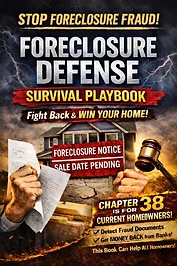
Order The Playbook
Get the Foreclosure Defense Survival Playbook
530 pages of structured, educational guidance covering mortgage documents, foreclosure procedures, evidence organization, and legal research — the same foundation this article draws from.