Mortgage Documents
Is Your Mortgage Paperwork Accurate? The Hidden Fraud Risks for Current Homeowners
Even if you are current on your payments, hidden errors and emerging AI-driven fraud in your loan documents can jeopardize your property rights. Learn why auditing your mortgage paperwork before refinancing is a critical step for every homeowner.

Disclaimer: The following article is for educational purposes only and does not constitute legal advice. If you have specific legal questions regarding your property or loan, please consult a qualified attorney in your jurisdiction.
If you are a homeowner who pays your mortgage on time every month, you probably don't spend much time thinking about the original stack of paperwork you signed at closing. You receive your monthly statement, you make your payment, and your balance slowly decreases. But what happens when you decide to refinance to take advantage of better rates, or you want to tap into your home equity?
For many homeowners, the refinancing process uncovers a nightmare of hidden defects, unrecorded assignments, and even outright fraud buried in their property records. In recent months, the real estate and mortgage industries have seen a alarming spike in sophisticated document fabrication. According to recent industry data, mortgage application fraud risk increased by 9.1% in the second quarter of 2026 alone, driven by a resurgence in purchase lending and sophisticated new fraud tactics (Cotality says mortgage fraud risk rose 9.1% in Q2).
Before you sign a new set of loan documents, it is absolutely vital to ensure that your current records are accurate, legally sound, and free of defects. This article will explore the emerging threats in the mortgage industry, the most common mistakes found in homeowner files, and why conducting a thorough mortgage document review is an essential step for every homeowner—even those who are perfectly current on their payments.
The Hidden Risks in Your Refinance Paperwork
When you apply for a refinance, the new lender will conduct a title search to ensure that your current lender holds a valid, perfected lien on your property. They need to know that when they pay off your old loan, they will step into the "first lien" position. Unfortunately, this is the exact moment when years of sloppy record-keeping by mortgage servicers and Wall Street securitization trusts come to light.
Refinance transactions are uniquely vulnerable to document defects and bad actors. In fact, recent reports indicate that fraud and forgery claims now account for approximately 40 percent of the total title insurance claim costs associated with refinance transactions—more than double the rate seen in standard purchase transactions (Refinance Fraud: Notaries are the last line of defense).
Why is the risk so high? Because your refinance paperwork relies entirely on the accuracy of the documents that came before it. If your original mortgage was sold multiple times, transferred into a securitized trust, or handled by the Mortgage Electronic Registration Systems (MERS), there is a high probability that the chain of title contains gaps. When a new lender discovers these gaps, your refinance can be delayed or denied entirely. Worse, if a fraudulent actor has recorded a fake lien or deed against your property, you may find yourself fighting in court just to prove you own your home.
How AI and Synthetic Identities are Corrupting Mortgage Documents
The landscape of mortgage fraud has evolved dramatically. We are no longer just dealing with the "robo-signing" scandals of the 2010s, where low-level bank employees forged thousands of signatures to push through foreclosures. Today, the threat is highly technological.
In July 2026, federal regulators and industry watchdogs highlighted a terrifying new trend: the use of Generative Artificial Intelligence (GenAI) to fabricate flawless financial and legal documents. As reported recently, bad actors are utilizing AI to create synthetic identities, fake pay stubs, and forged property records that can easily bypass traditional verification systems (Mortgage fraud case shows AI's fake-document risk).
For a current homeowner, this means that identity thieves can theoretically use AI-generated documents to impersonate you, take out a second mortgage or a home equity line of credit (HELOC) in your name, and siphon the equity right out of your property. Because these synthetic documents look incredibly authentic, county recording offices often accept them without question. By the time you go to review your refinance paperwork, you might discover a massive, fraudulent lien attached to your home. This makes a proactive review of your county property records and personal loan file more critical than ever.
Why Current Homeowners Need a Mortgage Document Review
Many homeowners operate under the false assumption that if they are not facing foreclosure, their mortgage documents must be perfectly fine. This is a dangerous misconception. The accuracy of your loan file dictates your legal rights as a property owner.
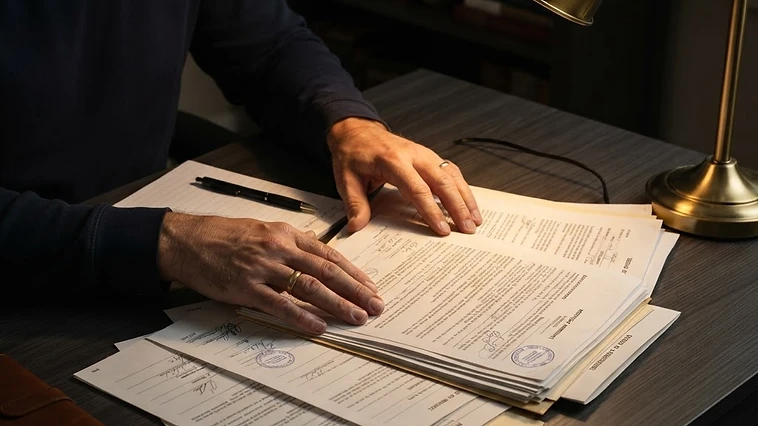 Homeowner conducting a mortgage document review on a dark desk with a gold lamp

Conducting a comprehensive mortgage document review allows you to verify that the entity currently collecting your monthly payments actually has the legal right to do so. In the complex world of mortgage securitization, loans are frequently separated into two parts: the promissory note (the IOU) and the mortgage or deed of trust (the security instrument that pledges your home as collateral).
Over the life of a loan, the note may be endorsed (signed over) to a half-dozen different banks, while the mortgage might be assigned to completely different entities. If these two documents are legally severed, or if the chain of assignments is broken, the current servicer may lack the legal standing to enforce the debt. While this might sound like a technicality, it becomes a massive problem if you ever need a loan modification, if your servicer misapplies your payments, or if you attempt to sell the home and the title company cannot verify who actually holds the lien.
Common Loan Document Errors to Look For
When you sit down to perform a mortgage audit of your own files, you aren't just looking for obvious signs of identity theft. You are looking for systemic, institutional errors that banks make every single day. Here are some of the most common loan document errors that current homeowners discover:
1. Missing or Fraudulent Endorsements on the Note: Your promissory note should have a clear chain of endorsements (similar to signing the back of a check) showing exactly how it transferred from your original lender to the current investor. Often, these endorsements are missing, undated, or stamped by individuals who never actually worked for the endorsing bank.
2. Unrecorded or "Robo-Signed" Assignments: Every time your mortgage is sold, an Assignment of Mortgage should be recorded in your local county land records. It is incredibly common to find gaps in this chain. Furthermore, many assignments are signed by "vice presidents" of MERS who are actually just employees of the servicing company—a conflict of interest that has been heavily litigated in courts nationwide.
3. Incorrect Principal Balances and Escrow Miscalculations: Servicers frequently make accounting errors. They may charge you for forced-place insurance you didn't need, miscalculate your escrow requirements, or fail to properly credit your principal payments. Over a 30-year term, a small accounting error can cost you tens of thousands of dollars.
4. Notary Irregularities: Take a close look at the notary stamps on your closing documents and assignments. Are the dates correct? Was the notary actually commissioned in the state where the document was supposedly signed? Notary fraud is a massive liability in real estate, and an invalid notarization can render a document legally void.
The Danger of Relying on Your Servicer's Word
It is tempting to simply call your mortgage servicer's customer service line and ask them to confirm that your paperwork is in order. However, relying on your servicer to police themselves is a recipe for disaster.
Mortgage servicers are essentially debt collectors. Their primary goal is to process payments as cheaply and quickly as possible. They are not incentivized to spend hours digging through their vaults to ensure your chain of title is legally perfected. In fact, federal and state regulators frequently have to step in to penalize servicers for deceptive practices, unlawful foreclosure procedures, and failing to provide homeowners with accurate information about their accounts.
If you want to know the truth about your loan, you have to demand the documents yourself. Under federal law (specifically the Real Estate Settlement Procedures Act, or RESPA), you have the right to send your servicer a Qualified Written Request (QWR) or a Request for Information (RFI). This legally compels the servicer to provide you with a complete payment history, a copy of your original promissory note, and the identity of the actual investor who owns your loan. Gathering this evidence is the first step in protecting your home.
Why Auditing Your Mortgage Paperwork Matters
Whether you are planning to refinance next month, hoping to sell your home in a few years, or simply want the peace of mind that comes with knowing your property rights are secure, auditing your mortgage paperwork matters. You cannot afford to wait until a crisis strikes—such as a sudden job loss or a servicing transfer that results in lost payments—to find out that your loan documents are a mess of errors, missing signatures, and potential fraud.
Even current, on-time homeowners must take a proactive approach to their financial security. By learning how to read a chain of title, how to spot a fabricated endorsement, and how to hold your servicer accountable, you build an impenetrable wall of defense around your most valuable asset.
This is exactly why the "Foreclosure Defense Survival Playbook" was written. This comprehensive, 530-page educational book is not just for homeowners in distress; it is the ultimate guide for any homeowner who wants to understand the complex machinery of the mortgage industry. The Playbook teaches you step-by-step how to organize your evidence, conduct a forensic-level review of your own loan documents, spot the hidden defects that lenders pray you never notice, and master the legal research necessary to protect your property rights.
Don't wait for a refinance underwriter or a fraudulent bad actor to tell you there is a problem with your home's title. Take control of your mortgage paperwork today. Order the Foreclosure Defense Survival Playbook and empower yourself with the knowledge to keep your home safe, secure, and legally protected.


Order The Playbook
Get the Foreclosure Defense Survival Playbook
530 pages of structured, educational guidance covering mortgage documents, foreclosure procedures, evidence organization, and legal research — the same foundation this article draws from.