Foreclosure Defense
Late on Your Mortgage? What Recent Servicing Abuse Reports Mean for Your Foreclosure Defense
Recent regulatory reporting on mortgage servicing errors, dual-tracking, and document problems shows why homeowners behind on payments need to understand their rights before foreclosure moves forward.

Why Late Payments Are Turning Into a National Servicing Crisis
If you've fallen behind on your mortgage in the last several months, you are far from alone — and recent regulatory reporting suggests you may also be facing more than just a debt problem. Consumer protection agencies and housing advocates have continued flagging a troubling pattern in recent weeks: mortgage servicers mishandling loss mitigation requests, misapplying payments, and moving borrowers toward foreclosure even while modification paperwork is pending.
This matters because foreclosure is not just about whether you missed payments. It is about whether the servicer and foreclosing party followed the law while pursuing your home. Homeowners searching for terms like "late mortgage payment help" or "stop foreclosure" often assume the only options are paying up or losing the house. In reality, servicing errors uncovered through recent enforcement trends are giving many homeowners new leverage in foreclosure defense.
What Recent Enforcement Reporting Reveals About Dual-Tracking and Loss Mitigation Failures
One of the most persistent issues highlighted in recent consumer-protection commentary is "dual tracking" — when a servicer continues to advance a foreclosure while a borrower's loss mitigation application (loan modification, forbearance, repayment plan) is still under review. Federal servicing rules under Regulation X generally prohibit this practice, yet reports continue to describe servicers scheduling sale dates, filing foreclosure complaints, or refusing to pause proceedings even after a homeowner submits a complete application.
Other recurring themes in recent servicing complaints include:
- Misapplied or misallocated payments that create artificial delinquencies
- Servicers losing or claiming never to have received submitted modification documents
- Escrow account errors inflating the amount claimed as owed
- Force-placed insurance charges added without proper notice
- Inconsistent or missing breach letters required before foreclosure can begin
For a homeowner facing foreclosure, each of these issues can translate into a factual dispute the servicer must prove — not just assume — in court. If you are behind on payments, requesting your full payment history and loss mitigation file is one of the most important early steps in preparing a defense.
The Robo-Signing Ghost: Why Document Problems Never Really Went Away
Many homeowners remember "robo-signing" as a scandal from the 2008–2012 foreclosure crisis, when bank employees signed thousands of foreclosure documents without reviewing them, often using fabricated titles or forged signatures. While the largest public settlements from that era are long closed, document integrity problems tied to the same root cause — high-volume, low-oversight processing — continue to surface in individual foreclosure cases today.
Recent commentary from housing attorneys and legal aid organizations continues to describe similar red flags in current foreclosure filings:
- Assignments of mortgage executed years after the original transfer supposedly occurred
- Signatures from "vice presidents" who appear to represent multiple unrelated companies
- Notarizations dated before the document itself was signed
- Endorsements on promissory notes that do not match the chain of custody described in the complaint
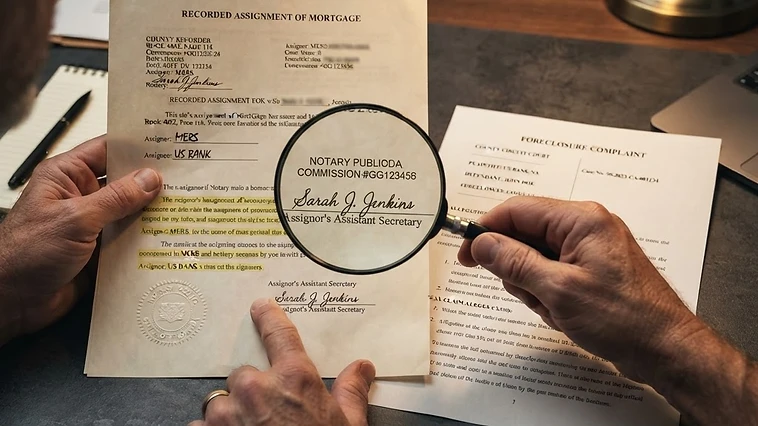 Homeowner examining assignment of mortgage document for signature and notary discrepancies during foreclosure defense review

These are not minor technicalities. In many states, the foreclosing party must prove it actually owns the debt and has standing to foreclose. If the assignment chain is broken, backdated, or executed by someone without real authority, that can be a legitimate basis to challenge the case — separate entirely from whether you missed payments.
How Servicing Errors Can Become Your Strongest Defense
Homeowners often feel that being behind on payments means they have "no case." That is a common misunderstanding. Falling behind explains why a servicer initiated collection or foreclosure — it does not excuse the servicer or foreclosing party from following the law while doing so.
Courts in many jurisdictions have made clear that procedural and evidentiary requirements still apply even to admittedly delinquent borrowers. A defense built around servicing abuse or documentation problems typically focuses on questions like:
- Did the servicer send legally required notices (default letter, right-to-cure notice) with accurate information?
- Was the loss mitigation review completed before the case moved forward?
- Does the party suing you actually own the note and mortgage, supported by admissible business records?
- Are the payment records and account histories consistent, or do they contain unexplained gaps and adjustments?
Building this kind of defense requires organizing your mortgage documents, payment history, and correspondence with the servicer — then comparing that paper trail against what is filed in your foreclosure case. This is exactly the kind of methodical, evidence-based approach that turns a "hopeless" default case into one with real negotiating leverage or even a dismissal.
What Homeowners Behind on Payments Should Do Right Now
If you are currently behind on your mortgage or have already received a notice of default or foreclosure complaint, consider these practical steps:
- Request your full servicing file. You are generally entitled to a payment history, and often to a copy of the note, mortgage, and all assignments recorded against your loan.
- Document every communication. Keep copies of letters, portal messages, and notes from phone calls, including names, dates, and what was said about loss mitigation options.
- Check the assignment chain. Pull recorded documents from your county recorder's office and compare the dates, signatures, and notarizations against the timeline described in your foreclosure complaint.
- Track loss mitigation deadlines. If you submitted a modification or forbearance request, note when it was submitted, what was requested, and whether the servicer confirmed it was complete.
- Learn your state's foreclosure procedure. Judicial and non-judicial states have very different timelines and defense opportunities, and missing a procedural deadline can eliminate options that would otherwise be available.
This article is for educational purposes only and does not constitute legal advice. Foreclosure laws vary significantly by state, and homeowners facing foreclosure should consult a licensed attorney in their jurisdiction about their specific situation.
Why the Foreclosure Defense Survival Playbook Helps
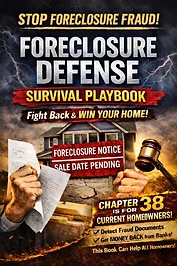
Understanding that servicing errors and documentation problems exist is only the first step — knowing how to find them in your own case is what actually changes outcomes. The Foreclosure Defense Survival Playbook was written specifically for homeowners who are behind on payments or already in foreclosure and need a clear, step-by-step way to fight back.
Across 530 pages, the Playbook walks you through how to:
- Read and decode your note, mortgage, and assignment documents
- Identify robo-signing red flags and broken chains of title
- Organize payment history and servicer correspondence into usable evidence
- Understand loss mitigation rules and dual-tracking violations
- Navigate court procedure as a self-represented (pro se) homeowner
- Conduct legal research to support motions and defenses specific to your state
Rather than leaving you to guess whether your servicer followed the rules, the Playbook gives you the same organizational framework attorneys use to evaluate foreclosure cases — broken down into plain language anyone can follow, even with no legal background.
If you are behind on payments and worried about losing your home, don't wait until a sale date is scheduled. Order the Foreclosure Defense Survival Playbook today and start building an organized, evidence-based defense before it's too late.

Order The Playbook
Get the Foreclosure Defense Survival Playbook
530 pages of structured, educational guidance covering mortgage documents, foreclosure procedures, evidence organization, and legal research — the same foundation this article draws from.