Foreclosure Defense
The 15-Year Foreclosure Fight: How Homeowners Are Pushing Back Against Mortgage Servicers
A recent high-profile foreclosure case in New York highlights the ongoing power struggle between homeowners and mortgage lenders, proving that procedural defenses can keep families in their homes for years.

Disclaimer: The following article is for educational purposes only and does not constitute legal advice. If you are facing foreclosure, consult with a qualified attorney in your jurisdiction to understand your specific legal rights and options.
When a homeowner falls behind on their mortgage payments, the immediate reaction is often panic, fear, and a sense of powerlessness. The banks and mortgage servicers seem to hold all the cards, armed with massive legal teams and an intimidating bureaucratic machine. However, recent news and ongoing court battles reveal a very different reality: homeowners who understand their rights, scrutinize their mortgage documents, and hold lenders accountable to the letter of the law can mount formidable defenses.
In late February 2025, a striking report highlighted the intense, ongoing power struggle between mortgage lenders and homeowners. According to a recent feature in American Banker titled The case of the stop-and-start, never-ending foreclosure, a Manhattan condo owner has managed to remain in her home for over 15 years after stopping mortgage payments. This case is not just an anomaly; it is a glaring symptom of a broader systemic issue within the mortgage servicing industry. It underscores how procedural errors, statute of limitations expirations, and aggressive foreclosure defense strategies can completely derail a bank's attempt to seize a property.
For homeowners currently facing late payments or active foreclosure proceedings, these high-profile battles offer crucial educational insights. By understanding the mechanics of foreclosure, the common mistakes made by lenders, and the legal standards required to prove ownership of a debt, you can transform yourself from a passive victim into an empowered defender of your home.
The Stop-and-Start Foreclosure Phenomenon
The concept of a "stop-and-start" foreclosure is incredibly common in the modern mortgage landscape. When a bank initiates a foreclosure, they are required to follow strict legal procedures. They must prove they have the legal standing to foreclose, which means they must possess the original promissory note and a valid, unbroken chain of mortgage assignments.
However, during the housing crash of 2008 and the subsequent years of rampant securitization, mortgages were bought, sold, sliced, and diced at lightning speed. Paperwork was routinely lost, destroyed, or fraudulently manufactured—a practice famously known as "robo-signing." Even today, the legacy of these sloppy practices haunts mortgage servicers. When a homeowner challenges a foreclosure, the bank is often forced to pause the proceedings to locate the necessary documents. If they cannot produce them, or if the documents are found to be defective, the court may dismiss the case.
This leads to the "stop-and-start" cycle. The bank dismisses the case, attempts to cure the paperwork defects, and then refiles the foreclosure months or even years later. For the educated homeowner, this cycle presents a massive opportunity. Every delay forces the bank to expend resources, and more importantly, it runs down the clock on the statute of limitations.
The Statute of Limitations: A Homeowner's Secret Weapon
One of the most powerful tools in foreclosure defense is the statute of limitations. Every state has a specific time limit within which a creditor must file a lawsuit to collect a debt or foreclose on a property. In some states, this period is as short as three to five years; in others, it may be longer.
When a mortgage is "accelerated"—meaning the bank demands the entire remaining balance of the loan immediately due to default—the statute of limitations clock begins ticking. If the bank files a foreclosure lawsuit but the case is subsequently dismissed (often due to the homeowner successfully challenging the bank's standing or evidence), the clock does not necessarily reset.
If the bank fails to successfully refile and complete the foreclosure within the statutory time limit, they may be permanently barred from ever foreclosing on the property. This is exactly how some homeowners, like the one featured in the recent New York case, are able to remain in their homes for over a decade. The lenders simply ran out of time due to their own procedural incompetence and the homeowner's relentless legal pushback. Understanding how your specific state handles the acceleration and de-acceleration of mortgage debt is a critical component of any foreclosure defense strategy.
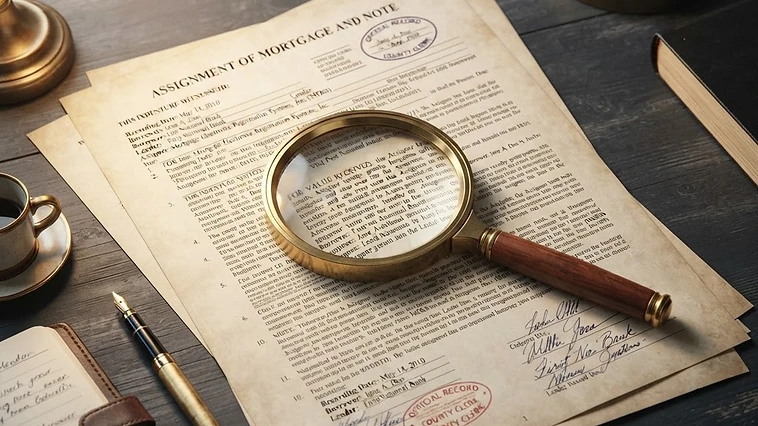 Magnifying glass examining a mortgage assignment document

Scrutinizing the Chain of Title and Assignments
To win a foreclosure case, the plaintiff (usually a trust or a large financial institution) must prove that they are the rightful owner of your specific mortgage and promissory note. Because most loans are sold multiple times after origination, the current servicer must show a clear "chain of title."
This is done through a document called an Assignment of Mortgage (or Assignment of Deed of Trust). An assignment legally transfers the rights of the mortgage from one entity to another. If there is a break in this chain—for example, if Bank A sold the loan to Bank C, but there is no assignment recorded from Bank A to Bank B, and Bank B to Bank C—the foreclosing party lacks standing.
Homeowners defending against foreclosure must meticulously audit their county land records. You are looking for:
- Missing Assignments: Are there gaps in the timeline of who owned your loan?
- Fraudulent Signatures: Does the signature on the assignment belong to a known "robo-signer"? (There are databases of known robo-signers available online).
- Post-Dated Assignments: Was the assignment created and recorded after the foreclosure lawsuit was filed? In many jurisdictions, the bank must have standing at the exact moment the lawsuit is initiated. If they acquired the rights to the loan after filing, the case must be dismissed.
- Trust Cut-Off Dates: If your loan is held by a Wall Street securitized trust, that trust has a "closing date" outlined in its Pooling and Servicing Agreement (PSA). If your mortgage was assigned to the trust years after this closing date, the assignment may be void under state law.
Holding Mortgage Servicers Accountable for Abuses
Mortgage servicers—the companies you actually send your monthly payments to—are notorious for making errors that push homeowners closer to the brink of foreclosure. These abuses include misapplying payments, charging unauthorized fees, failing to pay property taxes from escrow accounts, and "dual tracking."
Dual tracking is a particularly egregious practice where a servicer moves forward with foreclosure proceedings while simultaneously negotiating a loan modification or loss mitigation option with the homeowner. Federal regulations, specifically those enforced by the Consumer Financial Protection Bureau (CFPB), strictly prohibit dual tracking. If a homeowner submits a complete loss mitigation application, the servicer is generally required to halt the foreclosure process until the application is fully evaluated and an appeals process is exhausted.
When defending against foreclosure, documenting every interaction with your servicer is vital. Keep a detailed log of phone calls, save every piece of mail, and send all your correspondence via certified mail with a return receipt. If you can prove that the servicer violated federal regulations like the Real Estate Settlement Procedures Act (RESPA) or the Truth in Lending Act (TILA), you can file counterclaims against them. These counterclaims not only put the servicer on the defensive but can also result in financial damages awarded to the homeowner, which can be used as leverage to negotiate a favorable settlement or loan modification.
The Importance of Discovery and Evidence Organization
If your foreclosure case goes to court, the discovery phase is where the battle is truly fought. Discovery is the formal legal process where you have the right to demand documents, records, and answers from the bank.
Many homeowners make the mistake of simply showing up to court and telling the judge that they fell on hard times. While sympathetic, this is not a legal defense. A true foreclosure defense relies on demanding the bank produce the original "wet-ink" promissory note, the complete payment history, the pooling and servicing agreement, and the internal communication logs regarding your account.
When you force the bank to produce these documents, you often uncover the fatal flaws in their case. Perhaps the payment history shows unexplained fees that artificially inflated your default amount. Perhaps the original note has an anomalous endorsement, or lacks an endorsement altogether. Organizing this evidence meticulously allows you to file motions to compel, motions to strike false affidavits, and ultimately, motions for summary judgment in your favor.
Why the Foreclosure Defense Survival Playbook Helps
Facing a foreclosure is one of the most stressful experiences a family can endure, but as recent news proves, the banks are not invincible. Their systems are flawed, their paperwork is often a mess, and their legal arguments can be dismantled by a homeowner who knows exactly where to look. However, you cannot fight this battle blindly. You need a comprehensive, step-by-step guide to level the playing field.
This is exactly why the Foreclosure Defense Survival Playbook is your ultimate weapon. This massive 530-page educational resource is specifically designed for homeowners who are behind on payments or actively fighting in court. It demystifies the complex world of mortgage documents, teaches you how to spot fraudulent assignments and robo-signing, and provides a clear roadmap for organizing your evidence.
Inside the Playbook, you will learn how to audit your own mortgage file, understand the critical rules of court procedure, and master the discovery process to force the banks to prove their claims. It breaks down complex legal research into plain, actionable language, empowering you to hold mortgage servicers accountable for their abuses. Whether you are trying to negotiate a loan modification from a position of strength or preparing to challenge the bank's standing in front of a judge, this book provides the foundational knowledge you need to protect your most valuable asset.
Don't let the banks steamroll you with defective paperwork and intimidation tactics. Educate yourself, understand your rights, and take control of your financial future. Order the Foreclosure Defense Survival Playbook today and start building the defense your home deserves.


Order The Playbook
Get the Foreclosure Defense Survival Playbook
530 pages of structured, educational guidance covering mortgage documents, foreclosure procedures, evidence organization, and legal research — the same foundation this article draws from.