Mortgage Documents
The Hidden Risks in Your Refinance Paperwork: Why Every Homeowner Needs a Mortgage Document Review
Recent industry reports reveal a shocking surge in mortgage document defects and appraisal fraud. Learn why auditing your loan paperwork is essential, even if you are current on your payments.

Disclaimer: The following article is for educational purposes only and does not constitute legal advice. It is designed to help homeowners understand their mortgage documents and the importance of reviewing them for accuracy.
Have you ever looked closely at the massive stack of papers you signed at your real estate closing? Most homeowners assume that because they make their payments on time every month, their mortgage paperwork is flawless. You trust that the bank, the title company, and the notary did their jobs correctly. However, recent industry data and federal lawsuits reveal a very different reality. The mortgage industry is currently experiencing a massive surge in loan document errors, compliance failures, and even outright mortgage fraud.
If you are currently paying your mortgage on time, you might think these issues do not apply to you. But what happens when you decide to refinance to get a better rate or pull out equity? What happens if your loan is sold to a new servicer who relies on inaccurate, fabricated, or legally defective documents?
Conducting a thorough mortgage document review is not just for homeowners facing foreclosure. It is a vital financial health check for every property owner. In this article, we will explore the recent spike in mortgage defects, how fraud slips into the system, and why performing a mortgage audit on your refinance paperwork is one of the smartest moves you can make to protect your most valuable asset.
The Recent Surge in Loan Document Errors
Behind the scenes of the mortgage industry, quality control auditors track the "critical defect rate" of loans. A critical defect means there is a severe error in the loan's origination, underwriting, or closing documentation that makes the loan ineligible for sale on the secondary market or legally problematic.
According to recent reporting, the mortgage critical defect rate has surged, experiencing its biggest quarterly jump in years 1. Driven by a wave of refinance activity, lenders' pipelines filled up overnight, leading to a rising number of oversights and errors 1. Legal and compliance issues led all defect types, pointing to ongoing, systemic lapses in how mortgage paperwork is handled 1.
Furthermore, loan documentation errors specifically jumped to an 8.55% defect rate 1. This means that nearly one in ten loans reviewed had significant problems with the actual paperwork. The refinance defect share also increased dramatically, climbing to over 38% 1.
What does this mean for you? It means that if you recently refinanced, or are planning to, there is a statistically significant chance that your refinance paperwork contains loan document errors. These errors can range from missing signatures and incorrect loan amounts to improperly recorded deeds and defective assignments. When lenders rush to close loans, the paperwork suffers, and the homeowner is left holding a legally messy bag.
How Mortgage Fraud and Fabricated Documents Slip Through
It is easy to assume that "mortgage fraud" only happens to unsuspecting buyers in shady back-room deals. But recent federal lawsuits show that sophisticated fraud schemes are actively penetrating mainstream wholesale lending channels.
For example, Rocket Mortgage recently filed a federal lawsuit against a wholesale broker over a loan fraud scheme involving fabricated documents 2. The lawsuit alleges that the broker submitted loan applications that misrepresented borrower income, assets, and employment, backing those applications with documents that were "misleading, untrue, fabricated, altered and otherwise fraudulent" 2. Rocket Mortgage funded nearly $1 million in loans based on these applications before discovering the discrepancies 2.
In another recent case, lenders suffered over $10 million in losses due to an appraisal fraud scheme where perpetrators used mismatched appraisal photos to secure inflated real estate valuations 9. The fraudsters allegedly took photos of superior properties and used them to support inflated valuations, allowing them to originate mortgages for tens of thousands of dollars more than the actual purchase prices 9.
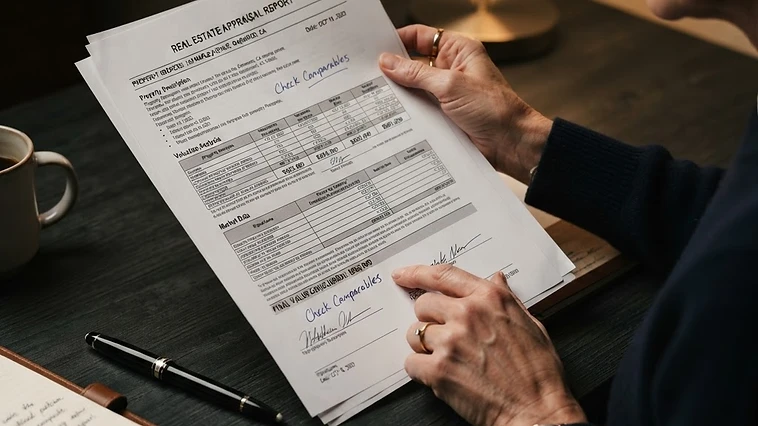 Close-up of a homeowner conducting a mortgage document review on a dark desk.

While these specific cases involved bad actors intentionally defrauding lenders, they highlight a terrifying reality for the average homeowner: the systems designed to catch fabricated documents, inflated appraisals, and title defects are not foolproof. If a broker can slip altered income documents past one of the largest lenders in the country, what errors or misrepresentations might be hiding in your own loan file?
Even if you provided perfectly accurate information to your loan officer, the data entered into the automated underwriting systems, the appraisal ordered by the appraisal management company, or the final numbers on your Closing Disclosure could have been manipulated or incorrectly calculated without your knowledge.
The Hidden Dangers of MERS and Assignment Problems
When you conduct a mortgage document review, one of the most critical areas to investigate is the chain of title. In a traditional mortgage transaction, if the lender sells your loan, they must record an "Assignment of Mortgage" in your local county land records.
However, to bypass county recording fees and speed up the securitization of loans, the banking industry created MERS (Mortgage Electronic Registration Systems). MERS acts as a nominee for the lender and tracks the buying and selling of mortgage servicing rights electronically.
While MERS is standard practice today, it frequently leads to severe documentation problems. When a homeowner decides to refinance, the new title company must ensure that the old mortgage is properly paid off and released (a "Satisfaction of Mortgage"). If MERS or the previous servicers failed to properly record assignments, or if the individuals signing the assignments were "robo-signers" who lacked the actual legal authority to transfer the debt, your property's title could be clouded.
These recording and assignment problems might not bother you while you are simply making your monthly payments. But the moment you try to sell your home or sign new refinance paperwork, a clouded title can bring the entire transaction to a grinding halt. Auditing your chain of title now ensures that you actually have clear ownership of your property.
What to Look For in a Mortgage Audit
If you are a current homeowner looking to protect your investment, conducting a personal mortgage audit is a proactive step. You do not need to be behind on your payments to request your complete loan file from your servicer.
When reviewing your mortgage paperwork, pay close attention to the following areas:
- The Promissory Note: This is the actual IOU. Does your servicer have a copy of the Note? Are the endorsements (the stamps transferring the Note from one bank to another) correct? Are there any unexplained allonges (attachments to the Note) that you never signed?
- The Mortgage or Deed of Trust: Check the legal description of your property. A surprising number of loan document errors involve incorrect lot numbers or missing pages in the legal description, which can legally invalidate the lien.
- Notary and Signature Irregularities: Look at the dates on your notarized documents. Were you actually in the presence of the notary on the date stamped? Backdated notarizations are a common form of compliance failure and can render a document legally void.
- The Closing Disclosure (CD) and Truth in Lending Act (TILA) Disclosures: Did the lender accurately disclose the Annual Percentage Rate (APR) and the total finance charges? Calculation errors in these documents are rampant and can sometimes give homeowners the right to rescind the loan.
- Appraisal Accuracy: Review the appraisal that was used to fund your loan. Are the comparable sales actually comparable? As recent fraud suits show, inflated appraisals are a massive risk. If your home was overvalued, you might be trapped in a loan that exceeds your home's true market value.
By systematically checking these elements, you can identify predatory refinance tactics, hidden fees, and structural defects in your loan before they become a crisis.
Why Auditing Your Mortgage Paperwork Matters
It is a common misconception that you only need to worry about your mortgage documents if you are facing foreclosure. The truth is, even current, on-time homeowners should audit their mortgage paperwork before refinancing, selling, or facing a future unexpected financial hardship.
When you sign refinance paperwork, you are legally binding yourself to a new set of terms, often paying off an old loan that may have been legally defective to begin with. If your current mortgage contains fatal loan document errors, you might have incredible leverage against your lender—leverage that you completely wipe out the moment you refinance into a new loan. Furthermore, if you don't catch appraisal defects or title issues now, they will inevitably surface later, usually at the worst possible time.
This is exactly why the "Foreclosure Defense Survival Playbook" is an indispensable resource for every homeowner, not just those in distress. This comprehensive, 530-page educational book teaches you step-by-step how to understand complex mortgage documents, navigate foreclosure procedures, organize your evidence, and conduct deep legal research.
The Playbook empowers you to look at the documents a lender or servicer handed you and spot the hidden fraud, errors, and defects that the untrained eye misses. Whether you are preparing to refinance, reviewing your original closing packet, or simply want the peace of mind that your home is truly secure, you need the right knowledge. Don't wait for a crisis to discover that your mortgage paperwork is flawed. Order the "Foreclosure Defense Survival Playbook" today, take control of your financial future, and learn how to audit your mortgage documents like a pro.


Order The Playbook
Get the Foreclosure Defense Survival Playbook
530 pages of structured, educational guidance covering mortgage documents, foreclosure procedures, evidence organization, and legal research — the same foundation this article draws from.