Mortgage Documents
The Hidden Risks in Your Refinance Paperwork: A Homeowner's Guide to Mortgage Document Review
Recent data shows a massive spike in refinance fraud and mortgage document errors. Learn why auditing your loan paperwork is crucial even if you are current on your payments.
Disclaimer: The following article is for educational purposes only and does not constitute legal advice. Always consult with a qualified attorney regarding your specific legal situation.
For many homeowners, paying the mortgage on time every month provides a sense of security. You might assume that because your payments are current, your mortgage documents are perfectly accurate and your property rights are fully protected. However, recent industry reports and federal investigations reveal a troubling reality: the mortgage industry is currently experiencing a significant surge in loan document errors, compliance defects, and sophisticated mortgage fraud.
If you are considering refinancing your home, or if you simply want to ensure that your property is safe from hidden title defects, conducting a thorough mortgage document review is no longer just a good idea—it is an absolute necessity. This article explores the latest trends in mortgage fraud and document errors, and explains why every homeowner should perform a comprehensive mortgage audit before signing new refinance paperwork.
The Alarming Rise in Refinance Fraud and Forgery
When homeowners think of mortgage fraud, they often imagine predatory lending tactics aimed at buyers with poor credit. However, recent data indicates that current homeowners seeking to refinance are increasingly becoming victims of sophisticated fraud schemes. According to a recent study commissioned by the American Land Title Association (ALTA), fraud and forgery claims tied to mortgage refinances have surged, now representing over 40% of all title insurer losses and expenses Refinance fraud and forgery claims soar, driving up title insurance losses.
The financial impact of these fraudulent activities is staggering. The average cost of fraud and forgery claims on refinances has climbed to $207,000. Even more concerning is the fact that about 40% of refinance-related losses and expenses stem from issues that cannot be identified through standard public record searches. This means that hidden defects in your refinance paperwork could be lurking beneath the surface, completely invisible to a casual observer.
For homeowners, this underscores the critical importance of a meticulous mortgage document review. Fraudsters are exploiting the refinance process, sometimes forging signatures or manipulating loan terms. If you do not carefully audit your documents, you could unknowingly agree to terms that jeopardize your home equity or leave you vulnerable to future legal disputes.
How AI is Fueling Loan Document Errors and Fake Paperwork
The rapid advancement of artificial intelligence (AI) has brought numerous benefits to various industries, but it has also provided bad actors with powerful new tools to commit mortgage fraud. Federal authorities are increasingly warning about the ease with which fake documents can be generated using AI technology.
In a recent high-profile case, federal prosecutors charged individuals with running a bank-fraud scheme that utilized falsified pay stubs and employment records to secure mortgages Mortgage fraud case shows AI's fake-document risk. While some of these specific crimes occurred just before the widespread adoption of generative AI, banking officials note that AI now makes it incredibly easy to produce receipts, pay stubs, and other forms that appear entirely legitimate upon initial review.
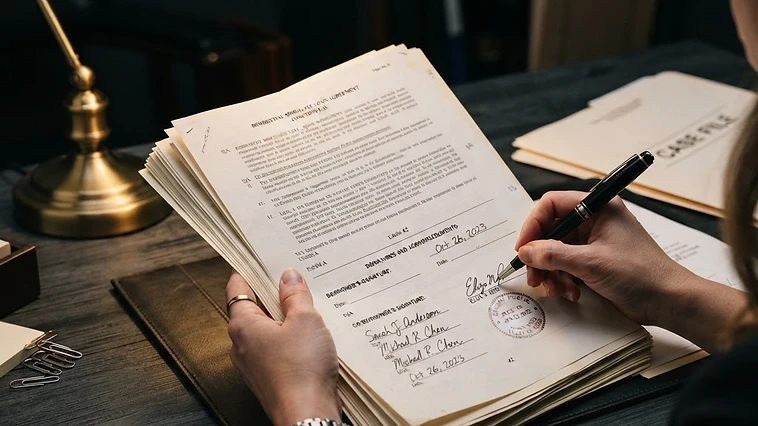 Close-up of hands reviewing mortgage refinance paperwork under a warm gold light.

How does this affect you, the current homeowner? If the mortgage industry is being flooded with highly convincing fake documents, the overall integrity of the loan origination and servicing process is compromised. When you sit down to review your refinance paperwork, you must be hyper-vigilant. A simple clerical error or a deliberately manipulated figure in your loan file could lead to miscalculated interest rates, improper escrow disbursements, or even wrongful foreclosure proceedings down the line. Conducting a personal mortgage audit helps ensure that the documents you are signing accurately reflect your financial reality and the agreed-upon terms.
Title Defects and Deed Fraud: A Hidden Threat to Current Homeowners
One of the most terrifying scenarios for any homeowner is discovering that they no longer legally own their property due to deed fraud. This is not a hypothetical threat; it is happening to real people across the country.
Recently, a Pittsburgh real estate agent uncovered dozens of cases of deed fraud. In one instance, a property owner contacted the agent's office to initiate a refinance, only to discover that county records showed they had signed over the deed to someone else—a transaction they never authorized Pittsburgh real estate agent says she's uncovered dozens of cases of deed fraud.
Deed fraud often occurs when criminals forge a homeowner's signature on a deed and file it with the county recorder's office. Once the title appears clear or transferred, the fraudsters can take out loans against the property or attempt to sell it. Because current homeowners who are not behind on their payments rarely check their property records, this type of fraud can go undetected for years. It is often only discovered when the legitimate homeowner attempts to sell or refinance the property.
This highlights a crucial step in any mortgage document review: verifying your title and deed status. Before you even begin the process of gathering refinance paperwork, you should check your local county records to ensure that your deed is intact and that no unauthorized liens or transfers have been recorded against your property.
The Spike in Mortgage Critical Defect Rates
Even if we set aside intentional fraud, the sheer volume of accidental loan document errors in the mortgage industry is cause for concern. According to ACES Quality Management, the mortgage industry's critical defect rate rose to 1.71% in the first quarter of 2026, up from 1.38% in the previous quarter Mortgage critical defect rate rises to 1.71% in Q1 2026.
What exactly constitutes a "critical defect"? These are significant errors in the loan file that affect the enforceability, compliance, or fundamental terms of the mortgage. The report noted that legal, regulatory, and compliance defects led the pack, accounting for 26.02% of all critical defects. Furthermore, as mortgage rates dipped and refinance activity increased, the share of reviews involving refinances jumped to 32.05%, with refinance defects specifically increasing to 38.57% of all defects.
When lenders rush to process a high volume of refinance applications, mistakes happen. Signatures are missed, disclosures are calculated incorrectly, and critical compliance documents are omitted. If you blindly trust the refinance paperwork handed to you by a lender or title company, you are playing a dangerous game of roulette with your most valuable asset. A proactive mortgage audit is your best defense against becoming a statistic in the industry's rising defect rate.
How to Conduct a Mortgage Document Review Before You Refinance
If you are a current homeowner preparing to refinance, you must take control of your financial destiny by conducting a thorough review of your existing and proposed mortgage documents. Here are the essential steps to include in your mortgage audit:
- Verify Your Current Property Records: Before applying for a refinance, visit your county recorder's office (many offer online portals) and pull your property's deed and lien history. Ensure that you are the sole recorded owner and that there are no unexpected liens, second mortgages, or fraudulent transfers attached to your property.
- Scrutinize the Loan Estimate and Closing Disclosure: When you receive your new refinance paperwork, compare the Loan Estimate side-by-side with the final Closing Disclosure. Look for unexplained fee increases, changes in the interest rate, or unexpected prepayment penalties.
- Check for Signature and Notary Irregularities: Fraud often involves forged signatures or improper notarizations. Ensure that every document requiring your signature was actually signed by you, and verify that the notary stamps are legitimate and correspond to the actual date and location of the signing.
- Review the Chain of Title and Assignments: If your current mortgage has been sold or transferred between servicers (which is highly common), review the assignments of mortgage. Ensure that there is a clear, unbroken chain of title from your original lender to your current servicer. Breaks in the chain of title can create massive legal headaches and are a common source of loan document errors.
- Audit Your Escrow Account: Review your current mortgage statements to ensure that your escrow account has been managed correctly. Lenders frequently make errors in calculating property tax and insurance disbursements. You do not want to roll an artificially inflated escrow shortage into your new refinance loan.
Why Auditing Your Mortgage Paperwork Matters
It is a common misconception that only homeowners facing foreclosure need to worry about the accuracy of their mortgage documents. The reality is that even current, on-time homeowners must audit their mortgage paperwork before refinancing or facing a potential future default. The recent surge in refinance fraud, AI-generated fake documents, and critical compliance defects proves that the mortgage industry is fraught with hidden risks.
When you sign refinance paperwork, you are entering into a complex, legally binding contract that dictates the terms of your homeownership for decades. If those documents contain errors, forged signatures, or predatory terms, you could lose thousands of dollars or, in the worst-case scenario, lose your home to a fraudulent deed transfer or an improper foreclosure.
This is exactly why the Foreclosure Defense Survival Playbook is an indispensable resource for every homeowner, not just those in financial distress. The Playbook provides a comprehensive, step-by-step guide on how to conduct a professional-level mortgage audit. It teaches you how to read complex legal jargon, spot hidden fraud, identify chain-of-title defects, and organize your evidence like a seasoned pro.
Do not wait until you are sitting at the closing table—or worse, facing a legal battle—to find out what is actually in your loan file. Protect your home, your equity, and your peace of mind. Order the Foreclosure Defense Survival Playbook today and empower yourself with the knowledge to ensure your mortgage documents are accurate, lawful, and free of fraud.


Order The Playbook
Get the Foreclosure Defense Survival Playbook
530 pages of structured, educational guidance covering mortgage documents, foreclosure procedures, evidence organization, and legal research — the same foundation this article draws from.