Mortgage Documents
The Hidden Risks in Your Refinance Paperwork: Why Every Homeowner Needs a Mortgage Document Review
Recent data shows a massive spike in refinance fraud and forgery claims. Learn why auditing your mortgage documents is crucial even if you are current on your payments.

Disclaimer: The following article is for educational purposes only and does not constitute legal advice. If you need legal assistance, please consult a qualified attorney in your jurisdiction.
When you pay your mortgage on time every month, it is easy to assume that your loan file is in perfect order. You receive your monthly statements, you make your payments, and your balance slowly decreases. However, recent industry reports reveal a troubling reality: the mortgage industry is currently experiencing a massive surge in document defects, forgery, and fraud. For homeowners who are considering refinancing, or simply want to ensure their property rights are secure, conducting a thorough mortgage document review is no longer just a good idea—it is an absolute necessity.
According to a recent study commissioned by the American Land Title Association (ALTA) and conducted by Milliman Inc., fraud and forgery claims tied to mortgage refinances have skyrocketed. These claims now represent over 40% of all title insurer losses and expenses. Even more alarming, the average cost of a fraud and forgery claim on a refinance has climbed to $207,000. This data shatters the common misconception that refinancing is a risk-free transaction.
If you are a current homeowner who is not behind on payments, you might think these statistics do not apply to you. But loan document errors and hidden mortgage fraud can lurk in any file, waiting to cause catastrophic financial and legal headaches down the road.
The Alarming Rise of Refinance Fraud and Forgery
The recent ALTA study highlights a critical vulnerability in the modern real estate market. While purchase transactions certainly face risks, the share of fraud and forgery claims for refinances has doubled in recent years. Fraudsters are becoming increasingly sophisticated, exploiting digital closing processes and the sheer volume of paperwork involved in modern lending.
One of the most concerning findings from the report is that approximately 40% of refinance-related losses and expenses stem from issues that cannot be identified through a standard public records search. This means that simply checking your county recorder's website is not enough to guarantee that your title is clear and your documents are accurate.
When you sign refinance paperwork, you are entering into a complex legal agreement that binds you and your property for decades. If the underlying documents from your original loan—or the new documents generated for your refinance—contain forged signatures, improper notarizations, or fraudulent assignments, your legal standing as a homeowner could be compromised. A proactive mortgage audit is the only way to uncover these hidden defects before they derail your financial future.
Common Loan Document Errors to Watch For
Even without malicious intent, the mortgage servicing industry is notorious for administrative sloppiness. Consumer protection agencies, including the Consumer Financial Protection Bureau (CFPB), frequently penalize servicers for widespread loan document errors and compliance failures.
When conducting a mortgage document review, homeowners should be on the lookout for several common errors:
1. Improper Assignments and Endorsements During the life of a loan, your mortgage is likely sold and transferred multiple times. Each transfer requires specific legal documentation, such as an assignment of mortgage and an endorsement on the promissory note. If these documents are missing, improperly dated, or signed by individuals who lacked the legal authority to do so (a practice commonly known as "robo-signing"), the chain of title is broken.
2. Escrow and Servicing Mistakes Servicing errors are incredibly common. As noted in recent industry compliance reviews, servicers frequently make mistakes regarding escrow accounts. This includes closing escrow accounts too soon, failing to pay property taxes on time, or illegally force-placing hazard insurance on a property that already has adequate coverage. These errors can artificially inflate your loan balance and monthly payments.
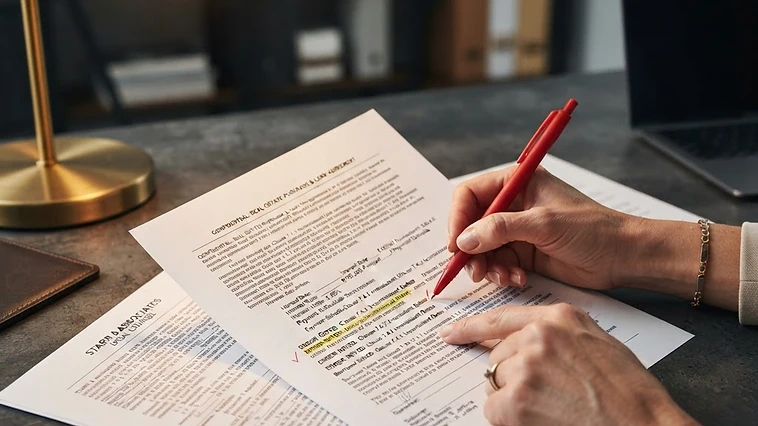 Homeowner conducting a mortgage document review on a dark desk to spot loan document errors.

3. Artificial Intelligence and Fabricated Documents As technology advances, so do the tools available to bad actors. Recent federal court cases have highlighted the growing risk of AI-generated fake documents in mortgage applications. While this often involves borrowers fabricating income, it also opens the door for sophisticated identity theft where criminals use fabricated documents to take out fraudulent loans or unauthorized refinances against a legitimate homeowner's property.
How Mortgage Fraud Impacts Current Homeowners
You might be wondering: "If I pay my mortgage on time, how does mortgage fraud affect me?" The answer lies in the integrity of your property's title and your legal liability.
Consider a scenario where a criminal uses stolen identity information and fabricated documents to execute a fraudulent refinance on your home. The bank lends money to the criminals under your name, and the criminals vanish with the cash. You are left with a massive, unauthorized lien on your property. Even if you can eventually prove the fraud, unraveling identity theft and clearing a fraudulent mortgage from your title takes immense time, effort, and legal expense. The ALTA study noted that defending a fraud or forgery claim in a refinance transaction now averages nearly $70,000 in legal costs.
Furthermore, if your original loan documents contain fatal errors—such as a missing promissory note or a defective deed of trust—you may face significant hurdles if you ever need to sell the property, refinance with a different lender, or pass the home on to your heirs. Title companies are becoming increasingly strict about insuring properties with clouded titles, and a routine refinance paperwork check could suddenly turn into a legal nightmare if historical defects are discovered at the closing table.
The Importance of a Proactive Mortgage Audit
Waiting until you are at the closing table to review your refinance paperwork is a recipe for disaster. By the time you are handed a stack of documents to sign, the pressure is on, and it is nearly impossible to conduct a thorough review of the fine print.
Instead, homeowners should conduct a comprehensive mortgage audit well before applying for a refinance. This involves requesting your complete loan file from your current servicer—including the original promissory note, the deed of trust or mortgage, all assignments, and a complete payment history.
By reviewing these documents carefully, you can verify that your payments have been applied correctly, that your interest rate and escrow calculations match your original agreement, and that the legal chain of title is intact. If you spot discrepancies, you have the time and leverage to demand corrections from your servicer before you enter into a new financial agreement.
Why Auditing Your Mortgage Paperwork Matters
Even if you have never missed a payment and have excellent credit, the accuracy of your mortgage documents is the foundation of your homeownership. The recent surge in refinance fraud, forgery claims, and servicing errors proves that you cannot blindly trust lenders and servicers to maintain your file perfectly. You must be your own advocate.
Auditing your mortgage paperwork matters because it protects your most valuable asset from hidden liabilities, title defects, and outright fraud. Whether you are preparing to refinance, planning to sell, or simply want peace of mind, knowing exactly what is in your loan file is empowering.
This is exactly why the Foreclosure Defense Survival Playbook is an essential resource for every homeowner, not just those facing financial distress. Across its 530 pages, the Playbook provides a deep, educational dive into how the mortgage industry actually works. It teaches you how to read complex mortgage documents, how to spot the telltale signs of loan document errors and robo-signing, and how to organize your evidence like a professional.
Don't wait for a servicing error to inflate your balance or a hidden title defect to ruin your refinance. Equip yourself with the knowledge to audit your own loan file today. Order the Foreclosure Defense Survival Playbook and take control of your mortgage paperwork before you sign on the dotted line.


Order The Playbook
Get the Foreclosure Defense Survival Playbook
530 pages of structured, educational guidance covering mortgage documents, foreclosure procedures, evidence organization, and legal research — the same foundation this article draws from.