Homeowner Education
The Hidden Risks in Your Refinance Paperwork: Why Every Homeowner Needs a Mortgage Document Review
Recent industry data reveals that nearly half of all mortgage files contain document errors or fraud vulnerabilities. Even if you are current on your payments, auditing your loan documents before refinancing is critical to protecting your home's equity.
Disclaimer: The following article is for educational purposes only and does not constitute legal advice. Always consult with a qualified attorney regarding your specific legal situation.
You pay your mortgage on time every single month. You have excellent credit, substantial equity in your home, and you are currently considering a refinance to secure a better rate or tap into your home's value. Because you have never missed a payment, you likely assume that your mortgage paperwork is flawless. Unfortunately, recent industry data reveals a shocking and uncomfortable truth: the mortgage industry is plagued by systemic document errors, missing information, and hidden fraud vulnerabilities.
When a homeowner is current on their payments, they rarely have a reason to scrutinize their original loan documents. The monthly statements arrive, the payments are made, and the escrow account is managed. But what happens behind the scenes in the secondary mortgage market—where loans are bought, sold, and transferred between servicers—is often a chaotic mess of missing assignments, defective titles, and regulatory violations.
Before you sign a massive stack of new refinance paperwork, it is absolutely critical to conduct a thorough mortgage document review of your current loan. Failing to do so could mean carrying over hidden defects into your new loan, falling victim to predatory refinance schemes, or unknowingly waiving your rights to challenge past mortgage fraud.
The Shocking Statistics Behind Loan Document Errors
If you think loan document errors are a rare occurrence, recent reporting paints a very different picture. According to recent data from National Mortgage News, mortgage fraud vulnerabilities and document defects were found in nearly 43.7% of reviewed real estate transactions in the first quarter of the year. Even more alarming, the growth rate in errors of any kind increased by 26% year-over-year across the country.
These are not simple typographical errors. The defects discovered in these audits primarily involve critical borrower data, vesting information, titleholder details, and property identifiers. In nearly 43.5% of transactions reviewed, discrepancies were found in Closing Protection Letters (CPLs). A CPL is a vital document that protects the lender and borrower against misconduct or fraud by the closing agent. When CPL discrepancies exist, it opens the door to wire fraud, misappropriation of funds, and unrecorded liens.
Furthermore, transaction participant licensing irregularities—such as credential mismatches, expired licenses, and inconsistent insurance records—were found in numerous files. What does this mean for the average homeowner? It means that the professionals who handled your original closing, notarized your documents, and recorded your deed may not have been legally authorized to do so, potentially rendering parts of your mortgage paperwork legally defective.
How Mortgage Fraud and Defects Hide in Plain Sight
Mortgage fraud is often associated with borrowers lying on their applications (so-called "liar loans"), but a significant portion of mortgage fraud is perpetrated by institutions, brokers, and closing agents. Because the residential mortgage lending industry relies on highly patterned, uniform transactions, very few people actually read the hundreds of pages of documents at the closing table. This lack of due diligence makes it incredibly easy for false documents, inflated fees, or improper assignments to be interjected into the transaction.
For a homeowner who is current on their payments, these defects hide in plain sight. You will not notice a break in your chain of title or a forged endorsement on your promissory note as long as you are simply paying the servicer who sends you a monthly statement.
However, these hidden defects become massive liabilities during a trigger event—such as a refinance, a property sale, or an unexpected financial hardship that leads to default. If your original mortgage contains notary irregularities, such as a signature that was robo-signed or notarized by someone who was not physically present, the legal validity of the lien on your property could be questionable. If you blindly refinance, you are essentially using a new loan to pay off an old loan that the current "lender" may not have even had the legal standing to enforce.
The Dangers of Refinancing Flawed Mortgage Documents
Refinancing is often marketed as a simple, straightforward financial maneuver. In reality, it is a complex legal transaction where a completely new loan is originated to satisfy and extinguish the old one. The American Land Title Association (ALTA) has recently highlighted that mortgage refinances carry significant fraud risks, particularly concerning deed forgery and seller impersonation.
When you refinance, you are required to sign a new promissory note and a new security instrument (a mortgage or deed of trust). If your current loan has a clouded title, unrecorded assignments, or Mortgage Electronic Registration Systems (MERS) irregularities, the new title company will have to clear these hurdles before issuing a new title policy.
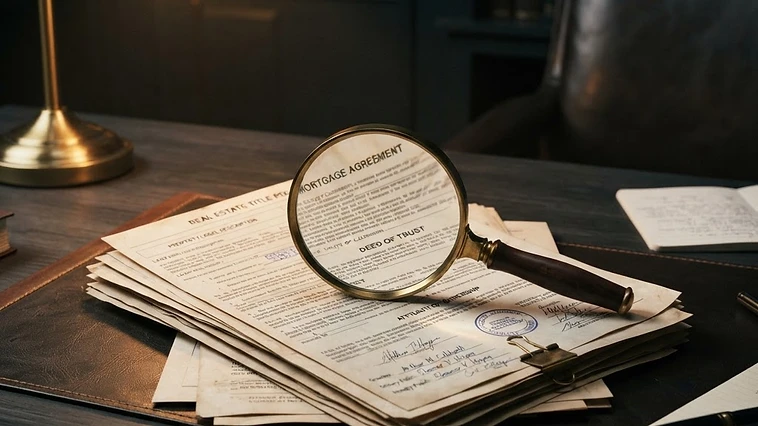
 Close-up of hands reviewing a mortgage promissory note and notary stamp under a warm gold desk lamp.
In some cases, predatory lenders use the refinance process to "cure" their own defective paperwork. If a lender knows that your original loan documents are riddled with compliance violations—such as violations of the TILA-RESPA Integrated Disclosures (TRID) rules—they may aggressively push you to refinance. By getting you to sign new refinance paperwork, they effectively wipe the slate clean, burying their past legal liabilities while locking you into a new loan that may contain hidden fees, inflated appraisal values, or unfavorable terms.
This is why a proactive mortgage audit is your best defense. You must know exactly what is in your current collateral file before you agree to replace it.
Conducting a Proactive Mortgage Audit: What to Look For
A mortgage audit is a forensic, line-by-line review of your loan file to identify regulatory violations, document defects, and signs of mortgage fraud. Even if you are not facing foreclosure, conducting a mortgage document review empowers you to understand exactly who owns your loan and whether your property rights have been compromised.
When auditing your mortgage paperwork, there are several critical areas to investigate:
-
The Promissory Note and Endorsements: The promissory note is the actual IOU. When loans are sold in the secondary market, the note must be properly endorsed (signed over) to the new owner, much like a check. In many cases, these endorsements are missing, undated, or stamped by known robo-signers. If the entity claiming to own your loan does not have a properly endorsed note, they may lack the legal standing to collect your debt.
-
The Chain of Assignments and MERS: The mortgage or deed of trust is the document that gives the lender the right to foreclose if you don't pay. When a loan is sold, an Assignment of Mortgage must be recorded in your local county land records. During the housing boom, the industry created MERS to bypass county recording fees, leading to a convoluted mess of untracked loan transfers. You must verify that every assignment in your chain of title is accurate, properly notarized, and recorded by individuals with the actual authority to do so.
-
TRID and Closing Disclosures: The Consumer Financial Protection Bureau (CFPB) strictly regulates how fees and closing costs are disclosed to borrowers. A thorough audit of your original Closing Disclosure can reveal illegal kickbacks, unearned fees, or yield spread premiums that violated federal law.
-
Notary and Signature Irregularities: Examine the notary stamps on your recorded documents. Are the dates correct? Was the notary commission actually valid on the date of signing? In many documented cases of mortgage fraud, documents were notarized days or weeks after the borrower actually signed them, or by notaries who were located in entirely different states.
Servicing Disclosures and the Threat of Predatory Refinance
Mortgage servicers are the companies that collect your monthly payments, manage your escrow account, and handle customer service. They are heavily regulated by the CFPB under the Real Estate Settlement Procedures Act (RESPA). However, servicing errors are rampant.
Servicers frequently misapply payments, fail to pay property taxes from escrow accounts on time, or charge unauthorized property inspection fees. If you are considering a refinance because your current servicer has mismanaged your escrow account and artificially inflated your monthly payment, you might be falling into a trap.
Predatory lenders often target homeowners with equity who are frustrated by servicing errors. They offer a "solution" in the form of a refinance, but the new loan often comes with exorbitant origination fees, prepayment penalties, or terms that strip the equity right out of your home. By conducting a mortgage document review, you can identify if your current servicer has violated RESPA rules. Instead of refinancing to escape a bad servicer, you may have the legal grounds to demand a correction, a refund, or even damages.
Why Auditing Your Mortgage Paperwork Matters
Many homeowners mistakenly believe that auditing mortgage documents is only for people who have fallen behind on their payments and are trying to fight off a foreclosure. This could not be further from the truth. Auditing your mortgage paperwork matters because your home is likely your most valuable financial asset. Allowing defective documents, unrecorded liens, or institutional fraud to sit unchallenged in your property's history is a massive financial risk.
Before you sign any new refinance paperwork, you must verify that the foundation of your current loan is legally sound. You need to know how to request your complete collateral file, how to read a title policy, and how to spot the subtle signs of notary fraud, missing endorsements, and TRID violations.
This is exactly why the "Foreclosure Defense Survival Playbook" is an essential resource for every homeowner, not just those in distress. This comprehensive, 530-page educational book teaches you step-by-step how to understand complex mortgage documents, organize your evidence, and conduct a professional-level mortgage audit on your own loan file. It demystifies the confusing world of MERS, securitization, and servicing disclosures, giving you the knowledge you need to protect your equity. Don't wait until you are at the closing table for a refinance—or worse, facing an unexpected financial crisis—to find out your loan documents are defective. Order the Playbook today and take control of your mortgage paperwork.


Order The Playbook
Get the Foreclosure Defense Survival Playbook
530 pages of structured, educational guidance covering mortgage documents, foreclosure procedures, evidence organization, and legal research — the same foundation this article draws from.