Mortgage Documents
The Hidden Risks in Your Refinance Paperwork: How AI and Mortgage Fraud Impact Current Homeowners
Recent federal fraud cases reveal how easily fake documents slip past lenders, making a personal mortgage audit essential for current homeowners before refinancing.

Disclaimer: The information provided in this article is for educational purposes only and does not constitute legal advice. Always consult with a qualified attorney regarding your specific legal situation.
When you pay your mortgage on time every month, it is easy to assume that your lender's paperwork is perfectly in order. You receive your monthly statements, you make your payments, and your escrow account handles the taxes and insurance. However, recent federal enforcement actions and court cases have exposed a deeply unsettling reality about the banking industry: lenders and servicers are routinely failing to catch blatant errors, and in some cases, outright mortgage fraud.
If you are a current homeowner considering a refinance, or if you simply want to ensure that your largest financial asset is protected, you cannot afford to blindly trust the documents your bank has on file. A comprehensive mortgage document review is not just for homeowners facing default; it is a critical protective measure for anyone holding a mortgage today.
The New Era of Mortgage Fraud and AI
In late July 2026, a major mortgage fraud case highlighted just how vulnerable the lending industry's document verification processes have become. According to reports from National Mortgage News, a Florida woman named Kimberly Williams pleaded guilty to conspiracy to commit bank fraud. The case revealed that fraudsters were using advanced artificial intelligence and digital manipulation to fabricate pay stubs and employment records for borrowers who otherwise would not have qualified for their loans.
What is most alarming about this case is not just that the fraud occurred, but that the lenders completely failed to catch it. The fabricated documents, which listed nonexistent wages from legitimate businesses like a New York restaurant and a Florida auto repair firm, sailed through the underwriting departments of multiple mortgage banks. These fraudulent loans were then successfully guaranteed by Fannie Mae, Freddie Mac, and the Federal Housing Administration (FHA).
If major financial institutions and government-backed agencies cannot detect AI-generated fake documents and blatant mortgage fraud during the origination process, how confident are you that they have maintained accurate, error-free records of your legitimate loan? The banking industry's reliance on automated systems and rapid processing has created an environment where loan document errors are not just possible—they are probable.
Why Current Homeowners Need a Mortgage Document Review
Many homeowners believe that as long as they are current on their payments, the accuracy of their mortgage paperwork does not matter. This is a dangerous misconception. When you decide to refinance your home, you are essentially paying off your old loan and entering into a new contract. If your original loan documents contain errors, illegal fees, or evidence of predatory lending, refinancing without conducting a mortgage audit means you are permanently burying those violations and waiving your right to hold the lender accountable.
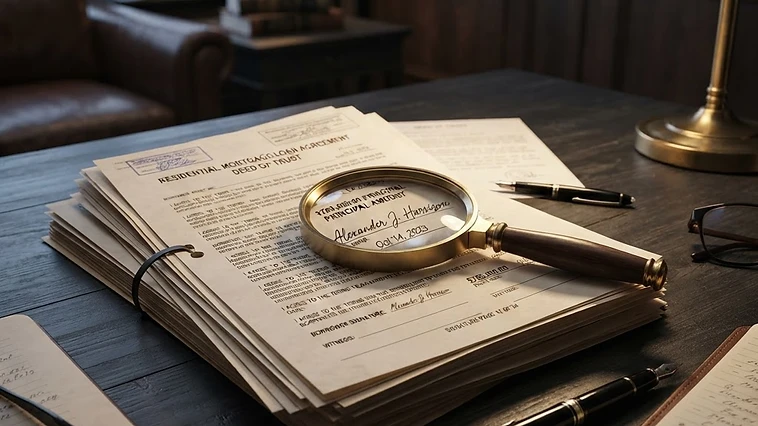
 A forensic view of mortgage documents and a laptop on a dark charcoal desk, representing a homeowner conducting a mortgage audit.
A thorough mortgage document review allows you to verify that your current lender actually holds the legal right to your debt. During the housing boom and subsequent crashes, millions of mortgages were bundled, securitized, and sold multiple times. In the rush to transfer these assets, banks frequently lost the original promissory notes, forged signatures (a practice known as robo-signing), and failed to properly record assignments of the deed of trust in local county records.
Even if you are not behind on payments, discovering these chain-of-title defects gives you immense leverage. It ensures that when you do refinance, you are paying off the correct entity, and it protects you from future claims by third-party debt buyers who might suddenly appear claiming they own your loan.
Common Loan Document Errors Hiding in Plain Sight
When you sit down to review your refinance paperwork or your original loan file, you are looking for specific discrepancies that indicate systemic failures by your lender or servicer. Some of the most common loan document errors include:
-
Unrecorded or Fraudulent Assignments: The Mortgage Electronic Registration Systems (MERS) was created by the banking industry to bypass county recording fees when transferring mortgages. However, MERS has been at the center of countless legal battles regarding its authority to assign mortgages. If your loan involves MERS, there is a high probability that the chain of title is clouded.
-
Notary and Signature Irregularities: Look closely at the signatures on your deed of trust and any subsequent assignments. Are the dates consistent? Was the document notarized in a state where the signer did not reside? Robo-signing—where bank employees sign thousands of documents a day without verifying their contents—remains a pervasive issue that invalidates the legal standing of the paperwork.
-
Servicing Disclosure Issues: Under the Real Estate Settlement Procedures Act (RESPA) and the Truth in Lending Act (TILA), your servicer is required to provide accurate and timely disclosures regarding your escrow account, interest rate adjustments, and fee assessments. A careful mortgage audit often reveals that servicers have been quietly siphoning money through unauthorized property inspection fees, inflated force-placed insurance premiums, or miscalculated escrow requirements.
The Dangers of Predatory Refinance and Title Defects
Refinancing is heavily marketed as a way to save money, lower your interest rate, or tap into your home's equity. However, the refinance process itself is a prime opportunity for lenders to engage in predatory practices. A predatory refinance often involves stripping the homeowner's equity through exorbitant closing costs, hidden junk fees, and complex loan terms that are not clearly explained.
Before you sign a new stack of refinance paperwork, you must understand exactly what you are agreeing to. Are you rolling over hidden fees from your previous servicer into your new principal balance? Are you inadvertently curing a title defect that the bank created years ago, thereby saving the bank from a massive legal liability at your own expense?
By conducting a mortgage document review before you refinance, you force the current lender to prove their standing and justify every penny they claim you owe. If you uncover evidence of past mortgage fraud or RESPA violations, you may be entitled to financial compensation, a reduction in your principal balance, or even the complete rescission of the loan under TILA.
How to Conduct a Basic Mortgage Audit on Your Own Files
Taking control of your financial security begins with gathering your evidence. You do not need to be a lawyer to start auditing your own mortgage file. The first step is to send a Qualified Written Request (QWR) or a Request for Information (RFI) to your current mortgage servicer. Under federal law, the servicer must respond to these requests and provide you with a complete copy of your collateral file, including the original promissory note, the deed of trust, all assignments, and a comprehensive payment history.
Once you receive these documents, compare them against the records held by your local county recorder's office. Does the bank's version of the assignment match the one filed with the county? Are there unexplained gaps in the chain of title? Calculate your payment history to ensure that every dollar you sent was properly credited to your principal and interest, rather than being diverted to mysterious corporate advance fees.
This level of scrutiny is exactly what the banking industry hopes you will never apply. They rely on the fact that most homeowners find mortgage paperwork intimidating and confusing. But with the right education and a systematic approach, you can decode these documents and protect your home from hidden fraud.
Why Auditing Your Mortgage Paperwork Matters
Even if you have never missed a payment and have a perfect credit score, the integrity of your mortgage documents is the only thing standing between you and potential financial disaster. The recent cases of AI-generated mortgage fraud prove that the banking system's safeguards are fundamentally broken. Lenders are processing loans with fabricated documents, losing critical paperwork, and relying on automated systems that prioritize speed over accuracy.
Auditing your mortgage paperwork matters because it is the only way to ensure that you are not paying for the bank's mistakes. Whether you are preparing to sign new refinance paperwork or simply want peace of mind, a thorough mortgage audit empowers you to hold your lender accountable.
This is exactly why the Foreclosure Defense Survival Playbook is an indispensable resource for every homeowner, not just those facing default. This comprehensive 530-page guide demystifies the complex world of mortgage documents, teaching you step-by-step how to spot fraud, identify loan document errors, and uncover the hidden defects that lenders pray you never find. By investing in the Playbook, you gain the forensic knowledge needed to audit your own files, protect your equity, and ensure that your home remains truly yours. Do not wait until you are at the closing table for a refinance to discover that your loan is built on a foundation of errors—order the Foreclosure Defense Survival Playbook today and take control of your mortgage.


Order The Playbook
Get the Foreclosure Defense Survival Playbook
530 pages of structured, educational guidance covering mortgage documents, foreclosure procedures, evidence organization, and legal research — the same foundation this article draws from.