Mortgage Documents
The Hidden Risks in Your Refinance: Why Every Homeowner Needs a Mortgage Document Review
Recent reports show a massive spike in refinance fraud and AI-generated fake documents. Learn why auditing your mortgage paperwork is essential even if you are current on your payments.
Disclaimer: The following article is for educational purposes only and does not constitute legal advice. If you require legal assistance, please consult a qualified attorney in your jurisdiction.
When you pay your mortgage on time every month, it is easy to assume that your lender and loan servicer are handling your account with the utmost accuracy. You receive your monthly statement, you make your payment, and your balance slowly decreases. For many homeowners, this seamless monthly transaction creates a false sense of security. However, recent industry reports and enforcement actions reveal a troubling reality: the mortgage industry is rife with loan document errors, title defects, and sophisticated mortgage fraud.
Even if you are completely current on your payments, you could be sitting on a ticking time bomb of defective paperwork. If you are considering refinancing your home, selling your property, or simply want to ensure that your largest financial asset is secure, conducting a thorough mortgage document review is no longer optional—it is a necessity.
The Alarming Surge in Refinance Fraud and Forgery
Many homeowners believe that fraud only happens to distressed borrowers facing foreclosure. Unfortunately, this is a dangerous misconception. According to a recent study commissioned by the American Land Title Association (ALTA) and conducted by Milliman Inc., fraud and forgery claims tied to mortgage refinances have skyrocketed. In fact, these claims now represent over 40% of all title insurer losses and expenses Refinance fraud and forgery claims soar, driving up title insurance losses.
The financial impact of these hidden defects is staggering. The average cost of fraud and forgery claims on refinances has climbed to $207,000, which is nearly seven times higher than other types of claims. What makes this trend so dangerous for the average homeowner is that these issues often cannot be detected through a simple public records search. Fraudsters and negligent institutions are exploiting the digital closing process, leading to a rise in false notary signatures, unauthorized assignments, and predatory refinance schemes.
When you sit down to sign your refinance paperwork, you are trusting that the chain of title is clear and that the entity claiming to own your loan actually has the legal right to do so. But if your original mortgage documents contain forged signatures, missing endorsements, or improper assignments, your new refinance could be built on a foundation of sand. This is why a proactive mortgage audit is critical before you sign any new contracts.
How Artificial Intelligence is Fueling Fake Documents
The digital age has brought convenience to the mortgage industry, but it has also introduced unprecedented risks. Recent reporting highlights how the rise of artificial intelligence has made it easier than ever for bad actors to create highly convincing, fraudulent documents Mortgage fraud case shows AI's fake-document risk.
In the past, spotting a fake document might have been as simple as noticing a misaligned signature or a poorly photocopied notary stamp. Today, AI tools can generate flawless counterfeit documents, including fake income verification, fabricated property appraisals, and even fraudulent mortgage assignments. While much of this technology is used by third-party scammers, the sheer volume of fake documents entering the financial system means that your loan file could easily become contaminated without your knowledge.
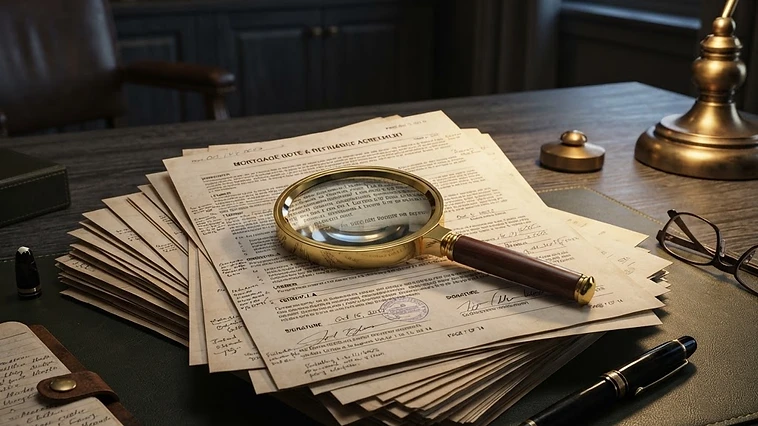
 Homeowner conducting a mortgage document review on a dark desk

For a homeowner who is current on their payments, the risk lies in the secondary mortgage market. Your loan is likely sold and transferred multiple times between different trusts, aggregators, and servicers. Every time your loan changes hands, new documents are generated and recorded. If an AI-generated fake document or a robo-signed assignment is inserted into your chain of title to cover up a missing piece of paperwork, your legal ownership of the property could be clouded. A comprehensive mortgage document review is the only way to trace the history of your loan and verify that every transfer was executed legally and accurately.
Common Loan Document Errors Hiding in Plain Sight
Beyond intentional mortgage fraud, the sheer incompetence of some loan servicers can put your property at risk. Consumer protection agencies, including the Consumer Financial Protection Bureau (CFPB), have recently directed examiners to heavily scrutinize mortgage servicers for Unfair, Deceptive, or Abusive Acts or Practices (UDAAP) 3 Common Mortgage Loan Servicing Errors You Can Avoid.
Even if you have never missed a payment, your servicer might be making critical errors behind the scenes. Common loan document errors include:
- Misapplied Payments: Your servicer may be placing your principal and interest payments into a suspense account rather than applying them to your balance, artificially inflating the amount of interest you owe.
- Escrow Miscalculations: Servicers frequently miscalculate property tax and insurance escrow requirements, leading to unjustified increases in your monthly payment.
- Improper MERS Registrations: The Mortgage Electronic Registration Systems (MERS) is used to track the ownership of mortgages. However, data entry errors within MERS can result in the wrong entity claiming ownership of your loan.
- Missing Promissory Notes: The most fundamental rule of mortgage law is that the entity collecting your payments must have the legal right to enforce the promissory note. In many cases, the original note has been lost, destroyed, or improperly endorsed.
If you attempt to refinance your home while these errors exist in your file, you could end up paying thousands of dollars in phantom fees, or worse, you could face legal hurdles in clearing your title. Conducting a mortgage audit allows you to identify these discrepancies and force your servicer to correct them before they derail your financial plans.
The Danger of Predatory Refinance Schemes
When interest rates fluctuate, homeowners are bombarded with offers to refinance. While refinancing can be a smart financial move, it is also a prime opportunity for predatory lenders to strike. Predatory refinance schemes often target homeowners who have substantial equity in their properties and a perfect payment history.
These schemes typically involve burying hidden fees, exorbitant closing costs, and unfavorable terms deep within the refinance paperwork. A lender might promise a lower interest rate, but offset that savings by charging massive origination fees or rolling unnecessary insurance products into the loan balance. Furthermore, if your original mortgage documents contained errors or title defects, a predatory lender might use the refinance process to "cure" those defects, effectively stripping you of your legal rights to challenge the original fraud.
Before you agree to any new loan terms, you must review your existing mortgage documents. Understanding exactly what you currently owe, who legally owns your loan, and whether your title is clear will empower you to negotiate from a position of strength. Do not let a lender rush you through the closing process. Take the time to scrutinize every page of your refinance paperwork.
Why Auditing Your Mortgage Paperwork Matters
It is a common misconception that you only need to worry about your mortgage documents if you are facing foreclosure. The truth is, even current, on-time homeowners must audit their mortgage paperwork before refinancing, selling, or facing a potential future default. The recent surge in refinance fraud, AI-generated fake documents, and rampant servicing errors proves that you cannot blindly trust the financial institutions handling your loan.
By conducting a thorough mortgage document review, you are taking control of your financial future. You can uncover hidden fees, expose fraudulent assignments, and ensure that your chain of title is pristine. But knowing what to look for in a stack of complex legal documents can be overwhelming.
This is exactly why the "Foreclosure Defense Survival Playbook" is an indispensable resource for every homeowner. Across its 530 pages, the Playbook breaks down the complex world of mortgage documents into plain, easy-to-understand language. It teaches you step-by-step how to perform your own mortgage audit, how to spot the telltale signs of robo-signing and forgery, and how to organize your evidence to hold your lender accountable. Whether you are preparing to refinance or simply want the peace of mind that your home is truly secure, the Playbook gives you the knowledge and tools you need to protect your most valuable asset. Don't wait until a hidden error threatens your home—order the Foreclosure Defense Survival Playbook today and start auditing your mortgage paperwork with confidence.


Order The Playbook
Get the Foreclosure Defense Survival Playbook
530 pages of structured, educational guidance covering mortgage documents, foreclosure procedures, evidence organization, and legal research — the same foundation this article draws from.