Mortgage Documents
The Hidden Risks in Your Refinance: Why Every Homeowner Needs a Mortgage Document Review
Recent data shows a sharp rise in mortgage document defects and compliance errors. Learn why auditing your loan paperwork is crucial before you refinance.
Disclaimer: The information provided in this article is for educational purposes only and does not constitute legal advice. Always consult with a qualified attorney regarding your specific legal and financial situation.
If you are a homeowner who pays your mortgage on time every month, you might assume that your loan file is in perfect order. When interest rates drop and the opportunity to lower your monthly payment arises, the natural next step is to gather your income statements and apply for a new loan. However, recent industry data and enforcement actions reveal a troubling reality: the banking and servicing industry is currently experiencing a massive spike in loan document errors, compliance failures, and sophisticated mortgage fraud.
Before you sign a new stack of refinance paperwork, it is absolutely critical to conduct a thorough mortgage document review of your existing file. Even if you are perfectly current on your payments, hidden defects in your original loan documents, improper assignments, or fraudulent title transfers could severely complicate your refinance, cloud your property's title, or leave you vulnerable to predatory servicing practices down the road.
The Alarming Rise in Loan Document Errors and Defects
When you sit down at the closing table, you trust that the lender, the title company, and the notary have executed their duties flawlessly. Unfortunately, statistical data proves that this is often not the case. According to a recent August 2026 report from ACES Quality Management & Control, the mortgage industry's critical defect rate has risen sharply to 1.71% in the first quarter of the year.
What exactly is driving this surge in defective loans? The data shows that legal, regulatory, and compliance defects accounted for a staggering 26.02% of all findings. Furthermore, as mortgage rates dipped and homeowners rushed to lower their payments, the share of reviews involving refinances increased significantly. In fact, refinance defects jumped to 38.57% of all defects recorded.
For the everyday homeowner, these are not just abstract statistics. A "critical defect" in the banking world often translates to missing signatures, improper disclosures, miscalculated loan terms, or legally unenforceable contracts. If your current mortgage contains these loan document errors, rolling them over into a new loan without addressing them can perpetuate a clouded title. A comprehensive mortgage audit is the only way to ensure that the foundation of your homeownership is legally sound before you enter into a new financial agreement.
AI, Deepfakes, and the New Era of Mortgage Fraud
In the past, mortgage fraud typically involved forged physical signatures or altered W-2 forms. Today, the landscape of financial crime has evolved into a highly sophisticated, technology-driven enterprise. Recent reporting from July 2026 highlights how the rise of artificial intelligence has made it exponentially easier for bad actors to create false documents, leading to a surge in deepfake fraud as a headline mortgage risk.
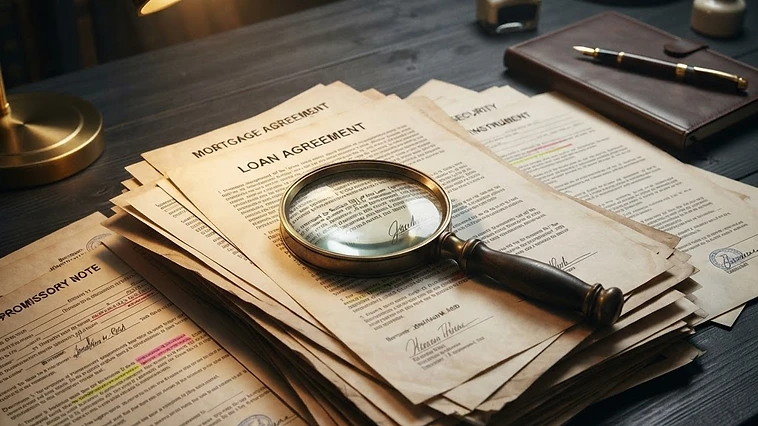
 Hands reviewing mortgage refinance paperwork with a gold pen on a dark desk.

Industry analysts note a "meaningful" shift in fraud tactics, with seller impersonation fraud more than doubling since 2024. In these scenarios, fraudsters use advanced technology to impersonate property owners, forging warranty or quitclaim deeds to illegally transfer property titles without the true owner's knowledge.
Furthermore, compliance-related issues around documentation are spiking. In recent quarters, closing protection letter discrepancies accounted for nearly 47.5% of title and wire fraud risk defects. If you are preparing your refinance paperwork, you cannot simply assume that the title search conducted by the bank's chosen vendor will catch these sophisticated anomalies. Conducting your own mortgage document review allows you to verify that no fraudulent liens, unauthorized deed transfers, or synthetic identity attachments have been quietly recorded against your property.
Appraisal Scams and Title Defects Hiding in Plain Sight
Beyond the paperwork you sign, the third-party services attached to your mortgage are also ripe for abuse. A glaring example of this occurred recently when a massive appraisal scam led to $65 million worth of defective loans. In this case, an appraiser took another individual's identity and claimed to conduct on-site inspection reports while actually being based abroad.
When appraisals are fabricated or inflated, it directly impacts your loan-to-value ratio, potentially forcing you to pay unnecessary private mortgage insurance (PMI) or trapping you in a predatory refinance structure. If your home's value was artificially manipulated during your original purchase or a previous refinance, you might be carrying a toxic loan without even realizing it.
Title defects are equally insidious. When loans are bought and sold on the secondary market, the accompanying paperwork must be meticulously recorded. However, the rush to securitize mortgages often leads to broken chains of title, missing promissory notes, and improper use of the Mortgage Electronic Registration Systems (MERS). If your mortgage was transferred multiple times, there is a high probability that the assignments were either recorded out of sequence, signed by known "robo-signers," or never legally executed at all. A thorough mortgage audit will trace the lineage of your loan to ensure that the entity claiming to hold your mortgage actually has the legal standing to demand payment or authorize a payoff for your refinance.
Navigating Servicing Disclosures and Notary Irregularities
Even if your original origination documents were pristine, the ongoing servicing of your loan introduces a myriad of opportunities for compliance failures. The Consumer Financial Protection Bureau (CFPB) maintains strict rules regarding mortgage servicing transfers, error resolution procedures, and loss mitigation disclosures.
When you request a payoff statement to complete your refinance paperwork, you may discover unexplained fees, corporate advances, or misapplied payments that have artificially inflated your principal balance. Servicers are legally required to provide accurate information and respond to notices of error within specific timeframes. However, if you do not know how to read your loan ledger or audit your payment history, you could end up rolling thousands of dollars in phantom fees into your new 30-year mortgage.
Additionally, notary irregularities remain a persistent issue in mortgage documentation. Documents that require notarization—such as the mortgage or deed of trust—must be signed in the physical or legally authorized digital presence of the notary. Yet, post-closing audits frequently uncover documents that were notarized days after the borrower signed, or notarized in states where the borrower has never traveled. These irregularities can render the recording of the security instrument invalid, creating a massive legal headache that must be resolved before a clean title policy can be issued for your refinance.
Why Auditing Your Mortgage Paperwork Matters
It is a common misconception that only homeowners facing foreclosure need to worry about loan document errors or mortgage fraud. The reality is that the banking system's systemic compliance failures affect everyone. If you are a current, on-time homeowner, you have the luxury of time and stability to audit your mortgage paperwork before you are under the duress of a financial hardship or a looming refinance deadline.
By conducting a proactive mortgage document review, you take control of your largest financial asset. You ensure that your title is clear, your principal balance is accurate, and your legal rights are protected against predatory servicing practices and sophisticated fraud schemes. You wouldn't buy a used car without checking under the hood; you certainly shouldn't sign a 30-year financial contract without verifying the integrity of the paperwork.
This is exactly why the "Foreclosure Defense Survival Playbook" is an indispensable resource for every homeowner, regardless of their payment status. This comprehensive, 530-page educational book goes far beyond foreclosure defense. It is the ultimate guide to understanding complex mortgage documents, navigating the intricacies of MERS and chain of title, and organizing evidence like a seasoned investigator. The Playbook teaches you step-by-step how to spot the hidden fraud, errors, and defects in the documents your lender or servicer handed you. Don't wait until a hidden defect derails your refinance or threatens your homeownership. Order the Foreclosure Defense Survival Playbook today, audit your files, and secure your peace of mind.


Order The Playbook
Get the Foreclosure Defense Survival Playbook
530 pages of structured, educational guidance covering mortgage documents, foreclosure procedures, evidence organization, and legal research — the same foundation this article draws from.