Mortgage Documents
The Hidden Risks in Your Mortgage Paperwork: Why Current Homeowners Must Audit Before Refinancing
Even if you are current on your mortgage payments, hidden document errors, title defects, and sophisticated fraud could be lurking in your loan file.

Disclaimer: The following article is for educational purposes only and does not constitute legal advice. Always consult with a qualified attorney regarding your specific legal situation.
When you pay your mortgage on time every month, it is easy to assume that your loan file is in perfect order. You receive your monthly statements, you make your payments, and your balance slowly decreases. However, the reality of the modern mortgage industry is far more complex. Behind the scenes, loans are bought, sold, securitized, and transferred between servicers with alarming frequency. In this chaotic environment, loan document errors, missing assignments, and even outright mortgage fraud can easily slip through the cracks.
For current homeowners who are considering refinancing, reviewing their mortgage paperwork is not just a good idea—it is an absolute necessity. A thorough mortgage document review can reveal hidden title defects, forged signatures, and recording errors that could jeopardize your property rights or complicate a future refinance. In this article, we will explore recent developments in mortgage document accuracy, the rising threat of sophisticated fraud, and why every homeowner should conduct a comprehensive mortgage audit.
The Illusion of a Flawless Loan File
Many homeowners believe that because their loan was approved and closed by a reputable lender, their refinance paperwork and original loan documents must be legally sound. Unfortunately, history and recent court rulings tell a different story. The rush to close loans, especially during periods of high refinance volume, often leads to sloppy paperwork, improper notarizations, and failures to properly record documents in the county land records.
Recent reports highlight that title defects are surprisingly common. According to industry experts, errors in public records, undisclosed easements, and even forged or fraudulent documents can sabotage real estate deals and refinancing efforts Seven Title Defects That Can Sabotage Your Real Estate Deal. A missing signature from a previous owner, an unrecorded mortgage assignment, or a typo in the legal description of your property might seem like minor administrative oversights, but they can create massive legal headaches down the road.
If you are planning to refinance, the new lender will conduct a title search. If they discover loan document errors or breaks in the chain of title from your current mortgage, your refinance could be delayed or denied entirely. This is why proactive homeowners are increasingly taking matters into their own hands by auditing their files before applying for a new loan.
Recent Court Rulings and Title Defects
The legal landscape surrounding mortgage documents is constantly evolving. A recent appellate court ruling in February 2026 highlighted the complex interplay between forged deeds, title defects, and mortgage validity Court says borrowers can't void mortgage after acquiring proper title | Mortgage Professional. In this case, borrowers attempted to void their mortgage by arguing that the original deed to their property was invalid when they signed the loan documents.
While the court acknowledged that a mortgage based on a forged or fraudulent deed is normally invalid, they ruled against the borrowers based on the principle of "equitable estoppel." Because the borrowers had explicitly promised they owned the property when they signed the mortgage paperwork, accepted the loan proceeds, and later acquired valid title, they could not subsequently claim the mortgage was void.
This ruling underscores a critical point for homeowners: the representations you make in your refinance paperwork are legally binding. It also highlights the fact that title issues, forged deeds, and invalid documents can and do happen. If a lender can be caught up in litigation over a void deed, homeowners must be equally vigilant about verifying the accuracy of the documents recorded against their property.
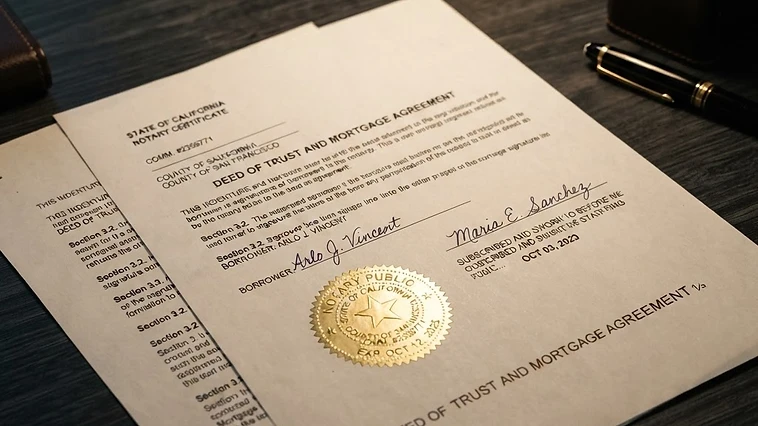 Close up of mortgage documents and a notary seal on a dark desk

The Rise of AI and Sophisticated Mortgage Fraud
While traditional loan document errors—such as missing notary stamps or incorrect dates—remain prevalent, the mortgage industry is now facing a new and highly sophisticated threat: artificial intelligence. Recent news reports have highlighted how AI is being used to generate incredibly convincing fake documents, escalating the risk of mortgage fraud Mortgage fraud case shows AI's fake-document risk.
Fraudsters can now use AI tools to create fabricated pay stubs, fake employment verifications, and even forged deeds and mortgage assignments. While much of this fraud is perpetrated by bad actors trying to obtain loans illegally, the proliferation of fake documents in the public record poses a direct threat to legitimate homeowners.
Imagine discovering that a fraudulent lien has been placed on your property, or that your mortgage was "assigned" to a phantom entity using a digitally forged signature. These scenarios are no longer confined to the realm of science fiction. As AI technology becomes more accessible, the burden falls on homeowners to regularly monitor their county land records and conduct a rigorous mortgage audit to ensure that no fraudulent documents have been attached to their title.
Common Loan Document Errors to Watch For
When conducting a mortgage document review, what exactly should you be looking for? Even if you are not a legal expert, there are several common red flags that any homeowner can spot with a careful eye:
- Breaks in the Chain of Title: If your loan was sold, there should be a clear, unbroken chain of assignments recorded in the county land records transferring the mortgage from the original lender to the current servicer. Missing assignments are a major red flag.
- Robo-Signed Documents: During the foreclosure crisis, it was revealed that banks were using "robo-signers" to mass-produce fraudulent mortgage assignments and affidavits. Look for signatures from known robo-signers or signatures that look drastically different across multiple documents.
- Notary Irregularities: Check the notary acknowledgments on your deed and mortgage. Are the dates correct? Was the notary's commission valid at the time of signing? Did the notary actually witness your signature?
- MERS Issues: If Mortgage Electronic Registration Systems (MERS) is listed as the nominee on your mortgage, ensure that any subsequent assignments out of MERS were executed by individuals who actually had the legal authority to do so.
- Inaccurate Loan Balances and Fees: Review your payment history and escrow accounts. Servicers frequently make accounting errors, applying payments incorrectly or charging unauthorized fees that artificially inflate your loan balance.
By identifying these loan document errors early, you can demand corrections from your servicer before they escalate into larger legal disputes or derail your refinance paperwork.
Why Auditing Your Mortgage Paperwork Matters
You might be thinking, "I pay my mortgage on time every month. Why should I care about a missing signature or a sloppy assignment?" The answer is simple: your home is likely your most valuable asset, and protecting your legal rights to that asset is paramount.
Even current, on-time homeowners should audit their mortgage paperwork before refinancing or facing a potential future default. If you wait until you are in financial distress to review your documents, you will be fighting an uphill battle against a well-funded bank. By conducting a mortgage audit now, from a position of strength, you can identify and resolve title defects, force your servicer to correct accounting errors, and ensure that your property rights are fully protected.
This is exactly why the Foreclosure Defense Survival Playbook is an essential resource for every homeowner, not just those facing foreclosure. This comprehensive, 530-page educational guide teaches you step-by-step how to read your mortgage documents, how to spot sophisticated fraud, and how to identify the fatal defects that lenders and servicers try to hide. Whether you are preparing to refinance, reviewing your current loan file, or simply want the peace of mind that comes with knowing your paperwork is accurate, the Playbook provides the knowledge you need to take control of your mortgage. Don't wait for a crisis to discover that your loan documents are flawed—order the Foreclosure Defense Survival Playbook today and start your mortgage document review with confidence.


Order The Playbook
Get the Foreclosure Defense Survival Playbook
530 pages of structured, educational guidance covering mortgage documents, foreclosure procedures, evidence organization, and legal research — the same foundation this article draws from.