Mortgage Documents
The Hidden Risks in Your Loan Files: Why Every Homeowner Needs a Mortgage Document Review
Recent federal crackdowns and industry reports reveal a shocking surge in mortgage document errors and refinance fraud, proving that even on-time homeowners need to audit their loan files.

Disclaimer: The following article is for educational purposes only and does not constitute legal advice. If you have specific legal questions regarding your mortgage, please consult with a qualified attorney in your jurisdiction.
You pay your mortgage on time every month. You have excellent credit, a stable income, and you are comfortably managing your household finances. Because you are not facing default or foreclosure, you might assume that your mortgage paperwork is perfectly accurate and legally sound. Unfortunately, recent industry data and federal enforcement actions reveal a much darker reality about the state of residential lending.
Behind the scenes of the American housing market, a quiet crisis of loan document errors, predatory refinance schemes, and mortgage fraud is unfolding. Whether you are currently refinancing your home, reviewing your existing mortgage paperwork, or simply organizing your financial records, you cannot afford to blindly trust the documents handed to you by a lender, broker, or servicer.
Even if you are current on your payments, hidden defects in your loan file—ranging from forged signatures and faulty assignments to miscalculated assets and title defects—can jeopardize your property rights, inflate your costs, and complicate future transactions. In this comprehensive guide, we will explore the latest developments in mortgage fraud and explain why conducting a thorough mortgage document review is an essential step for every homeowner.
The Alarming Surge in Loan Document Errors
When interest rates fluctuate, the mortgage industry often experiences a sudden influx of refinance applications. Lenders and brokers, eager to capitalize on the volume, frequently push loans through the underwriting process at breakneck speed. This rush inevitably leads to a breakdown in quality control and a spike in loan document errors.
Recent industry reports highlight just how severe this problem has become. According to a recent analysis of mortgage quality control trends, the industry's critical defect rate jumped by 23.9% in the first quarter of 2026, reaching 1.71%—the largest quarterly increase in four years Brief Refinance Shift Tests Mortgage Lenders’ Compliance Controls – NMP. Even more concerning for current homeowners is that refinance loans produced a disproportionate share of these issues, accounting for 38.57% of all critical defects.
What exactly constitutes a "critical defect"? These are not mere typos. They are substantial errors that affect the legal enforceability or financial accuracy of the loan. The data shows a significant shift toward compliance, documentation, and property-related categories. For example, calculation and analysis findings within the "Assets" category skyrocketed from 17.65% to 42.86% of all critical defects Brief Refinance Shift Tests Mortgage Lenders’ Compliance Controls – NMP.
This means lenders are increasingly struggling to correctly interpret financial information, properly source deposits, and accurately calculate borrower assets. Furthermore, legal defects continue to lead all defect types, pointing to ongoing, systemic lapses in how mortgage contracts are drafted, executed, and recorded Refinances lead to early-year surge in mortgage defects | National Mortgage News. If you are preparing to sign refinance paperwork, you must recognize that the institution processing your loan is statistically prone to making significant, legally binding mistakes.
Recent Mortgage Fraud Enforcement: What Homeowners Should Know
Beyond accidental loan document errors, deliberate mortgage fraud remains a persistent threat. Homeowners often assume that fraud only happens to "other people" or that it is solely a problem for the banks. However, when industry insiders fabricate documents or misrepresent loan terms, the homeowner is ultimately the one left holding a tainted title and a potentially unenforceable or predatory contract.
Federal law enforcement agencies have recently cracked down on several high-profile mortgage fraud schemes. In October 2026, the Department of Housing and Urban Development’s Office of Inspector General (HUD-OIG) announced the indictment of two Houston-area residents for a multi-year scheme involving falsified financial documents Two Charged in Mortgage Fraud Scheme Involving Falsified Financial Documents | Office of Inspector General, Department of Housing and Urban Development. The defendants allegedly submitted fraudulent loan applications supported by fabricated pay stubs, W-2 forms, and bank statements to multiple mortgage lenders, exposing the Federal Housing Administration (FHA) insurance program to nearly $5.9 million in potential losses Two charged in Houston mortgage fraud scheme targeting FHA loans | Mortgage Professional.
Similarly, in November 2026, Rocket Mortgage filed a federal lawsuit against a Virginia-based wholesale broker, alleging the broker submitted loan applications backed by documents that were "misleading, untrue, fabricated, altered and otherwise fraudulent" Rocket Mortgage sues Virginia broker over alleged loan fraud scheme | Mortgage Professional. The lawsuit claims the broker misrepresented borrower income, assets, and employment, forcing the lender to buy back the loans from third-party investors after the discrepancies were discovered.
These cases illustrate a critical point: the mortgage origination process is vulnerable to manipulation by bad actors. If a broker or loan officer is willing to alter bank statements or fabricate income to push a loan through underwriting, what other corners are they cutting? Are they properly disclosing your closing costs? Are they ensuring your title is clear? Are they legally recording your deed of trust? As a homeowner, you cannot rely on the lender's internal quality control to protect your interests. You must take proactive steps to verify the integrity of your own file.
Why a Mortgage Document Review is Crucial Before Refinancing
Refinancing your home is often presented as a simple, streamlined process—a quick way to lower your interest rate, shorten your loan term, or tap into your home equity. However, legally speaking, a refinance is the origination of an entirely new mortgage. It pays off and extinguishes your old loan and replaces it with a new promissory note and a new security instrument (mortgage or deed of trust).
Before you sign a new stack of refinance paperwork, you must conduct a thorough mortgage document review of both your existing loan and your proposed new loan. Here is why:
First, if your current mortgage contains legal defects, unrecorded assignments, or title clouds, refinancing can inadvertently sweep those issues under the rug, or worse, complicate the new title policy. For example, during the securitization boom, millions of mortgages were transferred between trusts using the Mortgage Electronic Registration Systems (MERS). These transfers often lacked proper documentation, resulting in broken chains of title. If your current loan has a defective chain of title, the entity claiming the right to be paid off in the refinance might not actually have the legal standing to release your lien.
Second, predatory refinance practices are on the rise. Unscrupulous lenders may attempt to pack your new loan with undisclosed fees, unnecessary insurance products, or unfavorable terms that strip your home equity. By performing a mortgage audit before you close, you can compare the Loan Estimate and Closing Disclosure line-by-line to ensure you are not being overcharged.
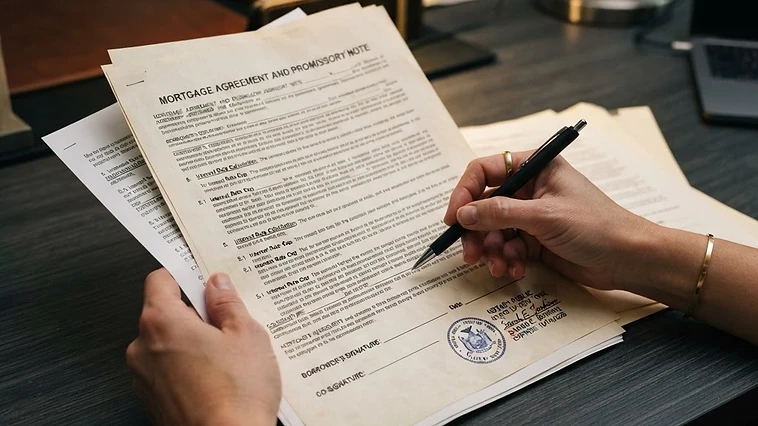 Close-up of a homeowner conducting a mortgage document review on a dark desk with warm lighting.

Third, notary and signature irregularities remain a massive problem in the industry. "Robo-signing"—the practice of mass-producing forged or fraudulently notarized mortgage documents—did not disappear after the 2010 foreclosure crisis; it simply evolved. Ensuring that your refinance paperwork is properly executed, witnessed, and notarized in your presence is vital to protecting your property rights.
How to Spot Red Flags in Your Refinance Paperwork
Conducting a personal mortgage audit requires patience, attention to detail, and an understanding of what to look for. While you may not be a forensic accountant or a lawyer, you can still identify common red flags in your loan files.
When reviewing your documents, pay close attention to the following areas:
1. The Promissory Note and Endorsements: The promissory note is the actual IOU. If your loan was sold on the secondary market, the note should contain specific endorsements (stamps) transferring the debt from one bank to another. Are these endorsements dated? Are they signed by known corporate officers? Blank endorsements or missing allonges (attachments to the note) are major red flags.
2. The Chain of Assignments: Your mortgage or deed of trust must be properly assigned in the county land records every time the loan is sold. Check your county recorder's office to ensure the chain of assignments matches the endorsements on your note. Missing assignments or assignments executed years after a trust closed are indicators of potential document fabrication.
3. Mathematical and Calculation Errors: As recent data shows, calculation errors are surging. Review your Closing Disclosure meticulously. Check the amortization schedule, the calculation of your escrow account reserves, and the application of your interest rate. Ensure that no "junk fees" have been quietly added to your principal balance.
4. Servicing Disclosures and MERS: Ensure that you have received all federally required servicing transfer notices. If MERS is listed as the nominee or beneficiary on your deed of trust, understand that MERS does not own your debt. You have the right to know the actual identity of your creditor.
Conducting a Personal Mortgage Audit
If you are a current homeowner looking to verify the accuracy of your loan, you do not necessarily need to hire an expensive forensic auditor right away. You can begin by requesting your complete collateral file from your current mortgage servicer.
Under the Real Estate Settlement Procedures Act (RESPA), you have the right to send a Qualified Written Request (QWR) or a Notice of Error (NOE) to your servicer. By sending a formal Request for Information (RFI), you can legally compel your servicer to provide you with copies of your original promissory note, deed of trust, all assignments, a complete payment history, and the identity of the master trust that currently owns your loan.
Once you receive these documents, organize them chronologically. Compare the signatures on the note to the signatures on the mortgage. Look for discrepancies in dates, notary stamps that do not match the state where the document was allegedly signed, and corporate titles that seem suspicious (e.g., a person signing as a Vice President of two different, competing banks on the same day).
By taking control of your own evidence organization and legal research, you empower yourself to spot mortgage fraud before it threatens your home. Even if you never miss a payment, knowing exactly who owns your loan and ensuring your documents are legally sound provides invaluable peace of mind.
Why Auditing Your Mortgage Paperwork Matters
It is a common misconception that only homeowners facing imminent foreclosure need to worry about loan document errors. The truth is, the integrity of your mortgage paperwork affects your financial security, your ability to sell or refinance your home, and your legal rights as a property owner. Even current, on-time homeowners must audit their mortgage paperwork before refinancing or facing a potential future default.
The banking industry has proven time and again that it prioritizes speed and profit over accuracy and legal compliance. From falsified income documents to surging critical defect rates, the risks are real and documented. You cannot afford to be passive when it comes to your largest financial asset.
This is exactly why the "Foreclosure Defense Survival Playbook" is an indispensable resource for every homeowner, not just those in distress. This comprehensive, 530-page educational book teaches you step-by-step how to understand complex mortgage documents, navigate servicing procedures, organize your evidence, and conduct your own legal research. It provides you with the knowledge to spot the exact types of fraud, errors, and defects in the documents a lender or servicer hands you.
Do not wait until a crisis strikes or a predatory refinance traps you in a bad loan. Equip yourself with the knowledge to audit your own files, protect your equity, and hold the mortgage industry accountable. Order your copy of the Foreclosure Defense Survival Playbook today and take control of your financial future.


Order The Playbook
Get the Foreclosure Defense Survival Playbook
530 pages of structured, educational guidance covering mortgage documents, foreclosure procedures, evidence organization, and legal research — the same foundation this article draws from.