Mortgage Documents
The Hidden Risks in Your Loan File: Why Every Homeowner Needs a Mortgage Document Review
Recent federal indictments reveal a surge in falsified mortgage documents. Learn why auditing your loan file is crucial, even if you are current on your payments.

Disclaimer: The following article is for educational purposes only and does not constitute legal advice. If you have specific legal questions regarding your mortgage or real estate transactions, please consult a qualified attorney in your jurisdiction.
When you pay your mortgage on time every month, it is easy to assume that your loan file is in perfect order. You receive your monthly statement, you make your payment, and your balance slowly decreases. However, recent federal enforcement actions and industry reports reveal a disturbing trend: the mortgage industry is currently battling a wave of document falsification, predatory lending practices, and sophisticated fraud. For current homeowners, this means that a comprehensive mortgage document review is no longer just for those facing foreclosure—it is a vital protective measure for anyone considering refinancing or simply wanting to ensure their property rights are secure.
In October 2026, the U.S. Department of Justice unsealed indictments against individuals in Texas for a massive mortgage fraud scheme involving falsified financial documents. According to the DOJ and the Office of Inspector General for the Department of Housing and Urban Development (HUD-OIG), industry insiders allegedly submitted fraudulent loan applications supported by fabricated pay stubs, W-2 forms, and bank statements to push loans through the system [1, 2]. While the perpetrators in these cases often target the lenders, the fallout can severely impact the homeowners whose names are attached to these manipulated files.
If you are preparing to refinance or simply organizing your financial records, you must ask yourself: Is my mortgage paperwork accurate, or are there hidden loan document errors lurking in my file?
The Rising Threat of Mortgage Fraud and Fabricated Documents
The recent indictments in the Southern District of Texas highlight a systemic vulnerability in the mortgage origination process. In this specific scheme, which ran from 2019 through 2023, defendants allegedly created false financial documents to help borrowers obtain FHA and conventional loans [1]. While some borrowers may be complicit in these schemes, many others are entirely unaware that a predatory broker or loan officer inflated their income or fabricated employment records just to close the deal and collect a commission.
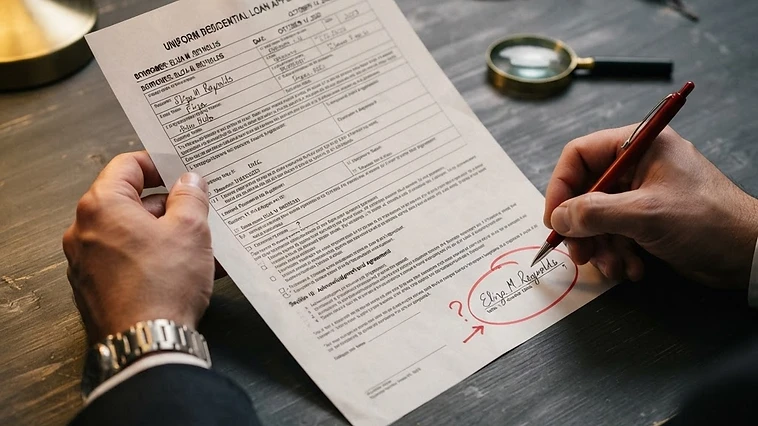 Close-up of a homeowner auditing mortgage refinance paperwork for document errors and fraud.

This type of mortgage fraud creates a ticking time bomb in your refinance paperwork. If your original loan file contains falsified documents, it can trigger severe complications down the road. For instance, if the lender later audits the file and discovers the discrepancies, they could call the loan due or flag your account for fraud, even if you have never missed a payment. Furthermore, if you attempt to refinance with a new lender, the underwriting process may uncover the historical inconsistencies, leading to a denial of your new loan application or triggering a broader investigation into your financial history.
How Artificial Intelligence is Complicating the Mortgage Audit
The threat of loan document errors and fraud is being amplified by the rapid advancement of artificial intelligence. According to recent industry reports, AI is making false financial evidence incredibly easy to produce, raising significant verification challenges for lenders and homeowners alike [5]. Fraudsters are now capable of generating hyper-realistic pay stubs, bank statements, and tax documents that can easily bypass standard underwriting scrutiny.
In a notable mortgage fraud case highlighted by National Mortgage News, conspirators used the identities of legitimate businesses to fabricate pay stubs for borrowers, reporting nonexistent wages to push loans past qualifying thresholds [9]. Because AI-generated documents often appear flawless upon initial review, these fraudulent files are successfully sold to government-sponsored enterprises like Fannie Mae and Freddie Mac.
For the everyday homeowner, this means that relying on the lender to catch errors is a dangerous gamble. Lenders process thousands of loans daily, and their primary goal is to close the transaction. A thorough mortgage audit conducted by the homeowner—or a trained professional working on their behalf—is the only way to ensure that the documents recorded against your property are authentic, accurate, and legally binding.
Spotting Red Flags in Your Refinance Paperwork
Conducting a mortgage document review requires a keen eye for detail. Even if you are current on your payments, you should periodically request a complete copy of your loan file from your servicer and review the documents recorded at your local county clerk's office. Here are the critical areas to scrutinize during your mortgage audit:
1. Income and Employment Verification
Review the original loan application (often referred to as the 1003 form) and the supporting income documents. Did the loan officer accurately state your income, or was it artificially inflated? Are the employers listed on the application correct? If you discover that a broker exaggerated your income to qualify you for a larger loan, you may be a victim of predatory lending. This is a classic form of mortgage fraud that puts the borrower at extreme risk of default if their actual income cannot support the inflated loan terms.
2. Chain of Title and Assignments
One of the most common sources of loan document errors involves the transfer of the mortgage from one lender to another. During the housing boom, mortgages were frequently bought, sold, and securitized, leading to a chaotic paper trail. Check the assignments of your mortgage recorded in the county land records. Is there a clear, unbroken chain of title from your original lender to your current servicer? Missing assignments, forged signatures (often referred to as "robo-signing"), or incorrect dates can cloud your title and make it incredibly difficult to refinance or sell your home in the future.
3. The Role of MERS
The Mortgage Electronic Registration Systems (MERS) was created by the banking industry to track assignments and servicing rights without having to record each transfer in the county land records [10]. While MERS is legal, its involvement often complicates the chain of title. If MERS is listed as the nominee or beneficiary on your deed of trust, you must ensure that any subsequent transfers or assignments executed by MERS officers are legitimate and properly authorized. Irregularities in MERS assignments are a frequent focal point in a comprehensive mortgage audit.
4. Notary and Signature Irregularities
Examine the signatures and notary stamps on your deed of trust, promissory note, and any recorded assignments. Are the signatures consistent? Were the documents notarized in the state where they were signed, and was the notary commission valid at the time? Fraudulent notarizations are a hallmark of deed fraud and title defects. If a document was notarized without your physical presence, or if the signature does not match your own, it is a massive red flag that requires immediate attention.
The Danger of Title and Deed Fraud
Beyond the origination of the loan, current homeowners must also be vigilant against title and deed fraud. As the Maryland Insurance Administration warns, deed fraud occurs when someone illegally transfers ownership of your property without your consent by forging signatures, stealing identities, or faking notarizations [8].
Criminals target properties with substantial equity, filing fraudulent quitclaim deeds to transfer the property into their own names or the names of shell companies. Once the fraudulent deed is recorded, they can take out massive loans against the property, leaving the true homeowner to deal with the financial wreckage. Regularly monitoring your property records and conducting a mortgage document review can help you catch unauthorized activity before it derails your financial stability or your plans to refinance.
Why Auditing Your Mortgage Paperwork Matters
It is a common misconception that you only need to worry about your mortgage documents if you fall behind on your payments and face foreclosure. The reality is that loan document errors, predatory lending practices, and mortgage fraud can impact any homeowner at any time. Whether you are preparing for a routine refinance, considering selling your home, or simply want peace of mind, auditing your mortgage paperwork is a critical step in protecting your most valuable asset.
Even current, on-time homeowners should audit their mortgage paperwork before refinancing or a future default. The documents a lender or servicer handed you at closing—or mailed to you years later—may contain hidden defects, forged signatures, or fabricated financial data that could jeopardize your property rights. You cannot rely on the bank to protect your interests; you must take control of your own financial security.
This is exactly why the Foreclosure Defense Survival Playbook is an indispensable resource for every homeowner. Across its 530 pages, the Playbook goes far beyond foreclosure defense. It provides a comprehensive, step-by-step education on how to read, analyze, and audit your mortgage documents. It teaches you how to spot the subtle signs of fraud, identify fatal errors in the chain of title, and organize your evidence like a seasoned investigator.
Do not wait until a refinance is denied or a legal crisis strikes to find out what is actually in your loan file. Order the Foreclosure Defense Survival Playbook today, master the art of the mortgage audit, and ensure that your home remains safely in your hands.


Order The Playbook
Get the Foreclosure Defense Survival Playbook
530 pages of structured, educational guidance covering mortgage documents, foreclosure procedures, evidence organization, and legal research — the same foundation this article draws from.