Mortgage Documents
The Hidden Risks in Your Loan File: Why Every Homeowner Needs a Mortgage Document Review
Even if you are current on your payments, your mortgage file could contain critical errors or signs of fraud. Learn why auditing your documents before refinancing is essential.
Disclaimer: The information provided in this article is for educational purposes only and does not constitute legal advice. Always consult with a qualified attorney regarding your specific legal or financial situation.
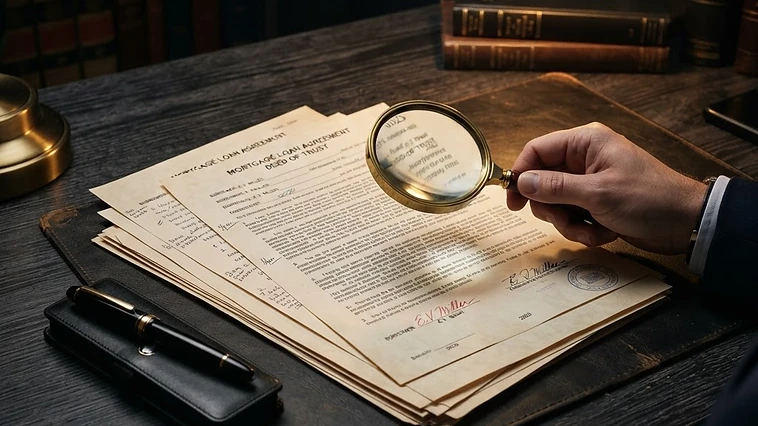
When you make your mortgage payment on time every month, it is easy to assume that everything behind the scenes is functioning perfectly. You receive your monthly statement, you pay the balance, and your equity slowly grows. However, the modern mortgage industry is a complex web of servicers, investors, automated systems, and third-party vendors. Even for homeowners who are completely current on their payments, the underlying paperwork can be riddled with inaccuracies, missing assignments, or even signs of sophisticated fraud.
If you are considering refinancing your home, taking out a home equity line of credit (HELOC), or simply organizing your financial estate, conducting a thorough mortgage document review is not just a good idea—it is a critical step in protecting your most valuable asset. Recent reports and enforcement actions highlight a disturbing trend: mortgage fraud and loan document errors are evolving, and they are increasingly targeting homeowners who have significant equity and pristine payment histories.
In this article, we will explore the latest risks hiding in your mortgage file, from AI-generated document fabrication to title forgery, and explain why a proactive mortgage audit is your best defense against predatory practices and servicing blunders.
The Alarming Rise of Refinance Fraud and Title Forgery
Many homeowners believe that mortgage fraud only happens to distressed borrowers or during the initial purchase of a home. Unfortunately, this is a dangerous misconception. Recent industry data reveals that refinance fraud and forgery claims have soared, now representing over 40% of all title insurer losses and expenses.
Bad actors are increasingly targeting properties with high equity. In a typical refinance fraud scheme, a fraudster may forge a homeowner's signature on a deed or loan document, effectively stealing the equity out of the property without the true owner's knowledge. Because the homeowner is current on their original mortgage, they may not discover the fraud until they attempt to sell the property, refinance their paperwork, or suddenly receive a notice of default on a loan they never authorized.
This is why reviewing your refinance paperwork is so vital. When you sit down at the closing table—or review documents via an electronic closing platform—you must verify that the chain of title is accurate, that no unauthorized liens have been recorded against your property, and that the entities listed on your documents are legitimate. A routine check of your county's property records can reveal unauthorized deeds of trust or assignments that could cloud your title and jeopardize your ownership rights.
AI and the New Era of Mortgage Fraud
We are entering a new frontier of financial crime, driven by advancements in artificial intelligence. According to recent risk mitigation reports from financial consulting firms, generative AI has supercharged the ability of fraudsters to create highly convincing, fabricated documents.
In the past, detecting a fake pay stub, a forged signature, or a fraudulent bank statement relied on spotting obvious visual inconsistencies. Today, AI-generated documents can replicate the visual formatting, fonts, and metadata of legitimate financial records with enough fidelity to pass standard automated checks. Furthermore, synthetic identities—created by combining fragments of real personally identifiable information (PII) with fabricated details—are being used to bypass knowledge-based authentication systems.
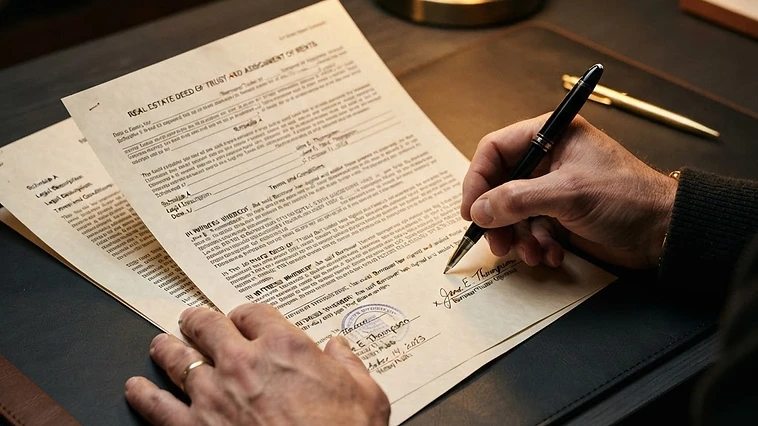 Close-up of hands reviewing mortgage refinance paperwork on a dark desk

For the current homeowner, this means that the barrier to entry for identity theft and mortgage fraud has never been lower. Fraudsters can use synthetic identities and AI-generated documents to apply for secondary mortgages or HELOCs against your property. If these fraudulent loans go into default, it creates incurable title defects that break the chain of title. Conducting a regular mortgage audit helps you ensure that the only loans attached to your property are the ones you actually signed and authorized.
Common Loan Document Errors Hiding in Plain Sight
Fraud is not the only threat to your home's security; sheer incompetence and systemic servicing errors can be just as damaging. The Consumer Financial Protection Bureau (CFPB) routinely directs its examiners to evaluate mortgage servicers for Unfair, Deceptive, or Abusive Acts or Practices (UDAAP). Even if you are paying on time, your servicer might be making mistakes that cost you money or put your property at risk.
One of the most common loan document errors involves the mishandling of escrow accounts and hazard insurance. For example, a servicer is strictly prohibited from force-placing hazard insurance if the borrower already has an active policy and an escrow account. Yet, audits frequently reveal that servicers ignore existing policies and charge borrowers exorbitant premiums for force-placed insurance, draining their escrow accounts and artificially inflating their monthly payments.
Another frequent issue arises with the Mortgage Electronic Registration Systems (MERS) and the assignment of the deed of trust. Mortgages are frequently bought and sold on the secondary market. When your loan changes hands, the transfer must be properly documented. However, it is incredibly common to find missing, incomplete, or improperly notarized assignments in a homeowner's file. If your loan documents lack a clear, unbroken chain of assignments, it can create massive legal headaches if you ever need to refinance, sell, or defend against an erroneous foreclosure action.
How to Approach Your Mortgage Document Review
If you are preparing to refinance, or if you simply want to ensure your financial house is in order, you must approach your mortgage document review with a forensic mindset. You cannot simply glance at the signature lines and assume the boilerplate text is correct.
First, gather your original closing documents, including the Promissory Note, the Deed of Trust (or Mortgage), the Closing Disclosure (or HUD-1 Settlement Statement), and any riders or addendums. Next, request a complete transaction history from your current mortgage servicer. Finally, pull a current title report or check your local county recorder's office for all documents recorded against your property.
When reviewing these documents, look for the following red flags:
- Inconsistent Signatures and Dates: Check the dates on your notarized documents. Are they consistent with the day you actually attended the closing? Are the notary stamps valid and legible?
- Unexplained Fees and Balances: Compare your servicer's transaction history with your own records. Look for unexplained corporate advances, mysterious property inspection fees, or unauthorized escrow deductions.
- Broken Chain of Title: Review the assignments of your mortgage. Does the entity currently collecting your payments actually have the legal right to do so? Are there gaps in the assignment history?
- Incorrect Interest Rates or Terms: If you previously modified your loan, ensure that the permanent modification agreement accurately reflects the interest rate, term, and principal balance you agreed to. Servicers frequently fail to update their computer systems to reflect modified terms.
By identifying these loan document errors early, you can force your servicer to correct the record before you enter into a new refinance agreement.
Why Auditing Your Mortgage Paperwork Matters
Even if you have never missed a payment, the integrity of your mortgage file is the foundation of your homeownership. Refinancing a mortgage that contains hidden errors, title defects, or signs of fraud only compounds the problem, potentially locking you into unfavorable terms or waiving your right to challenge past servicing abuses. Auditing your mortgage paperwork matters because it is the only way to verify that the banks, servicers, and third-party vendors are playing by the rules.
Unfortunately, the mortgage industry relies on the fact that most homeowners will never read beyond the first page of their loan documents. They count on your trust. But in an era of AI-generated fraud, rampant title forgery, and systemic servicing errors, blind trust is a liability.
This is exactly why the "Foreclosure Defense Survival Playbook" is an indispensable resource for every homeowner, not just those facing financial distress. This comprehensive, 530-page educational guide pulls back the curtain on the mortgage industry. It teaches you step-by-step how to conduct a professional-level mortgage audit, how to decode complex refinance paperwork, and how to spot the subtle loan document errors and fraud indicators that most people miss.
Whether you are preparing to refinance, reviewing your current loan, or simply want the peace of mind that your home is truly secure, you need the right tools to protect your equity. Don't wait for a servicing error to threaten your home. Order the "Foreclosure Defense Survival Playbook" today, take control of your mortgage documents, and ensure that your piece of the American Dream remains safely in your hands.


Order The Playbook
Get the Foreclosure Defense Survival Playbook
530 pages of structured, educational guidance covering mortgage documents, foreclosure procedures, evidence organization, and legal research — the same foundation this article draws from.