Mortgage Documents
The Hidden Risks in Your Loan: Why Every Homeowner Needs a Mortgage Document Review
Recent federal indictments highlight a surge in mortgage fraud and loan document errors, proving that even homeowners current on their payments must audit their paperwork.
Disclaimer: The following article is for educational purposes only and does not constitute legal advice. Always consult with a qualified attorney regarding your specific legal situation.
When you pay your mortgage on time every month, it is easy to assume that your loan file is in perfect order. You receive your monthly statements, you make your payments, and your balance slowly decreases. However, recent federal enforcement actions and industry reports reveal a troubling reality: the mortgage industry is rife with documentation errors, appraisal defects, and outright fraud. For current homeowners, especially those considering refinancing, conducting a thorough mortgage document review is no longer just a good idea—it is an absolute necessity.
Even if you are not behind on your payments, hidden loan document errors can cloud your title, complicate future sales, or trap you in predatory loan terms. This article explores the latest news in mortgage fraud and explains why every homeowner should perform a comprehensive mortgage audit of their refinance paperwork.
The Rising Tide of Mortgage Fraud and Falsified Documents
Mortgage fraud is not a relic of the 2008 financial crisis; it is an ongoing and evolving threat. Just this week, federal prosecutors in Texas unsealed an indictment against two individuals involved in a massive scheme to defraud mortgage lenders. According to the Department of Justice, the defendants submitted fraudulent loan applications supported by counterfeit pay stubs, manipulated bank statements, and fabricated W-2 forms Two charged in mortgage fraud scheme involving falsified financial documents. This four-year falsified-document scheme put the FHA insurance program at risk of nearly $5.9 million in losses.
While this specific case involved borrowers allegedly misrepresenting their own income, it highlights a systemic vulnerability: lenders and servicers frequently process, approve, and sell loans based on fabricated or inaccurate paperwork. If lenders can be duped by fake W-2s, they can just as easily make critical errors in your closing documents, assignments, and title records. When these loans are bundled and sold on the secondary market, the errors are compounded, leaving the current homeowner with a messy, legally questionable chain of title.
Appraisal Defects and the Threat to Your Home's Equity
Another alarming trend involves appraisal fraud, which directly impacts a homeowner's equity and the validity of their loan. A recent lawsuit in Baltimore detailed a continuing mortgage-fraud operation where appraisals were allegedly inflated by over $100,000. The complaint noted that certain appraisals even included photographs from entirely different properties to justify the inflated values Second Baltimore Mortgage Fraud Suit Details Foreclosure Fallout – NMP.
For a homeowner looking to refinance, an inaccurate appraisal can be devastating. If your home is overvalued due to fraudulent appraisal practices, you may end up borrowing more than the home is worth, trapping you in an underwater mortgage. Conversely, if an appraisal is artificially deflated, you may be denied favorable refinance terms. Reviewing your original appraisal and comparing it to your current refinance paperwork is a critical step in any mortgage audit.
The Hidden Danger of Loan Document Errors in Refinance Paperwork
Industry data confirms that loan document errors are on the rise, particularly in refinance transactions. According to a recent ACES Mortgage QC Industry Trends report, the refinance defect share rose dramatically from 26.04% to 37.35% in recent quarters Q3 2025 ACES Mortgage QC Industry Trends. The report noted a concentrated deterioration in key categories, most notably Legal/Regulatory/Compliance.
What does this mean for you? It means that more than a third of recently audited refinance loans contained significant defects. These defects can range from incorrect interest rates and misspelled names to missing signatures, improper notary stamps, and flawed disclosures. The Consumer Financial Protection Bureau (CFPB) advises homeowners to double-check loan amounts, interest rates, and all personal information, noting that errors can cause significant delays or legal complications down the line What should I do if I find an error in one of my mortgage closing documents?.
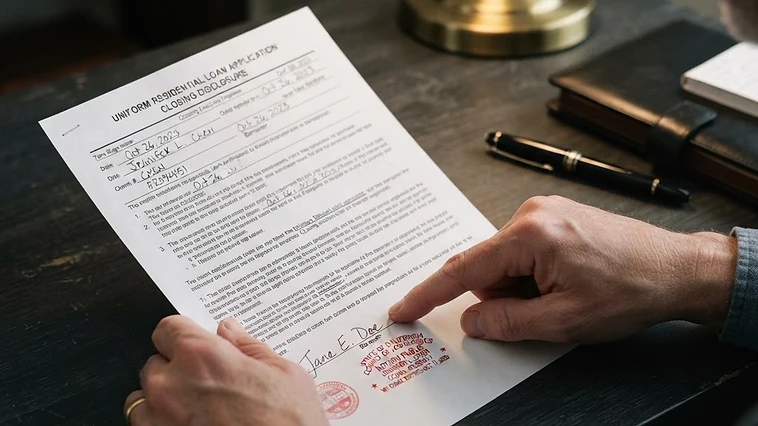 Close-up of a homeowner conducting a mortgage document review on a dark desk.

When you sit down to sign your refinance paperwork, you are legally binding yourself to the terms within those pages. If the lender has made a compliance error or failed to provide the required servicing disclosures, you could be waiving important legal rights without even knowing it. A proactive mortgage document review ensures that the terms you agreed to are the terms actually recorded in the county land records.
How AI and Fake Documents Complicate Your Mortgage Audit
As technology advances, so do the methods used to commit mortgage fraud. Industry experts warn that artificial intelligence is making fraudulent documents harder to spot. While AI is helping bad actors generate highly convincing fake documents, standard fraud tied to traditional issues—like forged signatures and fake notary stamps—remains prevalent Mortgage fraud is getting harder to spot – are advisers prepared for the new warning signs?.
For the average homeowner, this means that a casual glance at your loan file is no longer sufficient. You must look for inconsistencies across multiple documents. Does the signature on your promissory note match the signature on your deed of trust? Was the notary actually present when you signed the documents? Are there unexplained assignments from lenders that no longer exist? These are the types of questions a thorough mortgage audit seeks to answer.
Title Company Fraud and Escrow Irregularities
It is not just lenders and borrowers who are implicated in mortgage fraud; sometimes, the professionals trusted to facilitate the transaction are the culprits. In a recent case out of New Jersey, a title company owner and a real estate investor admitted to participating in a multimillion-dollar mortgage fraud scheme. They created fake escrow letters, fabricated documentation transferring control of properties, and lied to mortgage lenders about the receipt of funds at closing Title Company Owner and Real Estate Investor Admit Mortgage Fraud, COVID-19 Relief Program Fraud Schemes.
When title companies and settlement agents engage in fraudulent behavior, the integrity of your entire closing file is compromised. If your refinance paperwork was handled by a corrupt or negligent settlement agent, your mortgage may not be properly recorded, or your title insurance policy may be invalid. This is why reviewing your closing disclosure, ALTA settlement statement, and title commitment is a vital part of protecting your home.
Why Auditing Your Mortgage Paperwork Matters
Many homeowners believe that as long as they are current on their payments, the accuracy of their mortgage documents does not matter. This is a dangerous misconception. Even if you are paying on time, hidden loan document errors, unrecorded assignments, and compliance violations can severely impact your ability to sell your home, refinance at a lower rate, or protect your equity.
Auditing your mortgage paperwork matters because it puts you in control of your largest financial asset. Before you sign new refinance paperwork, or before a future financial hardship forces you into default, you must know exactly what is in your loan file. You need to verify that the entity collecting your payments actually has the legal right to do so, and that your original closing documents are free of predatory terms and fraudulent signatures.
This is exactly why the "Foreclosure Defense Survival Playbook" is an essential resource for every homeowner. You do not need to be facing foreclosure to benefit from this 530-page educational guide. The Playbook teaches you step-by-step how to conduct a comprehensive mortgage document review, how to spot hidden loan document errors, and how to organize your evidence like a pro. By learning how to audit your own refinance paperwork, you can identify mortgage fraud before it threatens your home. Do not wait for a crisis to discover that your loan documents are defective. Order the Foreclosure Defense Survival Playbook today and take the first step toward securing your home's legal foundation.


Order The Playbook
Get the Foreclosure Defense Survival Playbook
530 pages of structured, educational guidance covering mortgage documents, foreclosure procedures, evidence organization, and legal research — the same foundation this article draws from.