Mortgage Documents
Hidden Refinance Fraud: Why Current Homeowners Must Audit Their Mortgage Documents
Recent data reveals a sharp increase in refinance fraud and loan document errors. Learn why auditing your mortgage paperwork is critical, even if you are current on your payments.

Disclaimer: The information provided in this article is for educational purposes only and does not constitute legal advice. Always consult with a qualified attorney regarding your specific legal situation and before making decisions about your property or mortgage.
You pay your mortgage on time every single month. You have built substantial equity in your home, maintained an excellent credit score, and are now considering a refinance to secure a better interest rate or tap into your home's value. Because you have never missed a payment, you likely assume that your original loan documents are flawless and that your lender's accounting is perfectly accurate.
Unfortunately, recent enforcement actions, court rulings, and industry data from 2026 paint a very different picture. The mortgage industry is currently experiencing a sophisticated wave of document irregularities, title defects, and equity theft schemes. For homeowners who are current on their payments, the danger does not lie in an immediate foreclosure, but rather in hidden loan document errors and synthetic fraud that can hijack a refinance transaction or cloud a property's title.
Before you sign a single page of new refinance paperwork, it is absolutely critical to conduct a thorough mortgage document review of your existing file. Here is what recent industry data reveals about the hidden risks in your mortgage paperwork and why a proactive mortgage audit is your best defense.
The 2026 Spike in Mortgage Fraud and Synthetic Identities
Mortgage fraud is no longer limited to the predatory lending tactics seen during the 2008 financial crisis. Today, the threat has evolved into high-tech deception. According to recent industry reporting, including data highlighted in Mortgage Fraud News and Updates from HousingWire, mortgage application fraud risk saw a concerning 9.1% increase in the second quarter of 2026. This rise is largely driven by sophisticated actors targeting properties with substantial equity.
Even more alarming is the rise of synthetic identities and AI-generated documents. Fraudsters are increasingly using digitally altered identification and forged documents to impersonate homeowners. In a recent analysis of early 2026 data, as noted in Mortgage fraud risk decreased in beginning of 2026 - Cotality, while overall historical averages fluctuate, specific categories like undisclosed real estate fraud have seen significant year-over-year increases.
For a current homeowner, this means that bad actors could be attempting to take out secondary financing or execute a cash-out refinance on your property without your knowledge. If your own original mortgage documents contain errors or missing assignments, it becomes even harder to prove the true chain of title when fighting these fraudulent claims.
Refinance Forgery: Why Title Searches Are Not Enough
When you apply for a refinance, the title company will perform a public records search to ensure there are no outstanding liens on your property. However, public records cannot always detect sophisticated forgery.
According to a groundbreaking April 2026 report detailed in Refinance Fraud: Notaries are the last line of defense | NNA, fraud and forgery claims now account for approximately 40 percent of the total title insurance claim costs associated with refinance transactions. This is more than double the rate seen in standard purchase transactions. The report highlights a sobering reality: the average cost of fighting refinance fraud in court runs about $207,000.
Critically, the report notes that nearly 40 percent of all refinance losses are linked to fraud and forgery issues that cannot be identified through standard public record searches. No database query can flag a synthetic identity assembled using AI-generated documents, and no standard title search will catch a criminal impersonating a homeowner with a forged notary seal.
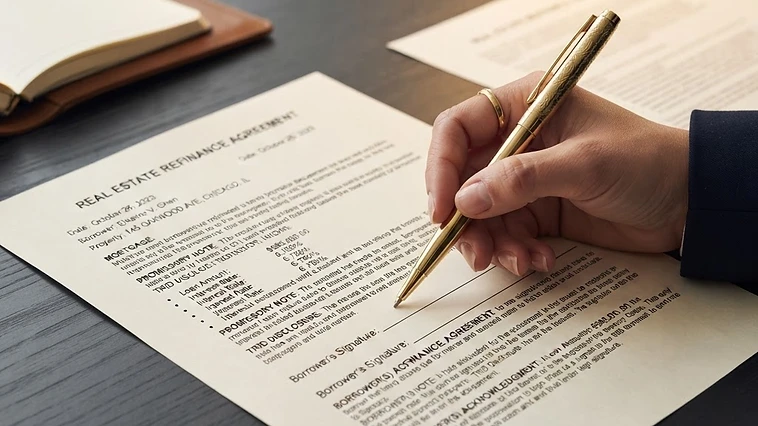 Close-up of a homeowner reviewing refinance paperwork and checking for loan document errors on a dark desk.

This is why relying solely on your new lender to verify your property's legal standing is a dangerous gamble. You must take ownership of your file by conducting a personal mortgage audit to ensure that every signature, notary stamp, and recorded deed from your original closing is legitimate and legally binding.
Common Loan Document Errors Hiding in Plain Sight
Even if you are not the victim of intentional mortgage fraud, your file is likely riddled with administrative loan document errors. The modern mortgage system relies heavily on third-party mortgage servicers to collect payments, assess fees, and manage escrow accounts.
As highlighted in Errors and Abuses by Mortgage Servicers & Your Legal ... Justia, mistakes made by mortgage servicers can have a devastating impact on homeowners. Servicers frequently fail to properly process monthly payments, misapply principal reductions, or illegally assess junk fees and unauthorized property inspection charges.
If you are current on your payments, you might not notice these subtle accounting errors. However, when you go to refinance, your current servicer will issue a payoff statement. If that payoff statement is inflated by years of misapplied payments and unauthorized fees, you will end up rolling those phantom debts into your new loan. You will literally be paying interest on the servicer's accounting errors for the next 30 years.
A comprehensive mortgage document review allows you to audit your payment history, scrutinize your escrow account, and demand corrections under the Real Estate Settlement Procedures Act (RESPA) before you request a final payoff quote.
Chain of Title, MERS, and Assignment Problems
During the life of a typical 30-year mortgage, the underlying promissory note and the servicing rights are often sold and transferred multiple times. In many cases, these transfers are tracked electronically by the Mortgage Electronic Registration Systems (MERS).
However, the electronic tracking of a loan does not supersede the legal requirement for proper, physical assignments of the Deed of Trust or Mortgage in your local county records. A common issue uncovered during a mortgage audit is a broken chain of title. This occurs when the original lender sells the loan but fails to properly execute and record the assignment to the new trust or investor.
Why does this matter if you are just trying to refinance? Because if the chain of title is broken, the entity claiming to own your loan may not have the legal authority to issue a valid reconveyance or satisfaction of mortgage when you pay them off. If you refinance and hand hundreds of thousands of dollars to a trust that cannot prove it legally owns your debt, your title remains clouded. Future buyers or title insurers may flag the defect, leaving you with a property that is difficult to sell or insure.
How to Approach a Mortgage Document Review
Protecting your equity requires a proactive approach. Before you begin shopping for refinance rates, you should gather your complete origination file, your payment history, and your publicly recorded documents.
Here are the foundational steps for reviewing your file:
- Examine the Promissory Note: Request a copy of your original promissory note from your current servicer. Look for specific endorsements (stamps that transfer the note from one bank to another). Are the endorsements signed by authorized individuals? Are they blank or specifically endorsed to a named trust?
- Verify the Recorded Assignments: Visit your county recorder's office (or their online portal) and pull every document recorded against your property. Ensure there is a clear, unbroken chain of assignments from your original lender to your current loan owner.
- Scrutinize Notary Signatures: Look closely at the notary stamps on your recorded documents. Check the dates. It is not uncommon to find documents that were notarized months or even years after the supposed signing date, which is a massive red flag for document fabrication.
- Audit the Payoff and Escrow: Request a detailed transaction history from your servicer. Calculate the application of your payments to ensure your principal balance aligns with your amortization schedule. Look for unexplained "corporate advances" or miscellaneous fees.
By identifying these issues early, you can force your servicer to correct the record, remove illegal fees, and properly record missing assignments before you sign new refinance paperwork.
Why Auditing Your Mortgage Paperwork Matters
The assumption that "everything is fine because I pay on time" is the greatest vulnerability a modern homeowner faces. The mortgage industry is a high-volume, profit-driven machine that frequently prioritizes speed over legal accuracy. Whether you are facing the threat of high-tech synthetic refinance fraud, or simply bleeding equity due to a servicer's accounting errors, the responsibility to protect your home falls entirely on you.
This is exactly why the "Foreclosure Defense Survival Playbook" was created. While the title mentions foreclosure, this massive 530-page educational manual is the ultimate resource for any homeowner who wants to understand the complex web of mortgage documents, securitization, and legal research.
The Playbook provides step-by-step educational guidance on how to organize your evidence, decode complex mortgage contracts, spot notary irregularities, and conduct a professional-level mortgage audit on your own file. It teaches you the exact terminology and procedures needed to hold lenders and servicers accountable for their errors.
Do not wait until you are sitting at a closing table signing new refinance paperwork to wonder if your original loan was handled legally. Protect your equity, uncover hidden fraud, and take control of your financial future. Order the "Foreclosure Defense Survival Playbook" today and learn how to audit your mortgage documents like a seasoned professional.


Order The Playbook
Get the Foreclosure Defense Survival Playbook
530 pages of structured, educational guidance covering mortgage documents, foreclosure procedures, evidence organization, and legal research — the same foundation this article draws from.