Mortgage Documents
Hidden Mortgage Fraud: Why Current Homeowners Must Audit Their Loan Documents
Even if you pay on time, your mortgage file may contain hidden fraud, calculation errors, or title defects. Learn why auditing your paperwork before refinancing is critical.

Disclaimer: The following article is for educational purposes only and does not constitute legal advice. If you need legal assistance, please consult a qualified attorney.
Have you ever wondered what is actually hiding inside your mortgage file? Most homeowners assume that as long as they make their monthly payments on time, their mortgage documents are perfectly accurate and legally sound. Unfortunately, recent headlines and industry reports reveal a very different reality. From fabricated loan applications to systemic calculation errors and servicing blunders, the mortgage industry is currently grappling with a wave of loan document errors and mortgage fraud.
If you are considering a refinance, or if you simply want to ensure your home is protected from future title defects, conducting a thorough mortgage document review is no longer just a good idea—it is an absolute necessity. Even homeowners who are perfectly current on their payments are discovering hidden defects in their refinance paperwork that could jeopardize their property rights.
Recent Mortgage Fraud and Loan Document Errors in the News
The last few weeks have brought a flurry of enforcement actions and lawsuits highlighting the severe issues lurking in mortgage origination and servicing. These aren't isolated incidents; they represent a systemic problem with how mortgage paperwork is handled, verified, and recorded.
In early November 2026, Rocket Mortgage filed a federal lawsuit against a Virginia-based wholesale broker over an alleged loan fraud scheme involving nearly $1 million in loans. According to the lawsuit, the broker submitted loan applications backed by documents that were "misleading, untrue, fabricated, altered and otherwise fraudulent" Rocket Mortgage sues Virginia broker over alleged loan fraud scheme. The lender was forced to buy back the loans after third-party investors flagged the discrepancies.
Similarly, in late October 2026, the Department of Justice announced the indictment of two Houston-area residents for their role in a massive mortgage fraud scheme. The defendants allegedly submitted falsified financial documents—including fake pay stubs, W-2 forms, and bank statements—to multiple mortgage lenders between 2019 and 2023 Two Charged in Mortgage Fraud Scheme Involving Falsified Financial Documents. This scheme exposed the FHA insurance program to nearly $5.9 million in potential losses.
These cases highlight a terrifying reality for the average homeowner: the professionals entrusted with your most sensitive financial data and property records are sometimes the very people introducing fraudulent or fabricated documents into the chain of title. If a broker falsified income documents to push a loan through, what other corners were cut in your closing package?
The Rise of Refinance Paperwork Defects
It isn't just intentional mortgage fraud that homeowners need to worry about; sheer incompetence and systemic calculation errors are also at an all-time high. According to the latest ACES Mortgage QC Industry Trends Report, the mortgage industry has been battling a significant spike in critical defect rates, particularly in refinance transactions.
While the overall critical defect rate saw a slight decline to 1.64% in the second quarter of 2026, it remains historically high, having jumped significantly earlier in the year Report Shows First Q1-To-Q2 Decline In Critical Defect Rate Since 2023. More alarmingly, the report noted that "Legal/Regulatory/Compliance" defects have been a massive driver of these errors. Furthermore, calculation errors in income and assets drove the majority of underwriting defects, rising to over 51% of the category's findings.
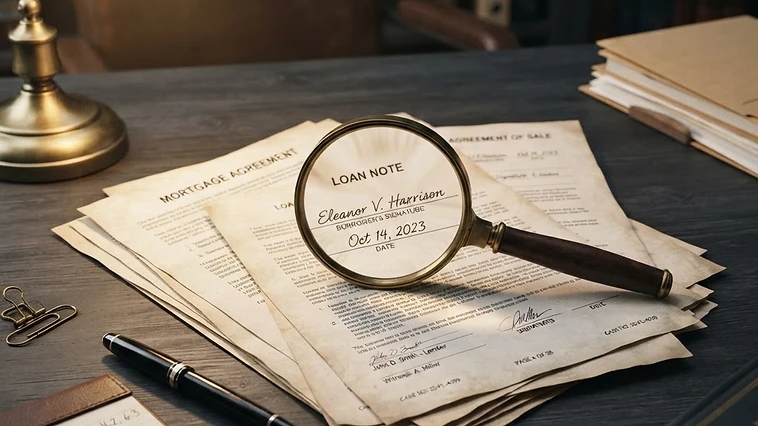
 A magnifying glass and pen resting on mortgage documents during a forensic loan audit.

What does this mean for you? It means that when you sit down to sign your refinance paperwork, there is a statistically significant chance that the lender has miscalculated your assets, botched the compliance disclosures, or failed to properly document the loan. In fact, the ACES report highlighted that the refinance defect share has exceeded the refinance review share for 10 consecutive quarters. If you are refinancing your home, your new mortgage file is at a high risk of containing critical loan document errors.
Servicing Errors and RESPA Violations
The errors don't stop at the closing table. Once your loan is sold and transferred to a mortgage servicer, a whole new set of risks emerges. Mortgage servicers are notorious for misapplying payments, failing to respond to borrower inquiries, and violating federal laws like the Real Estate Settlement Procedures Act (RESPA).
Just this week, RESPA News reported on a Texas homeowner who filed a lawsuit against Freedom Mortgage Corp., alleging severe RESPA violations related to the company's handling of qualified written requests (QWRs) and notices of error Your gateway to the world of RESPA. When servicers fail to properly track your payments or ignore your formal requests for information, it can lead to inaccurate payoff quotes, improper late fees, and even wrongful foreclosure proceedings.
For a homeowner who is current on their payments, these servicing errors might remain hidden in the background. You might not realize that your servicer has been miscalculating your escrow account or failing to properly record the assignment of your mortgage until you try to sell your home or refinance. By then, the damage is done, and untangling the mess can take months of legal wrangling.
How Hidden Mortgage Fraud Affects Current Homeowners
You might be thinking, "I pay my mortgage on time every month. Why should I care if there are loan document errors in my file?"
The answer lies in the legal concept of the "chain of title" and the enforceability of your mortgage contract. Your mortgage (or deed of trust) and your promissory note are legal instruments that dictate exactly who has the right to collect your payments and, ultimately, who has the right to foreclose on your home if you ever fall behind.
If your original loan documents were tainted by mortgage fraud—such as forged signatures, unauthorized notary stamps, or fabricated income statements—the legal validity of your mortgage could be called into question. Furthermore, if your loan was sold multiple times on the secondary market (as most are), the assignments transferring the mortgage from one bank to another must be perfectly executed and recorded in your local county records.
Common hidden defects include:
- Missing or Forged Assignments: The document transferring your mortgage to the current trust or investor may be missing, backdated, or signed by a known "robo-signer."
- Endorsement Failures: Your promissory note may lack the proper endorsements (signatures) required to legally transfer the debt.
- Title and Appraisal Defects: The original appraisal may have been inflated, or there may be unreleased liens on your property that the title company missed.
- MERS Irregularities: The Mortgage Electronic Registration Systems (MERS) may have been improperly used to bypass local recording fees, leading to breaks in your chain of title.
If you attempt to refinance your home, the new title search will often uncover these hidden defects. A missing assignment or an unreleased lien can completely derail your refinance, leaving you trapped in a higher interest rate while you spend thousands of dollars trying to clear your title.
Conducting a Mortgage Document Review Before You Refinance
To protect yourself, you must take a proactive approach. Do not wait for a title company to find a problem, and certainly do not wait until you are facing financial hardship to look at your paperwork. You need to conduct a comprehensive mortgage audit right now.
A proper mortgage document review involves gathering every single piece of paper related to your home loan. This includes:
- The Promissory Note: Request a copy of your original note from your servicer, including all allonges and endorsements. Check to see if the endorsements match the timeline of when your loan was allegedly sold.
- The Mortgage or Deed of Trust: Pull a copy of this document from your county recorder's office. Ensure that the legal description of your property is perfectly accurate.
- All Recorded Assignments: Trace the chain of title from your original lender to your current servicer. Are there any gaps? Are the signatures legible, or do they look like they were stamped by a machine?
- Closing Disclosures and HUD-1 Settlement Statements: Review these documents for calculation errors, undisclosed junk fees, or predatory lending terms.
- Servicing Logs and Payment Histories: Send a Qualified Written Request (QWR) to your servicer demanding a complete life-of-loan payment history. Check their math against your own bank statements.
By auditing these documents, you are looking for the exact types of legal, regulatory, and compliance defects that industry reports show are currently plaguing the market. If you find errors, you can demand corrections while you are still in a position of strength—current on your payments and not under the threat of foreclosure.
Why Auditing Your Mortgage Paperwork Matters
Even if you have never missed a payment, the integrity of your mortgage file is the foundation of your property rights. The recent surge in refinance paperwork defects, broker fraud, and servicing errors proves that you cannot blindly trust lenders and servicers to maintain accurate records. Auditing your mortgage paperwork matters because it is the only way to ensure that the entity collecting your money actually has the legal right to do so, and that your title is clear of toxic defects.
If you are preparing to refinance, or if you simply want the peace of mind that comes with knowing your home is secure, you need to know exactly what to look for. You need to know how to spot a forged signature, how to identify a broken chain of title, and how to force your servicer to hand over the evidence.
That is exactly what the "Foreclosure Defense Survival Playbook" is designed to do. This comprehensive, 530-page educational manual is not just for homeowners in distress; it is the ultimate guide for any homeowner who wants to conduct a forensic mortgage audit. The Playbook teaches you how to decode complex mortgage documents, understand the rules of evidence, and identify the hidden fraud and loan document errors that lenders pray you never find.
Don't wait until a hidden defect derails your refinance or a servicing error threatens your home. Take control of your property rights today. Order your copy of the "Foreclosure Defense Survival Playbook" and learn how to audit your mortgage paperwork like a pro.


Order The Playbook
Get the Foreclosure Defense Survival Playbook
530 pages of structured, educational guidance covering mortgage documents, foreclosure procedures, evidence organization, and legal research — the same foundation this article draws from.