Mortgage Documents
Hidden Mortgage Fraud: Why Current Homeowners Must Audit Their Loan Documents
With recent federal indictments exposing widespread falsified loan documents and appraisal fraud, even homeowners current on their payments are at risk. Discover why conducting a thorough mortgage document review is essential before your next refinance.
Disclaimer: The following article is for educational purposes only and does not constitute legal advice. If you need legal assistance regarding your mortgage or foreclosure, please consult a qualified attorney in your jurisdiction.
When you pay your mortgage on time every month, it is easy to assume that your loan file is in perfect order. You receive your monthly statement, you make your payment, and your balance slowly decreases. However, recent federal enforcement actions and court rulings have exposed a disturbing reality: the mortgage industry is still plagued by systemic fraud, falsified documents, and severe procedural errors. Even if you are completely current on your payments, your loan file could be a ticking time bomb of hidden defects.
For homeowners who are considering refinancing, reviewing their mortgage paperwork, or simply checking whether their loan documents are accurate, understanding these risks is paramount. A proactive mortgage document review can uncover loan document errors that might otherwise derail a future refinance, cloud your property's title, or leave you vulnerable to predatory servicing practices.
The Resurgence of Mortgage Fraud in Recent News
In late October 2026, the U.S. Department of Justice unsealed an 11-count indictment in the Southern District of Texas, charging two individuals in a massive mortgage fraud scheme. According to the DOJ and the Office of Inspector General for the Department of Housing and Urban Development (HUD-OIG), the defendants allegedly submitted fraudulent financial documents to multiple mortgage lenders between October 2019 and September 2023. This scheme involved falsified pay stubs, W-2 forms, and bank statements designed to misrepresent borrower employment and income, ultimately pushing through loans that did not meet underwriting standards.
While this specific case targeted individuals manipulating the system to qualify borrowers, it highlights a broader, systemic issue: the documents sitting in your lender's vault may not be as pristine as you think. In many cases of mortgage fraud, brokers, loan officers, or third-party processors alter documents without the borrower's full knowledge to ensure the loan closes and they receive their commission. If your original loan application contains inflated income figures or falsified employment records inserted by a rogue broker, it constitutes mortgage fraud. Even if you have never missed a payment, discovering these loan document errors during a routine mortgage audit is critical before you attempt to refinance or sell your home.
Artificial Intelligence and the Fake Document Epidemic
The landscape of mortgage fraud is evolving rapidly, making a thorough mortgage document review more difficult—and more necessary—than ever. Industry reports from October 2026 highlight that mortgage fraud is getting harder to spot due to the proliferation of Artificial Intelligence (AI). Bad actors are now using sophisticated AI tools to generate highly convincing, fake financial documents.
Companies that provide fraud detection software for lenders, such as Ocrolus, have recently had to roll out advanced AI-detection tools just to catch tampered and AI-generated bank statements and tax forms. In one recent case, underwriters were alerted to a fabricated $300,000 deposit that looked entirely legitimate to the naked eye. For the current homeowner, this raises a terrifying question: What if the securitization trust or mortgage servicer currently holding your note is relying on a file padded with fabricated documents?
When loans are bundled and sold on the secondary market, the accompanying paperwork is often rushed, lost, or recreated after the fact. If your servicer ever needs to prove standing—perhaps due to a servicing transfer dispute or a sudden, erroneous claim of default—they may rely on documents that were hastily (and sometimes fraudulently) manufactured. Conducting your own mortgage audit ensures that you know exactly what is in your file before a servicer tries to use it against you.
Appraisal and Title Defects: The Baltimore Fallout
Mortgage fraud is not limited to the borrower's income and employment verification. It frequently extends to the property's valuation and the chain of title. A second major mortgage fraud lawsuit recently detailed in Baltimore exposes the severe fallout of appraisal and title defects. In this ongoing litigation, lenders allege that appraisals overstated property values by massive margins—in some cases by over $113,000.
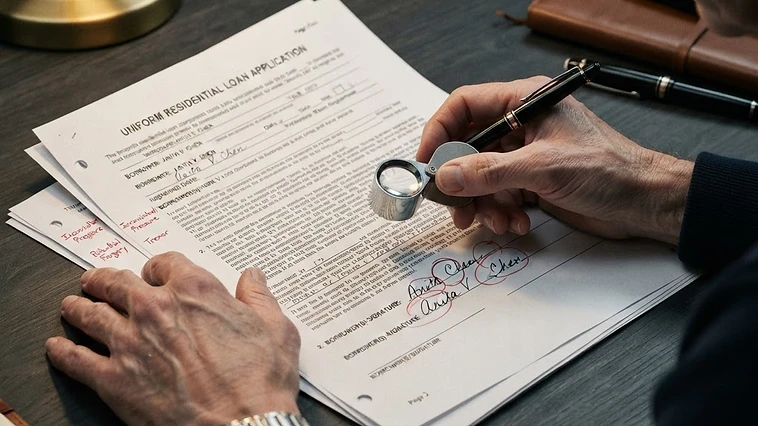 Close-up of hands reviewing mortgage loan documents for errors and fraud under warm desk lighting.

The complaint alleges that certain appraisals included photographs from entirely different properties or described nonexistent renovations. Furthermore, title companies are accused of withholding material information about recent, lower-priced acquisitions of the same properties.
How does this affect a homeowner who is current on their payments? If your home was subject to an inflated appraisal during your last purchase or refinance, you might be trapped in an underwater mortgage without realizing it until you try to sell. Furthermore, if the title company failed to properly record assignments or ignored defects in the chain of title, your ownership rights could be clouded. When you sit down to review your refinance paperwork, you must scrutinize the appraisal report and the title commitment. Look for discrepancies in property descriptions, unexplained jumps in valuation, and missing links in the chain of title.
The Danger of Recording and Assignment Problems
One of the most common and destructive loan document errors involves the improper recording and assignment of the mortgage or deed of trust. During the housing boom and subsequent crash, the Mortgage Electronic Registration Systems (MERS) was heavily utilized to bypass traditional county recording offices, allowing loans to be bought and sold rapidly on the secondary market.
However, this rapid transfer of loans often resulted in broken chains of title. An assignment of mortgage is a legal document that transfers the rights of the lender to another party. If your loan has been sold three times, there should be a clear, legally valid assignment recorded for each transfer. In reality, many homeowners find that their assignments are missing, backdated, or signed by "robo-signers"—individuals who sign thousands of legal documents a day without verifying their contents.
If you are current on your payments, you might wonder why a broken chain of assignment matters. It matters because if you ever need a loan modification, or if you want to refinance, the new lender will require a clear title. If the current servicer cannot legally prove they hold the note and the mortgage, your refinance paperwork will stall. A proactive mortgage audit allows you to identify these recording and assignment problems now, giving you time to demand corrective action from your servicer while you are in a position of strength.
How to Conduct a Basic Mortgage Document Review
Every homeowner should treat their mortgage file like a living, breathing legal dossier. To protect yourself from hidden fraud and loan document errors, you must conduct a comprehensive mortgage document review.
First, request a complete copy of your loan file from your current servicer. Under the Real Estate Settlement Procedures Act (RESPA), you have the right to send a Qualified Written Request (QWR) or a Request for Information (RFI) to your servicer, demanding copies of your original promissory note, the mortgage or deed of trust, all assignments, and a complete payment history.
Once you receive these documents, begin your mortgage audit by comparing the signatures on the promissory note to your actual signature. Look for any signs of forgery or unauthorized alterations. Next, examine the endorsements on the note. Are they stamped in blank? Are they signed by known robo-signers?
Then, review your closing disclosure and refinance paperwork. Ensure that the interest rate, loan term, and principal balance match what you agreed to. Check for hidden junk fees or predatory lending terms that may have been slipped into the fine print. Finally, visit your county recorder's office (or their online portal) and pull the property records for your home. Verify that every assignment of mortgage matches the timeline of when your loan was allegedly sold. If you spot discrepancies, you have uncovered potential mortgage fraud or fatal loan document errors that must be addressed.
Why Auditing Your Mortgage Paperwork Matters
It is a dangerous misconception that only homeowners facing imminent foreclosure need to worry about the accuracy of their loan files. The reality is that systemic mortgage fraud, appraisal defects, and sloppy securitization practices have infected millions of loans across the country. Even current, on-time homeowners should audit their mortgage paperwork before refinancing or facing a potential future default.
If you wait until you are behind on payments to discover that your loan documents are fraudulent or fatally flawed, you will be fighting an uphill battle against a hostile servicer. By conducting a mortgage document review now, while you are current, you take control of your financial destiny. You can clear title defects, correct loan document errors, and ensure that your refinance paperwork is legally sound.
This is exactly why the "Foreclosure Defense Survival Playbook" is an indispensable resource for every homeowner, not just those in distress. This comprehensive 530-page educational book teaches you step-by-step how to organize your evidence, conduct a professional-level mortgage audit, and spot the hidden fraud, errors, and defects in the documents your lender or servicer handed you. It demystifies complex legal research and empowers you to understand your mortgage documents on a forensic level. Do not wait for a crisis to discover the truth about your loan. Order the Foreclosure Defense Survival Playbook today, audit your file, and secure your home's future against the hidden threats of the mortgage industry.


Order The Playbook
Get the Foreclosure Defense Survival Playbook
530 pages of structured, educational guidance covering mortgage documents, foreclosure procedures, evidence organization, and legal research — the same foundation this article draws from.