Mortgage Documents
The Hidden Fraud in Your Refinance Paperwork: A Homeowner's Guide to Mortgage Document Review
Even if you are current on your mortgage payments, hidden errors and fraud in your loan documents can cost you thousands. Learn how to audit your paperwork before you refinance.

Disclaimer: The information provided in this article is strictly for educational purposes and does not constitute legal advice. If you have specific questions about your mortgage banking documents or require legal counsel, please consult a qualified attorney in your jurisdiction.
If you are like most responsible homeowners, you pay your mortgage on time every month. You keep your property in good condition, you monitor your credit score, and you trust that the financial institution servicing your loan is keeping accurate records. When interest rates shift or your financial goals change, you might naturally consider refinancing. You gather your tax returns, your pay stubs, and your bank statements, preparing to sign a new stack of refinance paperwork.
But before you sign your name on the dotted line of a new 30-year commitment, you must ask yourself a critical question: Are the original mortgage documents currently sitting in your lender's vault actually accurate?
For homeowners who are current on their payments, the idea of mortgage fraud or loan document errors might seem like a problem reserved for those facing foreclosure. However, recent federal enforcement actions, warnings from the Office of the Comptroller of the Currency (OCC), and investigations by the Consumer Financial Protection Bureau (CFPB) reveal a different reality. Systemic errors, predatory lending practices, and hidden defects are woven into the fabric of millions of active, performing loans.
Conducting a thorough mortgage document review is not just a defensive tactic for distressed borrowers; it is an essential financial health check for every homeowner.
The Illusion of Perfect Paperwork
When you sit down at a closing table, the sheer volume of paperwork is overwhelming. You are presented with a Promissory Note, a Deed of Trust or Mortgage, Truth in Lending Act (TILA) disclosures, Real Estate Settlement Procedures Act (RESPA) disclosures, and a mountain of addendums. The natural assumption is that because these documents were prepared by a massive financial institution, they must be legally flawless.
This assumption is dangerous. The mortgage industry operates on volume and speed. Loans are originated, bundled, securitized, and sold on the secondary market with dizzying rapidity. In this rush for profit, corners are frequently cut.
Recent reports from financial risk consultants highlight a staggering increase in mortgage fraud, including the use of synthetic identities and even large language models (LLMs) to generate falsified income and asset documents. While you may not be committing fraud, the entities handling your loan might be engaging in deceptive practices. The OCC recently issued updated "Safe Money" guidance warning consumers about mortgage fraud that targets homeowners through misleading terms, deceit, and misrepresentations made during the origination or funding of a mortgage loan.
If your original loan documents contain illegal fee structures, undisclosed yield spread premiums, or forged notary signatures, refinancing without addressing these issues means you are simply rolling a defective, potentially fraudulent loan into a new one. You might be paying off a debt that the current "lender" has no legal right to collect.
Recent Enforcement Actions and Federal Warnings
If you doubt that major lenders make significant errors on performing loans, you only need to look at the recent enforcement actions taken by federal regulators.
In late 2024, the Consumer Financial Protection Bureau (CFPB) issued multiple enforcement orders against major financial institutions and nonbank direct mortgage lenders. For example, actions were taken against lenders specializing in offering refinance mortgage loans guaranteed by the United States Department of Veterans Affairs. These enforcement actions often center around deceptive practices, failure to provide accurate disclosures, and charging illegal fees.
Furthermore, the Federal Reserve and the Department of Justice routinely penalize servicers for deficient practices in residential mortgage loan servicing. These are not isolated incidents; they are symptoms of an industry that frequently prioritizes efficiency over accuracy.
When a federal agency fines a bank millions of dollars for RESPA violations or deceptive refinance practices, it means thousands of everyday homeowners were overcharged, misled, or bound by defective contracts. Your loan could easily be one of them. This is why a proactive mortgage audit is a vital step before you engage in any new transaction with a lender.
Common Loan Document Errors Hiding in Plain Sight
What exactly are you looking for when you review your mortgage file? Loan document errors rarely announce themselves with red ink. They are usually buried in the fine print, hidden behind complex financial jargon, or concealed within the chain of title.
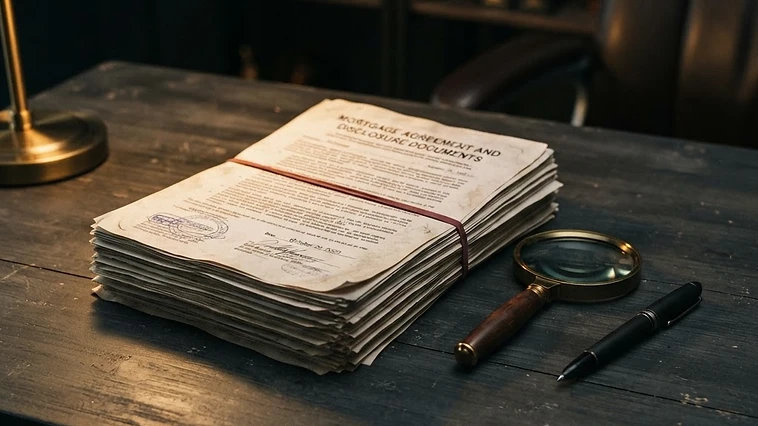
 Close-up of hands reviewing mortgage refinance paperwork under a warm gold desk lamp.
Here are some of the most common issues uncovered during a professional-level mortgage document review:
1. Truth in Lending Act (TILA) Violations TILA requires lenders to clearly disclose the Annual Percentage Rate (APR), finance charges, the amount financed, and the total of payments. If your lender miscalculated the APR by even a fraction of a percent, or if they hid finance charges in the principal balance, your original loan may be in violation of federal law.
2. RESPA and Closing Disclosure Errors The Real Estate Settlement Procedures Act (RESPA) governs the closing process and outlaws kickbacks and unearned fees. If your closing documents (such as the HUD-1 Settlement Statement for older loans or the Closing Disclosure for newer ones) show inflated appraisal fees, bogus processing fees, or undisclosed payments to mortgage brokers, you may have been a victim of predatory lending.
3. Notary and Signature Irregularities During the height of the housing crisis, "robo-signing" became a household word. Lenders were caught forging signatures and having notaries stamp documents without actually witnessing the signatures. While regulations have tightened, notary fraud and signature irregularities still occur. An invalidly notarized mortgage or deed of trust can severely impact the lender's security interest in your property.
4. Misapplied Payments and Escrow Manipulation Even if your origination documents are perfect, your servicing history might be a mess. Servicers frequently misapply principal and interest payments, charge unauthorized property inspection fees, or miscalculate escrow requirements. Over years of on-time payments, these "small" accounting errors can steal thousands of dollars of equity from your home.
The Role of MERS and Chain of Title Defects
One of the most complex and pervasive issues in modern mortgage paperwork involves the Mortgage Electronic Registration Systems, commonly known as MERS.
Historically, when a mortgage was sold from one bank to another, an Assignment of Mortgage had to be physically recorded at the county clerk's office. To bypass the time and expense of paying county recording fees, the banking industry created MERS. MERS acts as a digital registry that tracks the buying and selling of loans, often serving as the "nominee" for the lender.
However, the use of MERS has created massive chain of title defects. If you are refinancing, the new title company will run a search on your property. If your current loan was sold five times on the secondary market, but those transfers were only tracked internally on MERS and never properly recorded in your county, there may be a break in the chain of title.
Why does this matter to a homeowner who is current on their payments? Because if the chain of title is broken, the entity currently sending you a monthly statement might not actually own your loan. If you refinance, you are using the new loan proceeds to pay off an entity that may lack the legal standing to issue a valid release of lien. A thorough mortgage audit will trace the assignments of your mortgage to ensure that the bank claiming to hold your note is the actual legal party in interest.
How to Conduct a Mortgage Document Review
If you are preparing your refinance paperwork, you should simultaneously prepare to audit your existing loan. You do not need to be a lawyer to perform a basic review of your own file, but you do need to be meticulous and organized.
Step 1: Gather the Complete File You cannot audit what you do not have. Request a complete copy of your origination file from your current servicer. This should include the Promissory Note (with all endorsements), the Mortgage or Deed of Trust, the Closing Disclosure, the Loan Estimate, and the Notice of Right to Cancel.
Step 2: Request a Comprehensive Payment History Under federal law, you have the right to request a complete, line-by-line payment history from your mortgage servicer. This is known as a Qualified Written Request (QWR) or a Request for Information (RFI) under RESPA. Review this history to ensure every payment you made was credited on the correct date and that no unauthorized corporate advances or junk fees were added to your balance.
Step 3: Check the County Records Visit your county recorder's office (many have online portals) and pull every document recorded against your property. Compare the recorded assignments of mortgage against the letters you received telling you that your loan was sold. If there are missing assignments, or if an assignment was signed by a known robo-signer, you have identified a major red flag.
Step 4: Cross-Reference the Numbers Use an online amortization calculator to check the math on your original loan. Does the principal and interest payment match what is on your Promissory Note? Do the finance charges listed on your TILA disclosure make sense based on your interest rate and loan amount?
Why Auditing Your Mortgage Paperwork Matters
It is a common misconception that you only need to worry about loan document errors if you are facing foreclosure. In reality, auditing your mortgage paperwork matters precisely because you are a responsible homeowner with equity to protect.
When you refinance, you are essentially closing the book on your old loan. If that old loan contained illegal fees, TILA violations, or predatory terms, refinancing sweeps those violations under the rug, allowing the lender to walk away with your stolen equity. By conducting a mortgage audit before you refinance, you empower yourself to demand corrections, negotiate better terms, or even seek restitution for past violations.
Furthermore, life is unpredictable. You may be current on your payments today, but an unexpected medical emergency or job loss could change your financial situation tomorrow. If you ever face a future default, knowing exactly what defects exist in your loan documents gives you a massive tactical advantage.
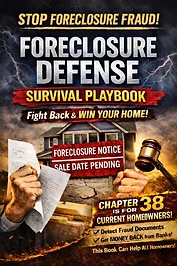
This is exactly why the Foreclosure Defense Survival Playbook is an indispensable resource for every homeowner, not just those in distress. This comprehensive 530-page educational book pulls back the curtain on the banking industry's most guarded secrets. It teaches you, in plain language, how to read your mortgage documents like a forensic auditor.
Whether you are preparing for a routine refinance or simply want the peace of mind that comes with knowing your home is truly secure, the Playbook provides the exact frameworks, evidence organization strategies, and legal research tools you need to spot hidden fraud. Don't wait until a bank threatens your home to find out if your paperwork is accurate. Take control of your largest financial asset today, audit your documents, and arm yourself with the knowledge found in the Foreclosure Defense Survival Playbook.

Order The Playbook
Get the Foreclosure Defense Survival Playbook
530 pages of structured, educational guidance covering mortgage documents, foreclosure procedures, evidence organization, and legal research — the same foundation this article draws from.