Homeowner Education
The Hidden Fraud in Your Refinance Paperwork: Why Current Homeowners Must Audit Their Mortgage Documents
Recent reports reveal a surge in AI-generated fake documents and refinance fraud. Even if you pay on time, auditing your mortgage paperwork is essential to protect your home.

Disclaimer: The information contained in this article is for educational and informational purposes only and should not be construed as legal advice. If you have specific questions about your mortgage documents or suspect fraud, please consult with a qualified attorney licensed in your jurisdiction.
You pay your mortgage on time every single month. You keep your property taxes current, maintain your home, and assume that because you are a responsible borrower, your lender's paperwork is equally flawless. But what happens when you decide to take advantage of lower interest rates or tap into your home equity?
Before you sign a single page of new refinance paperwork, you must ask yourself a critical question: Is the original mortgage file actually accurate, or is it hiding dormant fraud?
Recent enforcement actions and industry reports reveal a terrifying reality for American homeowners. The mortgage industry is currently battling a massive wave of document irregularities, forged signatures, and sophisticated synthetic fraud. Even if you are perfectly current on your payments, your loan file could be riddled with fatal defects. Conducting a comprehensive mortgage document review is no longer just for homeowners facing default—it is a mandatory step for anyone preparing to refinance or review their financial portfolio.
The Alarming Rise of AI-Generated Mortgage Fraud and Forged Documents
For years, the mortgage industry has struggled with "robosigning"—the practice of employees rapidly signing thousands of foreclosure and assignment documents without verifying their accuracy. Today, that threat has evolved into something much more insidious.
In July 2026, the mortgage and legal sectors were rocked by reports highlighting a terrifying new trend: the use of Artificial Intelligence to generate flawless, fake mortgage documents. According to recent industry reporting, a landmark legal case has exposed the severe risks of AI-generated fake documents infiltrating county recording offices and lender files Mortgage fraud case shows AI's fake-document risk. Advanced generative AI and large language models are now being weaponized to create synthetic identities and fabricate chain-of-title documents that look entirely legitimate to the untrained eye Mortgage Fraud: Emerging Risks, Mitigation Strategies.
Furthermore, the National Notary Association recently revealed that fraud and forgery claims now account for a staggering 40 percent of the total title insurance claim costs associated with refinance transactions Refinance Fraud: Notaries are the last line of defense. This is more than double the rate seen in standard purchase transactions. Criminals are using synthetic identities and AI to bypass traditional title searches. This means that even if you are the legitimate homeowner, fraudulent documents, fake assignments, or bogus liens could be attached to your property's title without your knowledge. If you do not audit your own file, you may never discover these issues until they derail your refinance or sale.
Why On-Time Homeowners Need a Mortgage Document Review
Most homeowners believe that if they are not behind on payments, their loan file is in perfect order. This is a dangerous misconception. The modern mortgage industry relies on a complex web of securitization, where loans are bundled, sold, and transferred multiple times between various trusts, sponsors, and depositors.
During these rapid transfers, paperwork is frequently lost, improperly endorsed, or outright fabricated to cover up administrative sloppy work. When you decide to refinance, you are essentially asking a new lender to pay off the old lender based on the existing paperwork. If your current file contains loan document errors, missing assignments, or fraudulent notary stamps, you might be inadvertently validating a defective loan.
Think of your mortgage as a chain. Every time your loan is sold, a new link is added to that chain. If one of those links is broken—for example, if an assignment of mortgage was never properly recorded, or if the promissory note was never legally endorsed to the current trust—the current servicer may not actually have the legal standing to demand payment or authorize a payoff for a refinance. By conducting a mortgage audit, you are verifying that the entity you have been paying actually has the legal right to collect your money, and that your title is clear of fraudulent encumbrances.
Common Loan Document Errors Hiding in Plain Sight
When you sit down to review your mortgage paperwork, you are looking for specific legal instruments that govern your home loan. The two most important documents are the Promissory Note (the I.O.U. that outlines your repayment terms) and the Mortgage or Deed of Trust (the security instrument that gives the lender the right to foreclose if you default).
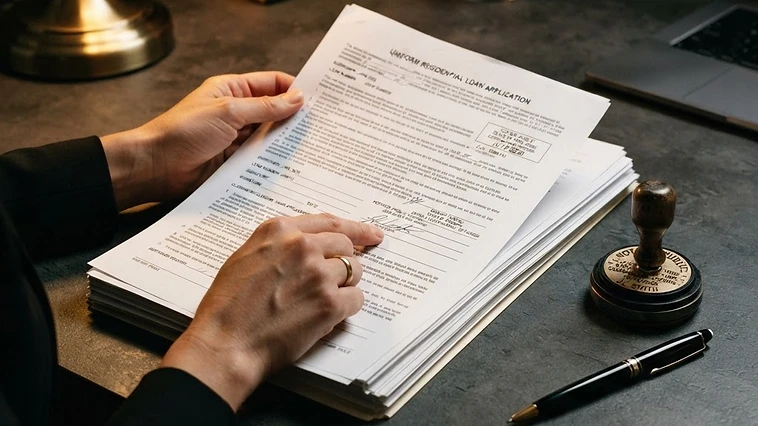 Hands reviewing a stack of mortgage refinance paperwork under a warm gold desk lamp.
Here are the most common loan document errors that current homeowners discover during a routine audit:
1. Missing or Fraudulent Endorsements on the Note When a loan is sold, the Promissory Note must be endorsed (signed over) to the new owner, much like a check. Often, these notes are transferred in blank or lack the necessary endorsements altogether. In some cases, auditors find "allonges" (separate sheets of paper with endorsements) that were clearly created years after the fact and backdated to cover up a missing transfer.
2. Broken Chains of Assignment If your Mortgage or Deed of Trust was sold, there must be a recorded Assignment of Mortgage in your county's public records. A common form of mortgage fraud involves fabricating these assignments years after a trust has closed, often using known robosigners whose signatures have been flagged by state attorneys general in previous enforcement actions.
3. MERS Irregularities The Mortgage Electronic Registration Systems (MERS) was created by the banking industry to bypass county recording fees by tracking loan transfers electronically. However, MERS has been at the center of countless legal battles regarding its authority to assign mortgages. If MERS is listed as the nominee on your Deed of Trust, you must carefully audit the corporate resolutions and signing authority of the individuals who executed any assignments on behalf of MERS.
4. Notary and Signature Fraud As highlighted by recent Department of Justice enforcement actions, real estate professionals and bad actors continue to originate and transfer residential mortgages using fake documents Real Estate Professional Pleads Guilty To $55 Million Mortgage Fraud Conspiracy. You should always verify the notary stamp on your recorded documents. Was the notary actually commissioned in the state where the document was signed? Was their commission valid on the date of the signature?
The Dangers of Blindly Signing Refinance Paperwork
Refinancing is not simply a modification of your interest rate; it is a legal process known as "novation." You are entering into a brand new contract that completely extinguishes and replaces the old one.
Why is this dangerous for the uninformed homeowner? Because if your original lender committed fraud, violated Truth in Lending Act (TILA) disclosures, charged illegal junk fees, or lacked the legal standing to hold your loan, signing a new refinance agreement often acts as a waiver of your right to challenge those past violations. You are effectively taking a potentially fraudulent, unenforceable debt and washing it clean by signing a brand new, legally binding contract with a new lender.
Furthermore, predatory refinance schemes often target homeowners who have built up substantial equity. Scammers and unethical brokers may rush you through the closing process, burying unfavorable terms, exorbitant origination fees, or mandatory arbitration clauses deep within the stack of refinance paperwork. If you have not audited your original documents, you lack the baseline knowledge needed to spot discrepancies in the new disclosures.
How to Conduct a DIY Mortgage Audit Before You Refinance
Conducting a basic mortgage document review does not require a law degree, but it does require patience, organization, and an eye for detail. Here is how current homeowners can begin auditing their own files:
Step 1: Request Your Collateral File Under the Real Estate Settlement Procedures Act (RESPA), you have the right to send a Request for Information (RFI) or a Notice of Error (NOE) to your mortgage servicer. You should request a complete copy of your collateral file, which includes the original Promissory Note (with all endorsements and allonges), the Deed of Trust, all Assignments, and a complete life-of-loan payment history.
Step 2: Pull Your County Property Records Do not rely solely on what the servicer sends you. Visit your local county recorder's office (or their online portal) and pull every document recorded against your property's parcel number. Compare the recorded assignments against the documents provided by your servicer. Look for discrepancies in dates, signatures, and corporate entities.
Step 3: Scrutinize the Signatures Cross-reference the names of the individuals who signed your assignments and endorsements. A simple web search of the signer's name alongside the word "robosigner" or "fraud" can often reveal if the individual was implicated in past government enforcement actions.
Step 4: Verify the Math Review your payment history and escrow account statements. Servicers frequently make accounting errors, misapplying principal payments to interest or charging unauthorized property inspection fees. Ensure that the payoff quote you receive for your refinance accurately reflects your true principal balance.
Why Auditing Your Mortgage Paperwork Matters
Even if you have never missed a payment and have excellent credit, the integrity of your mortgage paperwork is the only thing standing between your family and potential title disputes, predatory lending practices, or future foreclosure issues. Auditing your mortgage paperwork matters because your home is likely your most valuable financial asset, and you cannot afford to leave its legal standing to chance or trust that a massive banking institution has kept your file pristine.
Before you sign away your rights in a new refinance, you need to know exactly what is hiding in your current loan file. That is exactly why the Foreclosure Defense Survival Playbook was written.
This comprehensive, 530-page educational resource is not just for homeowners in distress. It is the ultimate guide for any homeowner who wants to pull back the curtain on the mortgage industry. The Playbook teaches you step-by-step how to read complex mortgage documents, how to spot forged signatures and AI-generated fraud, how to organize your evidence, and how to conduct the same level of legal research used by industry professionals.
Don't wait until a hidden defect derails your financial future or clouds your property title. Take control of your mortgage paperwork today. Order the Foreclosure Defense Survival Playbook and empower yourself with the knowledge to protect your home, audit your documents, and secure your peace of mind.


Order The Playbook
Get the Foreclosure Defense Survival Playbook
530 pages of structured, educational guidance covering mortgage documents, foreclosure procedures, evidence organization, and legal research — the same foundation this article draws from.