Mortgage Documents
The Hidden Flaws in Your Loan: Why Every Homeowner Needs a Mortgage Document Review
Recent industry reports reveal a massive spike in mortgage document errors and compliance defects, proving that even on-time homeowners need to audit their loan paperwork.

Disclaimer: This article is for educational purposes only and does not constitute legal advice. The information provided is intended to help homeowners understand their mortgage documents and is not a substitute for professional legal counsel.
If you are a homeowner who pays your mortgage on time every month, you might assume that your loan file is in perfect order. You receive your monthly statements, you make your payments, and your balance slowly decreases. However, the reality of the modern mortgage industry is far more chaotic. Behind the scenes, loans are bought, sold, securitized, and transferred between servicers at breakneck speed. In this high-volume environment, paperwork is frequently botched, signatures are rushed, and compliance regulations are overlooked.
Whether you are currently exploring a lower rate or simply organizing your financial life, conducting a thorough mortgage document review is an essential step for every homeowner. Recent data and federal enforcement actions reveal a disturbing trend: the industry is currently experiencing a massive surge in loan document errors, compliance failures, and outright mortgage fraud. Even if you are perfectly current on your payments, your refinance paperwork or original loan documents could be riddled with defects that jeopardize your chain of title or cost you thousands in hidden fees.
The Hidden Risks in Your Refinance Paperwork
When interest rates shift, homeowners rush to refinance. While securing a lower rate is financially beneficial, the sudden influx of applications often overwhelms lenders, leading to a breakdown in quality control. If you have recently refinanced or are planning to, you must pay close attention to your refinance paperwork.
According to recent industry data, the mortgage industry's critical defect rate jumped significantly in the first quarter of 2026. As reported in Mortgage critical defect rate rises to 1.71% in Q1 2026, the overall critical defect rate rose to 1.71%, up from 1.38% in the previous quarter. This 23.9% quarterly increase is the largest seen in four years.
What exactly is a "critical defect"? In the mortgage industry, a critical defect means that a loan possesses at least one major error that could render it uninsurable or ineligible for sale on the secondary market. For the homeowner, this means the foundational documents governing your property rights are flawed. The data shows that refinance loans are particularly vulnerable, producing 38.57% of these critical defects. As lenders rush to push through refinance applications, they are making systemic errors in calculation, analysis, and documentation.
Recent Spikes in Loan Document Errors and Compliance Failures
When you sit down to sign a stack of mortgage documents, you trust that the lender has adhered to all state and federal regulations. Unfortunately, the numbers tell a different story. The same industry reports highlight that legal, regulatory, and compliance defects accounted for a staggering 26.02% of all findings, making it the leading category for loan defects.
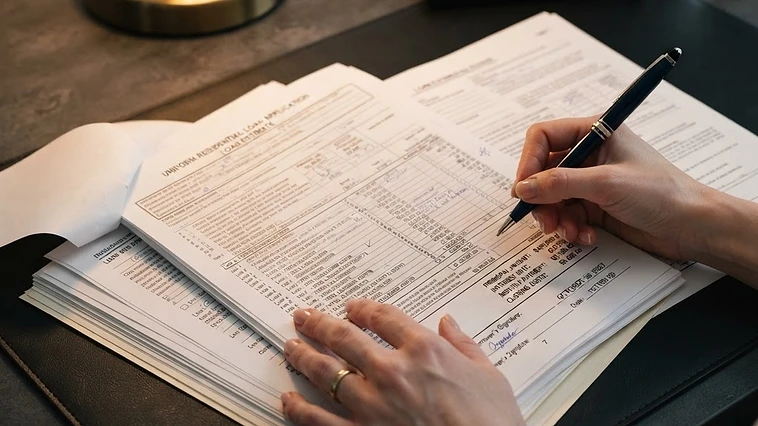 Close-up of a homeowner conducting a mortgage document review on a dark desk.

These loan document errors are not just minor typos. They involve failures to provide mandatory disclosures, inaccurate calculations of assets and income, and botched loan documentation. For example, Brief Refinance Shift Tests Mortgage Lenders’ Compliance Controls – NMP notes that loan documentation defects increased to 8.55% of critical defects. Furthermore, calculation and analysis findings skyrocketed from 17.65% to 42.86% within the asset category.
For a current homeowner, these statistics should be a wake-up call. If lenders are struggling to correctly interpret financial information and execute compliant paperwork, what errors might be hiding in your own file? A proactive mortgage audit allows you to verify that your principal balance, interest rate calculations, and escrow accounts are accurate, ensuring you aren't quietly overpaying due to a servicer's mathematical blunder.
Mortgage Fraud and Falsified Documents: A Growing Threat
While institutional incompetence is a major concern, malicious mortgage fraud remains a persistent threat in the real estate market. Federal authorities are actively cracking down on sweeping schemes that corrupt the integrity of the mortgage process.
Recently, the Department of Justice announced multiple indictments related to falsified financial documents. In Texas, a grand jury indicted four individuals in a multi-year scheme that resulted in over $7.3 million in fraudulent home loans, as detailed in Grand jury indicts 4 in sweeping $7.3 million mortgage fraud scheme targeting FHA and VA programs. The defendants allegedly flooded lenders with fabricated W-2s, pay stubs, and bank statements. Similarly, another case highlighted in Two charged in mortgage fraud scheme involving falsified financial documents involved Houston-area residents submitting fraudulent loan applications to multiple lenders.
While these specific cases involve borrowers and brokers conspiring to defraud lenders, they highlight a broader systemic vulnerability: the mortgage industry's verification systems are highly susceptible to manipulation. If fraudulent documents can easily slip through the underwriting process, it raises serious questions about the overall integrity of mortgage record-keeping. When you conduct a mortgage document review, you are not just looking for lender mistakes; you are ensuring that no unauthorized or fraudulent modifications, assignments, or liens have been attached to your property's title.
The Dangers of Sloppy Legal Work and Servicing Disputes
Even after your loan is closed, the risks do not disappear. Mortgage servicers—the companies that collect your monthly payments—are notorious for sloppy record-keeping and aggressive legal tactics. If you ever need to dispute a fee or request information, you may find yourself stonewalled by a bureaucracy that barely understands its own files.
Borrowers frequently have to rely on the Real Estate Settlement Procedures Act (RESPA) to force servicers to respond to inquiries. However, navigating these disputes is complex. In a recent ruling covered by Court affirms dismissal of mortgage servicer dispute case | LAWS.com News, an appellate court dismissed a borrower's RESPA claims regarding fees and interest added during a mortgage modification, ruling they were not recoverable under specific RESPA servicing provisions. This underscores how strictly courts interpret mortgage laws and why your documents must be pristine.
Furthermore, the legal representation hired by these financial institutions is not infallible. In a shocking recent development, a law firm representing a major mortgage trustee in a foreclosure appeal was caught using artificial intelligence to draft a legal brief, resulting in the submission of fake, non-existent case citations. As reported in AI Errors Leave Mortgage Trustee Without Brief In Foreclosure Appeal – NMP, the appellate court struck the entire brief, calling it a "cautionary tale about the misuse of artificial intelligence." If the attorneys representing Wall Street trusts are carelessly using AI to hallucinate legal arguments, you cannot blindly trust that the documents they drafted for your loan are accurate or legally binding.
How to Approach Your Own Mortgage Audit
Given the high rates of critical defects, compliance failures, and sloppy legal work in the industry, every homeowner should perform a basic mortgage audit. You do not need to be behind on your payments to benefit from this process. In fact, reviewing your documents while you are current gives you the leverage and time to correct errors without the looming threat of foreclosure.
When reviewing your refinance paperwork or original loan file, start by examining the chain of title. Look at the Deed of Trust or Mortgage and any subsequent Assignments. Are the dates sequential? Are the signatures legible, or do they look like they were mass-produced by a robo-signer? Check for the presence of the Mortgage Electronic Registration Systems (MERS) and ensure that any transfers involving MERS comply with your state's recording laws.
Next, review your closing disclosures and Truth in Lending Act (TILA) statements. Recalculate the math. Ensure that the interest rate, APR, and total loan costs match what you agreed to. Finally, audit your current monthly statements. Look for unexplained fees, improper escrow calculations, or unauthorized property inspection charges. If you spot discrepancies, you can use RESPA to send a Qualified Written Request (QWR) or Notice of Error (NOE) to demand answers from your servicer.
Why Auditing Your Mortgage Paperwork Matters
Many homeowners believe that as long as they make their payments, the paperwork doesn't matter. But your mortgage documents are the legal foundation of your homeownership. A single missing signature, a botched assignment, or a hidden compliance defect can cloud your title, complicate a future sale, or result in thousands of dollars in unjustified servicer fees.
This is exactly why the "Foreclosure Defense Survival Playbook" is an indispensable resource for every homeowner, not just those facing financial distress. The Playbook is a comprehensive, 530-page educational guide that demystifies the complex world of mortgage documents, securitization, and legal research. It teaches you step-by-step how to conduct a professional-level mortgage audit on your own file, how to spot the exact loan document errors that plague the industry, and how to organize your evidence to hold lenders and servicers accountable.
Don't wait until you are trying to sell your home, refinance, or facing an unexpected financial hardship to find out your loan file is a mess. Take control of your financial future today. Order the "Foreclosure Defense Survival Playbook" and learn how to protect your greatest asset from the hidden flaws, errors, and fraud lurking in the modern mortgage industry.


Order The Playbook
Get the Foreclosure Defense Survival Playbook
530 pages of structured, educational guidance covering mortgage documents, foreclosure procedures, evidence organization, and legal research — the same foundation this article draws from.