Mortgage Documents
The Hidden Dangers in Your Refinance Paperwork: Why Current Homeowners Must Audit Their Mortgages
Even if you are current on your mortgage payments, hidden loan document errors and refinance fraud could jeopardize your home. Learn why auditing your paperwork is essential before you refinance.

Disclaimer: The information contained in this article is for educational purposes only and does not constitute legal advice. If you have specific questions about your mortgage banking documents or require legal counsel, please seek the advice of a qualified attorney.
When you pay your mortgage on time every month, it is easy to assume that everything behind the scenes is functioning perfectly. You receive your monthly statement, you make your payment, and your balance slowly decreases. For many homeowners, the only time they pull out their original loan documents is when they are preparing to sell their home or apply for a refinance. However, recent industry reports and federal enforcement actions reveal a troubling reality: the mortgage industry is rife with loan document errors, missing assignments, and sophisticated refinance fraud.
Even if you are completely current on your payments and have never missed a beat, your mortgage file could be a ticking time bomb of inaccuracies. From artificial intelligence being used to fabricate income documents to title insurance losses skyrocketing due to forgery, the modern real estate landscape requires homeowners to be more vigilant than ever. Before you sign a new stack of refinance paperwork, it is absolutely critical to conduct a thorough mortgage document review.
The Surging Threat of Refinance Fraud and Forgery
Many homeowners believe that fraud only happens during the initial purchase of a home or when a borrower is in default. This is a dangerous misconception. According to a recent Milliman Inc. study commissioned by the American Land Title Association (ALTA), fraud and forgery claims tied specifically to mortgage refinances have surged dramatically. In fact, these claims now represent over 40% of all title insurer losses and expenses [6].
The financial impact of these hidden defects is staggering. The average cost of fraud and forgery claims on refinances has climbed to $207,000—almost seven times higher than other types of claims [6]. What makes this trend so alarming for the average homeowner is that these issues often cannot be detected through a simple public records search. Fraudsters are exploiting the digital closing process, and errors in the chain of title are becoming more common as loans are bought, sold, and transferred between servicers.
When you decide to refinance, your new lender will rely on the existing public record to establish their lien position. If your original mortgage paperwork contains forged signatures, improper notarizations, or unrecorded assignments, it can create a nightmare scenario that delays your refinance, increases your costs, or even threatens your legal claim to the property. This is why a proactive mortgage audit is not just for distressed borrowers—it is a necessary protective measure for every homeowner.
How AI and Digital Fabrication Complicate Mortgage Fraud
The rapid advancement of artificial intelligence has introduced a new layer of complexity to mortgage fraud. While the industry has long dealt with altered documents, the tools available to bad actors today are unprecedented. A recent federal case in the Middle District of Florida highlighted this exact risk, demonstrating how fraudsters used digital fabrication to create fake payroll documents and bypass underwriting thresholds [4].
In this scheme, conspirators used the identities of legitimate businesses to generate nonexistent wages on phony pay stubs, receiving compensation via electronic funds transfer for their efforts [4]. While this specific case involved front-end origination fraud, the implications for current homeowners are profound. If bad actors can seamlessly fabricate employment records, they can just as easily fabricate mortgage assignments, lien releases, and notary stamps.
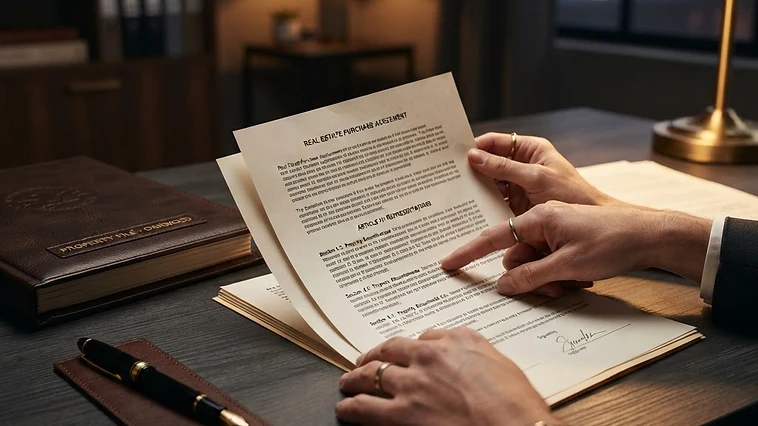 Homeowner conducting a mortgage document review on a dark desk with gold lighting

When your loan is sold from one institution to another, the transfer must be documented through an assignment of mortgage. During the housing crisis, the industry became infamous for "robo-signing"—the practice of mass-producing forged or improperly executed assignments to rush foreclosures. Today, the risk of digital robo-signing and AI-assisted forgery means that the documents sitting in your county recorder's office might look legitimate at first glance but fail under forensic scrutiny. Conducting a detailed mortgage document review helps you identify these irregularities before they become a legal liability.
Common Loan Document Errors Hiding in Plain Sight
Beyond intentional mortgage fraud, simple human error and systemic servicing failures pose a massive risk to your financial health. The Consumer Financial Protection Bureau (CFPB) has recently directed its examiners to heavily evaluate whether mortgage servicing and collection practices raise Unfair, Deceptive, or Abusive Acts or Practices (UDAAP) concerns [5].
When you review your refinance paperwork or your current loan file, you are looking for several common loan document errors that frequently hide in plain sight:
- Misapplied Payments and Escrow Errors: Servicers frequently make mistakes when calculating escrow requirements or applying your monthly payments to principal and interest. Over time, a small calculation error can cost you thousands of dollars and artificially inflate your payoff quote when you go to refinance.
- Missing or Defective Assignments: If your loan was sold, there must be a clear, unbroken chain of title. Often, assignments are left unrecorded, or they are signed by individuals who lacked the legal authority to execute the document.
- TILA and RESPA Violations: The Truth in Lending Act (TILA) and the Real Estate Settlement Procedures Act (RESPA) require lenders to provide specific disclosures at closing. If your original lender failed to provide accurate Annual Percentage Rate (APR) calculations or failed to disclose kickbacks, your loan documents are legally defective.
- MERS Irregularities: The Mortgage Electronic Registration Systems (MERS) was created to track loan transfers without recording every assignment in county records. However, MERS has been at the center of countless legal disputes regarding its authority to assign mortgages or initiate foreclosures. If MERS is listed as the nominee on your deed of trust, your mortgage audit must include a deep dive into how and when MERS transferred your loan.
Why a Mortgage Document Review is Essential Before Refinancing
Refinancing your home is essentially taking out a brand-new loan to pay off the old one. During this process, the new lender will require a clean title and a precise payoff amount from your current servicer. If you have not conducted a mortgage document review, you are blindly trusting that your current servicer's numbers are accurate and that your original lender filed everything correctly.
Consider the defense costs associated with title disputes. Defending a fraud or forgery claim on a refinance transaction now averages nearly $70,000 [6]. Even if you have a title insurance policy, the stress, delay, and potential legal exposure can derail your financial plans. By auditing your mortgage paperwork before you apply for a refinance, you take control of the narrative. You can demand corrections, file Notices of Error (NOEs) under RESPA, and ensure that you are not paying for junk fees, miscalculated interest, or fraudulent charges.
Furthermore, if you discover significant loan document errors or evidence of predatory lending in your original file, you may have immense leverage. In some cases, homeowners have used these discoveries to negotiate better terms, force principal reductions, or hold their servicers accountable for regulatory violations.
How to Conduct a Basic Mortgage Audit on Your Own Files
Taking the first step toward protecting your home does not require a law degree; it requires organization and attention to detail. A proper mortgage audit begins with gathering every single document related to your home. This includes your original promissory note, the mortgage or deed of trust, the closing disclosure (or HUD-1 settlement statement), all loan modifications, and your complete payment history.
Once you have your file assembled, start by verifying the signatures. Do the signatures on the note match the signatures on the mortgage? Are the notary stamps clear, and were you actually in the presence of the notary on the date listed? Next, pull your property's history from the county recorder's office. Trace the chain of title from the day you bought the house to the present. If your servicer claims that "Bank A" sold the loan to "Bank B," there should be a recorded assignment reflecting that transfer. If the assignment is missing, or if it was recorded years after the supposed sale, you have identified a major red flag.
Finally, scrutinize your payment history. Request a comprehensive transaction history from your servicer and calculate the interest and escrow deductions yourself. Look for unexplained corporate advances, property inspection fees, or late charges that were assessed even when you paid on time. These "nickel and dime" charges are a hallmark of servicing abuse and can add up to a substantial sum when it is time to refinance.
Why Auditing Your Mortgage Paperwork Matters
It is a dangerous myth that only homeowners facing foreclosure need to worry about the accuracy of their loan files. The reality is that the mortgage industry is a high-volume, profit-driven machine that frequently prioritizes speed over accuracy. Whether it is the rising threat of AI-generated refinance fraud, the staggering $207,000 average cost of title forgery claims, or simple servicing errors that drain your equity, the risks are too great to ignore.
Even current, on-time homeowners must audit their mortgage paperwork before refinancing or facing a potential future default. You cannot rely on the bank to catch its own mistakes, and you certainly cannot rely on them to act in your best interest. You must become your own advocate, and that requires education, preparation, and the right tools.
This is exactly why the Foreclosure Defense Survival Playbook is an indispensable resource for every homeowner. This comprehensive, 530-page educational guide is not just for those in distress—it is the ultimate manual for understanding mortgage documents, organizing evidence, and conducting a professional-level mortgage audit on your own files. The Playbook teaches you step-by-step how to spot fraud, identify hidden errors, and expose the defects in the documents your lender or servicer handed you. Do not wait until a minor paperwork error turns into a massive legal battle or derails your refinance. Order the Foreclosure Defense Survival Playbook today, audit your files, and secure the peace of mind that comes with knowing your home is truly protected.


Order The Playbook
Get the Foreclosure Defense Survival Playbook
530 pages of structured, educational guidance covering mortgage documents, foreclosure procedures, evidence organization, and legal research — the same foundation this article draws from.