Mortgage Documents
The Hidden Dangers in Your Mortgage Documents: Why Every Homeowner Needs a Mortgage Audit
Recent federal crackdowns and the rise of AI-generated fake documents highlight a growing risk for homeowners. Even if you are current on your payments, auditing your mortgage paperwork is essential to protect your property rights.

Disclaimer: The following article is for educational purposes only and does not constitute legal advice. If you need legal assistance regarding your specific situation, please consult a qualified attorney.
For most homeowners, paying the mortgage on time every month provides a sense of security. You receive your monthly statement, you make your payment, and you assume that the bank, the servicer, and the title company have handled your paperwork flawlessly. However, recent federal enforcement actions, court rulings, and industry reports reveal a disturbing reality: the mortgage industry is rife with document errors, title defects, and sophisticated fraud.
Even if you are completely current on your payments and have never missed a beat, your loan file could be a ticking time bomb of inaccuracies. Whether you are planning to refinance, sell your home, or simply want peace of mind, conducting a thorough mortgage document review is no longer just for homeowners facing default. It is a necessary step for every property owner to ensure their chain of title is clear and their legal rights are protected.
The Rising Threat of Mortgage Fraud and AI-Generated Fake Documents
In recent weeks, the mortgage industry has been rocked by a series of high-profile fraud cases and alarming reports regarding the integrity of loan originations. According to recent reporting from National Mortgage News, the rise of artificial intelligence has made it easier than ever for bad actors to generate fake documents, including falsified pay stubs, forged signatures, and fraudulent appraisals. In one recent federal case out of Florida, individuals pleaded guilty to a bank-fraud scheme that utilized fabricated payroll documents to con multiple lenders into issuing government-backed mortgages.
While you might assume that mortgage fraud only involves borrowers lying on their applications, the reality is much more complex. Fraud and negligence often occur on the institutional side. Recent enforcement actions have targeted title company owners pleading guilty to wire fraud for failing to segregate escrow funds, and appraisers facing decades in prison for identity theft and conducting fraudulent property inspections that led to $65 million worth of defective loans.
Furthermore, cyberattacks involving artificial intelligence have surged, leading to massive data breaches at major lenders. When institutional safeguards fail, the resulting chaos often trickles down to the homeowner's file in the form of lost documents, forged assignments, and clouded titles. This is why relying blindly on your servicer's records is a dangerous game.
Why Current Homeowners Must Perform a Mortgage Document Review
If you are paying your mortgage on time, you might wonder why you should care about loan document errors. The answer lies in the legal concept of "chain of title" and the mechanics of how mortgages are bought, sold, and securitized on Wall Street.
When you signed your original loan documents, your lender likely didn't keep your mortgage. It was probably sold to an aggregator, bundled into a residential mortgage-backed security (RMBS), and transferred multiple times. During these transfers, the physical promissory note must be properly endorsed, and the mortgage or deed of trust must be legally assigned in your local county land records.
Historically, and continuing to this day, the financial industry has struggled with the meticulous record-keeping required by real estate law. Assignments are frequently lost, signatures are sometimes "robo-signed" by individuals who have no personal knowledge of the documents they are executing, and the Mortgage Electronic Registration Systems (MERS) can sometimes obscure the true owner of your debt.
If you decide to refinance your home, the new lender will require a clear title. If your current mortgage paperwork contains unrecorded assignments, missing endorsements, or fraudulent notary stamps from a previous transfer, your refinance could be delayed or denied. Worse, if a dispute ever arises regarding your escrow account, property taxes, or insurance, having a pristine, audited file is your only defense against a servicer's automated—and often flawed—system.
 Hands reviewing mortgage refinance paperwork on a dark desk under warm lighting.

Common Loan Document Errors Hiding in Your Refinance Paperwork
When you sit down to review your refinance paperwork or your original origination file, you aren't just looking for typos in your name or address. You are looking for structural defects that could invalidate the security instrument or inflate your financial obligations. Recent industry quality control reports have highlighted a shocking increase in loan defects. For instance, recent data shows that appraisal defects jumped over 150%, while borrower and mortgage eligibility defects more than doubled.
Here are some of the most common loan document errors discovered during a comprehensive mortgage audit:
1. Missing or Fraudulent Assignments: If your loan was sold, there should be a clear, unbroken chain of assignments recorded in your county clerk's office. Often, these assignments are missing entirely, or they are dated years after the trust that supposedly bought your loan was closed. In some cases, signatures on these assignments are forged or executed by known "robo-signers."
2. Unreleased Prior Liens: According to FinCEN reports on mortgage loan fraud, a frequent issue involves loan closing services failing to properly disburse loan proceeds or pay off underlying property liens. Prior lenders sometimes fail to release home equity loans in land record offices after receiving a payoff. This means that a previous mortgage might still be legally attached to your property, clouding your title and jeopardizing your current standing.
3. Appraisal and Title Defects: Appraisal fraud doesn't just hurt the bank; it hurts you. If your home was artificially overvalued due to a fraudulent appraisal scheme, you might be paying higher property taxes and insurance premiums than necessary. Additionally, title companies that fail to properly record your deed of trust leave you vulnerable to competing claims on your property.
4. Truth in Lending Act (TILA) and RESPA Violations: Federal law requires lenders to provide precise disclosures regarding your interest rate, finance charges, and total payments. Hidden fees, miscalculated APRs, and failure to provide the required notice of a transfer of servicing rights are rampant. These loan document errors can sometimes give homeowners powerful leverage to demand corrections or financial restitution.
How to Conduct a Basic Mortgage Audit
Conducting a mortgage audit requires patience, attention to detail, and a willingness to dig into public records. While a professional forensic audit can be highly detailed, current homeowners can start by taking the following steps to review their own files:
Step 1: Gather Your Origination Documents Locate your original closing folder. You need the Promissory Note, the Mortgage (or Deed of Trust), the Closing Disclosure (or HUD-1 Settlement Statement), and the Truth in Lending disclosures. If you don't have these, you can request a complete copy of your collateral file from your current servicer by sending a Qualified Written Request (QWR) or a Request for Information (RFI) under the Real Estate Settlement Procedures Act (RESPA).
Step 2: Pull Your County Land Records Visit your local county recorder's office (many have online portals) and search for your property by your name and parcel number. Download every document recorded against your property since you bought it. This includes the original deed of trust, any assignments, substitutions of trustee, and lien releases.
Step 3: Compare the Note to the Assignments The Promissory Note is the I.O.U., and the Mortgage is the document that secures the debt to your house. Look at the endorsements (stamps) on the back of your Note. Do they match the chain of assignments recorded in the county? If the Note is endorsed to "Bank A," but the recorded assignment says the mortgage was transferred directly to "Bank C," you have a broken chain of title.
Step 4: Scrutinize Signatures and Notaries Look closely at the signatures on your assignments and closing documents. Do the signatures look identical, or do they vary wildly? Are the notary stamps valid for the date the document was signed? In many mortgage fraud cases, documents are backdated, and a quick check of the notary's commission expiration date can reveal that the document was fabricated years after the fact.
Step 5: Review Your Payment History and Escrow Request a complete life-of-loan payment history from your servicer. Check how your payments are being applied to principal, interest, taxes, and insurance. Servicing software is notoriously glitchy, and unauthorized fee assessments (like improper property inspection fees or forced-placed insurance) can drain your equity without you ever realizing it.
Why Auditing Your Mortgage Paperwork Matters
The financial ecosystem surrounding your home is vast, complex, and heavily automated. When you are current on your payments, it is easy to assume that the machinery is working perfectly. However, the recent surge in AI-facilitated fraud, title company indictments, and skyrocketing appraisal defects proves that the system is deeply flawed.
Auditing your mortgage paperwork matters because your home is likely your most valuable asset. If you wait until you are refinancing to discover that a prior lien was never released, or if you wait until a financial hardship strikes to find out that your servicer has been misapplying your escrow funds, it may be too late to easily fix the problem. Proactively reviewing your refinance paperwork and origination documents ensures that you hold the leverage, not the bank.
This is exactly why the Foreclosure Defense Survival Playbook is an indispensable resource for every homeowner, not just those facing default. This comprehensive, 530-page educational guide pulls back the curtain on the banking industry's darkest secrets. It teaches you, step-by-step, how to read complex mortgage documents, how to spot the telltale signs of robo-signing and mortgage fraud, and how to organize your evidence like a seasoned investigator.
By securing your copy of the Playbook today, you empower yourself with the knowledge to audit your own loan file, demand accountability from your servicer, and protect your family's wealth from institutional negligence and hidden fraud. Don't wait for a crisis to discover the errors in your loan file—take control of your mortgage paperwork today.

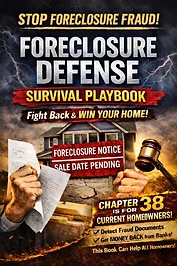
Order The Playbook
Get the Foreclosure Defense Survival Playbook
530 pages of structured, educational guidance covering mortgage documents, foreclosure procedures, evidence organization, and legal research — the same foundation this article draws from.