Mortgage Documents
The Hidden Dangers in Your Mortgage File: Why Current Homeowners Must Audit Their Documents
Recent cases of AI document fabrication and deed fraud prove that even homeowners who are current on their payments need to audit their mortgage paperwork.
Disclaimer: The following article is for educational purposes only and does not constitute legal advice. If you have specific questions about your mortgage banking documents or suspect fraud, please consult with a qualified attorney.
Imagine finding out that the home you own and pay for every single month is suddenly entangled in a web of title defects, forged signatures, or predatory fraud. You are not behind on your payments. You have never missed a property tax deadline. Yet, hidden deep within your loan file, a ticking time bomb of loan document errors is waiting to detonate the moment you attempt to refinance or sell your property.
Recent headlines have exposed a terrifying reality for American homeowners. From sophisticated artificial intelligence bots fabricating income documents to rogue title company owners embezzling escrow funds, the integrity of the modern mortgage file is under unprecedented attack. For homeowners who are currently paying their mortgages on time, the assumption is often that their paperwork is perfectly fine. However, a proactive mortgage document review is no longer just for those facing foreclosure—it is a vital protective measure for every single property owner.
The Illusion of the Perfect Loan File
When you sit down at a closing table to sign your refinance paperwork or original purchase documents, you are presented with a mountain of legalese. Promissory notes, deeds of trust, truth-in-lending disclosures, and closing disclosures are slid across the table, often with sticky notes pointing to where you need to sign. Most borrowers trust that the lender, the title company, and the notary public have executed their duties flawlessly.
Unfortunately, recent enforcement actions prove this trust is frequently misplaced. For example, a recent federal case highlighted a title company owner in Florida who pleaded guilty to wire fraud after failing to properly segregate and disburse funds from escrow accounts [1]. When title companies mishandle funds or fail to properly record documents in the county land records, it creates severe chain-of-title defects. You might think your previous mortgage was paid off and released during a refinance, but loan document errors at the county recording office could mean the old lien is still attached to your property.
If you are planning to refinance to take advantage of better rates or tap into your home equity, these hidden defects will abruptly halt the process. A thorough mortgage audit of your own file can reveal whether prior lenders actually released their liens and whether your current mortgage was recorded legally and accurately.
AI and the New Wave of Mortgage Fraud
Historically, mortgage fraud required a certain level of insider knowledge and manual forgery. Today, the landscape has shifted dramatically. Recent reports from financial risk consultants and industry news outlets highlight how generative artificial intelligence has supercharged document fabrication fraud [4, 6]. Bad actors can now generate convincing paystubs, bank statements, and synthetic identities in a matter of minutes.
While you know you didn't submit fake documents, how does this affect you? The danger lies in the secondary mortgage market and the actions of rogue mortgage brokers or correspondent lenders. In some cases, brokers have been caught altering a borrower's legitimate refinance paperwork to ensure a loan gets approved and they get their commission. They might inflate your income or alter asset statements without your knowledge.
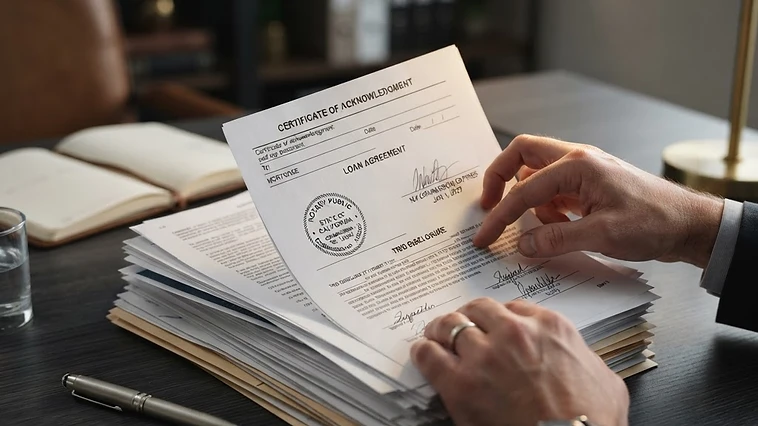 Hands reviewing refinance paperwork and notary stamps under a warm gold light.

If your loan is later audited by the investor (such as Fannie Mae or Freddie Mac) and these fabricated documents are discovered, the loan could be flagged for early payment default review or repurchase demands. While the lender bears the immediate financial brunt, the homeowner is left with a tainted loan file, potential accusations of misrepresentation, and a nightmare scenario if they ever need a loan modification or face a sudden financial hardship. Conducting a mortgage document review allows you to request your complete file from your servicer and verify that the information submitted on your behalf was 100% accurate.
Deed Fraud: Stealing Homes from Current Borrowers
One of the most alarming trends in real estate is the rise of deed fraud targeting homeowners who are completely current on their payments. In Pittsburgh, a real estate agent recently uncovered dozens of cases where homeowners discovered their properties were no longer legally theirs, despite never missing a mortgage payment or attempting to sell [7].
Fraudsters achieve this by forging the homeowner's signature on a deed transferring the property to a shell LLC or a fake trust, and then having the document illegally notarized. Once the fraudulent deed is recorded at the county courthouse, the criminals can take out loans against the property's equity or attempt to sell it to an unsuspecting third party.
Similarly, the Arizona Attorney General recently sued operators of a predatory real estate scheme who tricked vulnerable homeowners into transferring their deeds into deceptively named shell LLCs, utilizing illegal notarizations by a spouse with a financial interest in the transaction [1].
These cases underscore why you cannot simply pay your mortgage and ignore your property records. Regularly checking your county's land records to ensure no unauthorized deeds, liens, or fraudulent assignments have been recorded against your property is a critical component of a comprehensive mortgage audit.
The MERS Machine and Assignment Irregularities
If you look closely at your mortgage or deed of trust, you will likely see the acronym MERS (Mortgage Electronic Registration Systems, Inc.). MERS was created by the banking industry to bypass county recording fees when mortgages are bought and sold on the secondary market. Instead of recording a new assignment every time your loan changes hands, MERS remains the "nominee" for the lender in the county records.
However, the use of MERS has led to widespread confusion and documentation errors regarding who actually owns the promissory note and who has the legal standing to enforce the debt. When you are current on your payments, this might seem like an abstract banking problem. But if you ever need to refinance, the new title company must verify the exact chain of title. If there are missing assignments, unauthorized corporate signers (often referred to as "robo-signers"), or discrepancies between the MERS registry and the physical promissory note, your title is clouded.
Reviewing your refinance paperwork means scrutinizing every assignment of mortgage. Are the signatures legible? Was the person signing the assignment actually an employee of the bank, or were they a third-party vendor signing thousands of documents a day? Were the notary stamps valid at the time of signing? Identifying these loan document errors early gives you the leverage to demand corrections from your servicer before they become an insurmountable legal hurdle.
Why Auditing Your Mortgage Paperwork Matters
It is a common misconception that only homeowners facing foreclosure need to worry about the accuracy of their loan files. The reality is that the modern mortgage industry is a high-volume, fast-paced machine prone to clerical errors, lost documents, and, as recent news proves, outright mortgage fraud. Even if you are perfectly current on your payments, you must audit your mortgage paperwork before refinancing, selling, or facing an unexpected future default.
By conducting a proactive mortgage document review, you protect your most valuable asset. You ensure that your chain of title is clear, that no fraudulent liens have been attached to your home, and that the documents your lender relies upon are legally sound. Waiting until you are in financial distress to discover that your promissory note was lost or your deed was fraudulently transferred is a recipe for disaster.
This is exactly why the "Foreclosure Defense Survival Playbook" is an indispensable resource for every homeowner, not just those in distress. This comprehensive 530-page educational book teaches you step-by-step how to read your mortgage documents, understand complex banking procedures, and organize your evidence like a professional. It empowers you to spot the hidden fraud, notary irregularities, and title defects that lenders and servicers hope you will never notice. Don't wait for a crisis to understand your own legal paperwork. Order the Foreclosure Defense Survival Playbook today, take control of your financial future, and ensure your home truly belongs to you.


Order The Playbook
Get the Foreclosure Defense Survival Playbook
530 pages of structured, educational guidance covering mortgage documents, foreclosure procedures, evidence organization, and legal research — the same foundation this article draws from.