Foreclosure Defense
Foreclosure Normalization and Servicer Abuses: Defending Your Home in 2026
As foreclosure rates normalize, mortgage servicers are facing increased regulatory scrutiny for compliance violations and abuses. Learn how to protect your homeowner rights.


Disclaimer: The information provided in this article is strictly for educational purposes and does not constitute legal advice. If you are facing foreclosure, you should consult with a qualified attorney to discuss your specific situation.
For years, homeowners navigating financial hardship had a temporary safety net. Pandemic-era forbearance programs, emergency moratoriums, and historically low foreclosure volumes provided a buffer against the immediate threat of losing a home. However, the landscape has drastically shifted. We have officially entered an era of "foreclosure normalization," and mortgage servicers are aggressively ramping up their collection and litigation efforts.
Unfortunately, as foreclosure volumes rise, so do the instances of mortgage servicing abuses, sloppy paperwork, and outright violations of homeowner rights. Recent enforcement actions by federal regulators highlight a growing concern: banks and servicers are once again cutting corners at the expense of vulnerable homeowners.
If you are behind on your mortgage payments or already facing a foreclosure lawsuit, understanding the current regulatory environment and the tactics used by mortgage servicers is your first line of defense.
The Return of "Foreclosure Normalization"
According to a July 9, 2026, report published by JD Supra, the mortgage market is undergoing a meaningful correction, and "foreclosure normalization is here" [16]. This means that the artificially low foreclosure rates of the past few years are gone, and foreclosure activity is rising steadily across the country.
For homeowners, this normalization means that mortgage servicers are no longer holding back. They are actively filing notices of default, initiating judicial and non-judicial foreclosures, and pushing cases through the court system as quickly as possible. However, this rush to clear backlogs and process new defaults has led to a spike in compliance risks and litigation for the servicers themselves [16].
When servicers prioritize speed over accuracy, homeowners suffer. The pressure to process thousands of delinquent accounts often results in the same systemic errors that plagued the housing market during the 2008 financial crisis: lost paperwork, misapplied payments, and fraudulent document execution.
Recent Enforcement Actions Against Mortgage Servicers
Federal watchdogs are taking notice of the rising tide of servicer misconduct. In recent weeks, regulatory bodies have issued severe warnings and taken direct enforcement actions against financial institutions for violating consumer protection laws.
On June 18, 2026, the Office of the Comptroller of the Currency (OCC) announced a series of enforcement actions, including an Order of Prohibition against a former Vice President and Senior Mortgage Lending officer, signaling a strict crackdown on mortgage lending and servicing violations [4].
Similarly, the Consumer Financial Protection Bureau (CFPB) has been actively updating its policies and pursuing enforcement actions against servicers for illegal foreclosure practices. On June 25, 2026, the CFPB held discussions regarding current policy updates to address the rising compliance risks in the mortgage servicing sector [16]. The CFPB has historically taken aggressive action against servicers—such as Fay Servicing—for violating law enforcement orders and engaging in illegal foreclosure actions [14].
These regulatory actions prove a critical point for homeowners: just because a bank or mortgage servicer claims you owe a specific amount, or claims they have the right to foreclose, does not mean their claims are legally valid or accurate. Servicers make mistakes, and sometimes, they intentionally violate the law to expedite a foreclosure.
Common Mortgage Servicing Abuses to Watch For
If you are in default, you must scrutinize every document, statement, and notice you receive from your mortgage servicer. Mistakes made by mortgage servicers can have a devastating impact on homeowners if they do not detect and address them [11]. Here are the most common abuses to watch for:
1. Misapplication of Payments
Under the prompt crediting rule of the Real Estate Settlement Procedures Act (RESPA), a servicer must credit your payment on the day it receives the funds, with very few exceptions [11]. However, servicers frequently fail to properly process monthly payments, placing funds into "suspense accounts" instead of applying them to the principal and interest. This can trigger false defaults, unwarranted late fees, and inaccurate reporting to credit bureaus.
2. Dual Tracking
Dual tracking is one of the most egregious and illegal practices in the mortgage industry. This occurs when a mortgage servicer ostensibly negotiates with a homeowner for a loan modification or loss mitigation option, while simultaneously moving forward with the foreclosure process [11]. Federal law strictly prohibits dual tracking. If you have submitted a completed loss mitigation application, your servicer must finish its review before proceeding with a foreclosure sale [20].
3. Phantom Fees and Foreclosure Fee Inflation
Servicers often tack on inappropriate foreclosure costs, property inspection fees, or other invalid charges when a homeowner falls behind on payments [11]. In some cases of foreclosure fraud, service providers charge exorbitant fees to serve notices, passing thousands of dollars in inflated costs onto the homeowner's account [9].
 Close-up of hands reviewing mortgage loan ledger documents under a warm gold desk lamp.

Your Legal Rights When Facing Foreclosure
Homeowners are not powerless in the face of a foreclosure action. Both federal and state laws provide robust protections that you can use to defend your home.
The 120-Day Rule
Under federal law, a mortgage servicer cannot officially begin the foreclosure process until your mortgage payments are more than 120 days overdue [19]. This 120-day period is designed to give you time to submit a loss mitigation application and explore alternatives to foreclosure, such as a loan modification, short sale, or deed in lieu of foreclosure. Furthermore, the servicer must attempt to contact you by phone within 36 days of a missed payment to discuss these options [19].
State-Specific Protections
Many states have enacted their own Homeowner Bill of Rights to provide additional layers of protection. For example, in California, the servicer must contact you to discuss ways to avoid foreclosure before starting the nonjudicial foreclosure process, and they must assign you a single point of contact [24]. In New York, homeowners have the right to be notified at least 90 days before a foreclosure suit is filed, informing them that they are in default and at risk of foreclosure [20].
If a servicer fails to strictly comply with these pre-foreclosure notice requirements, it can serve as a powerful defense to stop or dismiss the foreclosure action entirely.
The Importance of Evidence and Document Review
Winning a foreclosure defense often comes down to the evidence. When a bank files a foreclosure lawsuit, they must prove that they have the legal standing to foreclose. This requires producing the original promissory note, the mortgage (or deed of trust), and a clear, unbroken chain of assignments proving how the current plaintiff acquired the loan.
Because mortgages are frequently bought, sold, and securitized into complex trusts, the paperwork is often a mess. To cover up missing documents, servicers have historically resorted to "robo-signing"—the practice of having employees blindly sign thousands of affidavits and assignments without verifying the accuracy of the information [21].
While the massive robo-signing settlements of 2012 [26] were supposed to end these practices, title fraud and fabricated documents remain a persistent issue in foreclosure litigation. As noted by legal experts, lying and fraud by servicers are evidence of substantive invalidity in a foreclosure claim [15].
If you are defending against a foreclosure, you must demand discovery. You have the right to request the servicer's payment history ledgers, the pooling and servicing agreement (PSA) if the loan was securitized, and proof of the chain of title. Often, a forensic review of these documents will reveal fatal flaws in the bank's case, such as forged signatures, backdated assignments, or unexplained jumps in the chain of title.
Why the Foreclosure Defense Survival Playbook Helps
Facing a foreclosure can feel like standing in front of a freight train, especially when dealing with massive financial institutions that seem to hold all the cards. But as recent regulatory enforcement actions prove, banks and mortgage servicers are not invincible. They make mistakes, they violate consumer protection laws, and they frequently rely on flawed or fabricated evidence to steal homes.
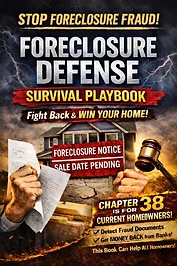
This is exactly why the Foreclosure Defense Survival Playbook is an indispensable resource for any homeowner behind on payments. This comprehensive, 530-page educational guide demystifies the complex world of mortgage documents, court procedures, and legal research. It teaches you how to audit your own mortgage file, spot the signs of robo-signing and servicer abuse, and organize your evidence like a forensic investigator.
Whether you are working with an attorney or navigating the early stages of default on your own, the Playbook empowers you with the knowledge to hold your mortgage servicer accountable. Don't let a bank illegally take your home due to their own compliance failures. Order the Foreclosure Defense Survival Playbook today and learn how to fight back with facts, evidence, and the law on your side.

Order The Playbook
Get the Foreclosure Defense Survival Playbook
530 pages of structured, educational guidance covering mortgage documents, foreclosure procedures, evidence organization, and legal research — the same foundation this article draws from.