Foreclosure Defense
Foreclosure Defense in 2026: Navigating New CFPB Rules and Servicer Abuses
As foreclosure filings surge, homeowners must understand the CFPB's new Regulation X loss mitigation rules and how to spot mortgage servicing abuses.
Disclaimer: The information provided in this article is for educational purposes only and does not constitute legal advice. Foreclosure laws vary by state, and every homeowner’s situation is unique. If you are facing foreclosure, consider consulting with a qualified foreclosure defense attorney.
If you have fallen behind on your mortgage payments in 2026, you are not alone. Following the complete expiration of pandemic-era protections and forbearance programs, the housing market is experiencing a rapid "normalization" of foreclosure activity.
For homeowners fighting to keep their properties, the legal landscape is shifting. In August 2026, the Consumer Financial Protection Bureau (CFPB) moved forward with critical updates to federal mortgage servicing rules under Regulation X, fundamentally changing how mortgage servicers must handle loss mitigation (foreclosure alternatives). At the same time, state enforcement actions against major loan servicers—including multi-million-dollar settlements for deceptive practices—prove that mortgage servicing abuses are still rampant.
Understanding these recent changes to federal rules, recognizing servicer misconduct, and knowing how to organize your evidence are the foundational steps of foreclosure defense. This educational guide breaks down what the most recent 2026 developments mean for your homeowner rights and how you can use this knowledge to fight back.
The 2026 Foreclosure Surge: What the Data Shows
For several years, mortgage moratoriums and emergency forbearance programs provided a cushion for homeowners struggling with economic hardship. Today, that cushion has completely eroded.
Data from the first quarter of 2026 revealed a startling 26% year-over-year increase in foreclosure filings nationwide. Bank repossessions (the final stage of the foreclosure process) jumped by 45%. Certain regions, particularly the Mid-Atlantic and Rust Belt, are seeing foreclosure listings account for as much as 5% to 6% of their local housing inventory.
This spike is largely driven by homeowners exhausting their loss mitigation options after exiting long-term forbearance. For borrowers with FHA-insured loans, the Department of Housing and Urban Development (HUD) has a strict "waterfall" of options that servicers must offer before foreclosing. Unfortunately, as default volumes rise, many understaffed mortgage servicers are rushing the process, skipping mandatory procedural steps, and pushing homeowners into foreclosure prematurely.
Understanding the August 2026 CFPB Mortgage Servicing Rules
To combat the rising tide of defaults, the CFPB has targeted the federal rules that govern how mortgage servicers operate, specifically the Real Estate Settlement Procedures Act (RESPA) Regulation X.
Historically, Regulation X contained strict anti-dual tracking provisions. "Dual tracking" is the illegal practice where a bank negotiates a loan modification with you while simultaneously moving forward with foreclosure proceedings. However, under the old rules, these protections only triggered if a borrower submitted a complete loss mitigation application.
Servicers notoriously used this as a loophole. They would repeatedly claim that an application was "incomplete"—asking for updated pay stubs or re-submitted tax returns—while pushing the foreclosure through the courts.
The CFPB's August 2026 rule updates aim to streamline this framework by removing the rigid "complete application" hurdle. Under the newly expected framework, the focus shifts toward procedural safeguards and fee caps. What does this mean for homeowners?
- Easier Access to Protection: You no longer need to jump through endless documentation hoops just to pause a foreclosure sale. Servicers are required to implement procedural safeguards earlier in the communication process.
- Fee Caps: The rules aim to restrict the predatory fees that servicers often stack onto an account while a borrower is in a loss mitigation review cycle.
- Language Accessibility: Servicers face stricter requirements to provide accurate, translated communications to borrowers whose first language is not English.
While these rule changes are designed to help borrowers, enforcing them requires vigilance. Servicers frequently fail to update their internal software and compliance manuals in time, leading to illegal foreclosures that violate these new CFPB standards. As a homeowner, understanding these rules allows you to spot when a servicer breaches federal law.
Ongoing Servicer Abuses: Lessons from Recent Enforcement Actions
If you believe your mortgage servicer is acting deceptively, you are likely correct. History and recent legal actions show that servicing abuses are systemic.
In June 2026, the California Attorney General announced a $4.6 million settlement with Select Portfolio Servicing (SPS), a major sub-prime mortgage servicer. The state's investigation found that SPS violated state and federal mortgage servicing laws by actively misleading homeowners who were exiting forbearance programs.
According to the enforcement action, the servicer:
- Failed to provide homeowners with adequate information about their forbearance exit options.
- Did not inform borrowers of their right to apply for other loss mitigation options.
- Sent inaccurate mortgage statements wrongly claiming that late fees would be charged for missed payments covered under forbearance.
Similarly, the CFPB has recently taken heavy enforcement actions against other nonbank mortgage servicers, such as Fay Servicing, for allegedly violating prior law enforcement orders. In these actions, the CFPB found that servicers continued to initiate foreclosure proceedings against borrowers who were actively seeking mortgage assistance, blatantly violating anti-dual tracking laws.
These enforcement actions are crucial tools for foreclosure defense. If a servicer has a documented history of federal and state violations, a homeowner can use this public record to bolster their own claims of servicer abuse, predatory practices, or unclean hands in a foreclosure lawsuit.
How to Protect Yourself: Evidence, Discovery, and Foreclosure Defense
When a bank files a foreclosure lawsuit—or initiates a non-judicial foreclosure sale—they are banking on the fact that you will not fight back. More than 80% of foreclosure cases go uncontested. But when you actively defend your home, you force the servicer to prove they have the legal right to foreclose and that they followed every federal and state regulation along the way.
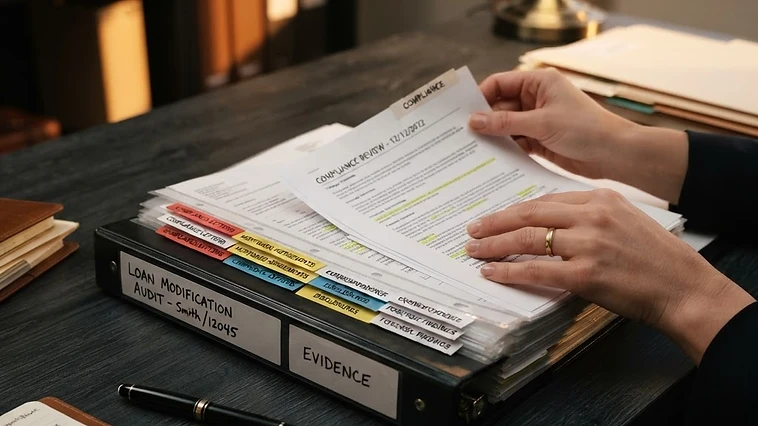 A neatly organized binder of mortgage documents and loss mitigation evidence on a dark legal desk.

To mount a successful foreclosure defense, you must meticulously organize your evidence and understand legal discovery. Here are the core strategies for defending your home in 2026:
1. Send a Request for Information (RFI) and Notice of Error (NOE)
Under RESPA, you have the right to send your servicer a Request for Information (RFI) or a Notice of Error (NOE). These are formally written letters sent to a designated address requesting specific documents or pointing out servicing mistakes (such as misapplied payments or illegal fees). By law, the servicer must acknowledge your letter within 5 days and provide a full response within 30 days. Failing to respond is a federal violation that can be raised in your defense.
2. Demand the Collateral File
Do not assume the entity foreclosing on you actually owns your loan. During the securitization boom, mortgages were sold, transferred, and packaged into trusts multiple times. Demand to see the original promissory note, the mortgage (or deed of trust), and all assignments. Check the endorsements (allonges) on the note. If the chain of title is broken, or if an assignment was “robo-signed” years after the trust closed, the plaintiff may lack the legal standing to foreclose.
3. Log Every Communication
Your most powerful weapon against servicer abuse is a detailed communication log. Every time you speak to your servicer, write down the date, time, the agent's name or ID number, and exactly what was said. If a phone representative tells you, "Don't worry about the foreclosure notice, you are in active loss mitigation," you must document it. This log can be used as evidence to prove the servicer misled you or violated CFPB early intervention rules.
4. Scrutinize the Breach Letter
Before accelerating your loan and filing for foreclosure, the servicer must send you a Notice of Default or "Breach Letter." Most mortgages (specifically Paragraph 22 in standard Fannie Mae/Freddie Mac documents) require this letter to contain highly specific language detailing the default, the exact amount needed to cure, and a strict timeframe (usually 30 days). If the servicer skips this step or sends a defective letter, you can often move to have the foreclosure case dismissed.
Why the Foreclosure Defense Survival Playbook Helps
Fighting foreclosure can feel like navigating a maze in the dark. The banks have teams of attorneys, endless resources, and automated systems designed to take your property. But they also make massive procedural errors, violate CFPB regulations, and rely on homeowners giving up without a fight.
The Foreclosure Defense Survival Playbook is a comprehensive, 530-page educational resource created specifically to level the playing field for homeowners. Whether you are already in litigation or just starting to receive default letters, this Playbook walks you through the actual documents, procedures, and legal research methods used in real foreclosure cases.
Inside the Playbook, you will learn how to:
- Draft and send RESPA-compliant Requests for Information (RFI) and Notices of Error (NOE) to force your servicer to hand over critical documents.
- Decode your mortgage trust documents, track down SEC filings, and spot broken chains of assignment and robo-signing.
- Organize an impenetrable evidence binder that tracks every servicer lie, dual-tracking violation, and misapplied payment.
- Understand court procedures, discovery requests, and how to effectively conduct your own legal research.
Don't let a mortgage servicer illegally take your home because you didn't know your rights. Arm yourself with the knowledge to hold them accountable. Order the Foreclosure Defense Survival Playbook today and take the first step toward saving your home.

Order The Playbook
Get the Foreclosure Defense Survival Playbook
530 pages of structured, educational guidance covering mortgage documents, foreclosure procedures, evidence organization, and legal research — the same foundation this article draws from.