Mortgage Servicing
Defending Against Mortgage Servicing Abuses, Junk Fees, and Deceptive Practices
Recent federal enforcement actions and court rulings expose widespread mortgage servicing abuses, including illegal junk fees and deceptive loss mitigation tactics.

Disclaimer: The information provided in this article is for educational purposes only and does not constitute legal advice. If you are facing foreclosure, you should consult with a qualified attorney to discuss your specific situation.
For homeowners struggling to keep up with monthly payments, the threat of foreclosure is a terrifying reality. But what happens when the very institutions tasked with managing your loan—the mortgage servicers—engage in deceptive practices, assess illegal fees, and violate federal laws? Recent enforcement actions by the Consumer Financial Protection Bureau (CFPB) and rulings from federal appellate courts have exposed a disturbing trend of mortgage servicing abuses that directly harm homeowners in distress.
From assessing unauthorized "junk fees" to sending misleading loss mitigation notices, mortgage servicers are frequently failing to comply with the strict regulations designed to protect consumers. For homeowners building a foreclosure defense, understanding these recent developments is critical. By recognizing when a servicer has violated the Real Estate Settlement Procedures Act (RESPA), the Truth in Lending Act (TILA), or the Fair Debt Collection Practices Act (FDCPA), you can better organize your evidence and assert your homeowner rights.
The Rise of Mortgage Servicing Junk Fees
One of the most pervasive issues highlighted in recent CFPB Supervisory Highlights is the assessment of illegal "junk fees" by mortgage servicers. When a homeowner falls behind on payments, servicers often begin charging a variety of default-related fees. While some of these fees are permitted under the mortgage contract, examiners have found widespread instances of servicers crossing the line into unfair, deceptive, and abusive acts or practices (UDAAP).
For example, federal regulators recently discovered that mortgage servicers were charging homeowners for property inspections following a delinquency, even when such inspections were explicitly prohibited by investor guidelines (such as those set by Fannie Mae). These unnecessary property inspection fees artificially inflate the homeowner's debt, making it even more difficult to cure the default and avoid foreclosure.
Additionally, examiners found that servicers were assessing improper late fees that exceeded the maximum amount allowed by the loan agreement or state law. In some cases, servicers continued to charge late fees even after consumers had entered into loss mitigation agreements that should have paused such penalties. For a homeowner in foreclosure, auditing the loan history for these illegal junk fees is a vital step in challenging the accuracy of the servicer's claimed debt.
Deceptive Loss Mitigation Practices and Regulation X
Loss mitigation is the process by which a homeowner and a mortgage servicer work together to avoid foreclosure, often through loan modifications, forbearance, or repayment plans. This process is heavily regulated by RESPA and its implementing regulation, Regulation X. Unfortunately, recent federal reports indicate that servicers are routinely violating these rules.
Regulators have cited servicers for sending deceptive loss mitigation eligibility notices to consumers. In some instances, servicers sent notices to homeowners in default stating that they had been approved for a repayment option when, in fact, no final decision had been made. This type of misrepresentation can cause homeowners to stop pursuing other alternatives, falsely believing their home is safe, only to be blindsided by a foreclosure action later.
Furthermore, examiners found that servicers violated Regulation X by failing to provide a clear deadline for accepting or rejecting loss mitigation offers in their written notices. Without a clear deadline, homeowners are left in the dark, and servicers may prematurely revoke an offer or proceed with foreclosure. The CFPB has been pushing to streamline mortgage servicing rules to ensure that servicers focus on helping borrowers rather than rushing to foreclose, emphasizing that rigid paperwork requirements should not be used as a weapon to deny assistance.
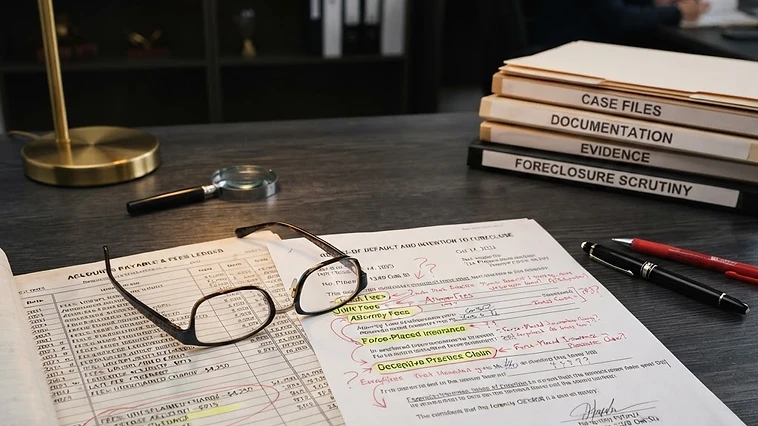 Mortgage documents and financial ledgers being scrutinized for servicing errors and junk fees.

Debt Collection Abuses and the FDCPA in Foreclosure
Mortgage servicers are not just loan administrators; in many cases, they are also considered debt collectors subject to the Fair Debt Collection Practices Act (FDCPA). The FDCPA was enacted to outlaw abusive, deceptive, and unfair debt collection practices. Recent court rulings, such as the Fourth Circuit's decision in Ruben Palazzo v. Bayview Loan Servicing, LLC, highlight the ongoing tension between mortgage servicing communications and debt collection laws.
In the Palazzo case, the homeowner, who was in Chapter 13 bankruptcy proceedings, alleged that his mortgage servicers violated the FDCPA by sending written communications—including payoff statements—that amounted to unlawful attempts to collect a discharged debt. While the court ultimately affirmed the dismissal of the homeowner's claims based on the specific facts and disclaimers in that case, the litigation underscores a critical point for foreclosure defense: every piece of correspondence from a servicer must be scrutinized.
Servicers often attempt to shield themselves from FDCPA liability by including boilerplate disclaimers on their letters, stating that the communication is "not an attempt to collect a debt." However, courts have recognized that a mere disclaimer does not automatically immunize a servicer if the overall context and demand of the letter clearly function as a debt collection effort. Homeowners must carefully organize all correspondence, payoff statements, and default notices to identify potential FDCPA violations, which can serve as powerful leverage in foreclosure litigation.
The Impact of Recent Enforcement Actions on Homeowners
Federal regulators have not hesitated to take action against repeat offenders in the mortgage servicing industry. Recent consent orders demonstrate the severe consequences for companies that systematically fail to respect homeowner rights.
For instance, the CFPB recently entered into consent orders with Sutherland Global Services and its subcontractor, NOVAD Management Consulting, resolving allegations that they failed to properly service reverse mortgages. The agencies alleged that these companies systematically ignored thousands of homeowner requests for loan payoff statements, short sales, deeds-in-lieu of foreclosure, and lien releases. Even worse, the companies were accused of falsely telling homeowners they were in default and ignoring the homeowners' attempts to contest the inaccurate information.
Similarly, enforcement actions against other major servicers, such as Fay Servicing, highlight a pattern of improper foreclosure practices. These actions often result in millions of dollars in consumer redress and civil penalties. For the homeowner facing foreclosure, these enforcement actions provide a roadmap of common servicer errors. If a massive, federally regulated servicer is being fined for failing to process loss mitigation applications or ignoring payoff requests, it is highly likely that similar errors exist in the files of everyday homeowners.
Defending Your Home: Recognizing Servicer Errors
To effectively defend against foreclosure, homeowners must become proactive investigators of their own mortgage files. The systemic abuses uncovered by recent federal actions—robo-signing, junk fees, ignored loss mitigation applications, and deceptive notices—are not isolated incidents; they are built into the business models of many servicing companies.
When building a foreclosure defense, you must demand a complete accounting of your loan. This involves sending a Qualified Written Request (QWR) or a Request for Information (RFI) under RESPA to obtain your complete payment history, servicing notes, and copies of all assignments and endorsements.
Once you have the documents, you must audit them meticulously. Look for unexplained property inspection fees assessed while you were in active loss mitigation. Check the math on late fees to ensure they do not exceed the contractual limits. Review every loss mitigation denial letter to ensure the servicer provided the specific reasons for denial and the required appeals process under Regulation X. If the servicer claims to hold the note, demand to see the original document to verify that the chain of title and assignments are legally valid and not the product of robo-signing.
Why the Foreclosure Defense Survival Playbook Helps
Navigating the treacherous waters of mortgage servicing abuses, junk fees, and complex federal regulations is nearly impossible without the right knowledge. The mortgage industry relies on the fact that most homeowners do not understand their rights under RESPA, TILA, or the FDCPA. They expect you to accept their inflated debt calculations and deceptive notices without a fight.
This is exactly why the Foreclosure Defense Survival Playbook is an indispensable resource for any homeowner facing default. This comprehensive, 530-page educational guide breaks down the complex world of mortgage documents, foreclosure procedures, and legal research into plain, understandable language. It teaches you how to audit your loan history for the exact types of illegal junk fees and property inspection charges recently targeted by the CFPB.
Furthermore, the Playbook provides step-by-step guidance on how to organize your evidence, draft effective Requests for Information, and spot the deceptive loss mitigation tactics that servicers use to push homeowners into avoidable foreclosures. By educating yourself on court procedures, discovery, and how to hold servicers accountable for their errors, you level the playing field. Don't let mortgage fraud and servicing abuses cost you your home. Order the Foreclosure Defense Survival Playbook today and empower yourself with the knowledge needed to fight back and protect your most valuable asset.


Order The Playbook
Get the Foreclosure Defense Survival Playbook
530 pages of structured, educational guidance covering mortgage documents, foreclosure procedures, evidence organization, and legal research — the same foundation this article draws from.