Foreclosure Defense
Defending Against Foreclosure in 2025: Servicer Abuses, Junk Fees, and Your Rights
Recent data shows foreclosures take an average of 762 days, giving homeowners time to uncover illegal junk fees, servicer abuses, and flawed mortgage documents.

Disclaimer: The information provided in this article is for educational purposes only and does not constitute legal advice. If you are facing foreclosure, you should consult with a qualified attorney in your jurisdiction.
Facing foreclosure is one of the most stressful experiences a homeowner can endure. When you fall behind on your mortgage payments, it often feels like the bank holds all the cards and that losing your home is an inevitable conclusion. However, recent data and federal enforcement actions reveal a very different reality. The foreclosure process is highly regulated, and mortgage servicers frequently make critical, sometimes illegal, errors that can be used to defend your home.
According to the Year-End 2024 U.S. Foreclosure Market Report released by ATTOM in January 2025, while overall foreclosure filings have seen a slight decline, the average time it takes to foreclose on a property has stretched to 762 days. In states like Louisiana, Hawaii, and New York, the process takes even longer. This extended timeline is not just a bureaucratic delay; it is a crucial window of opportunity for homeowners to scrutinize their mortgage documents, audit their payment histories, and hold their mortgage servicers accountable for widespread abuses.
The 2025 Foreclosure Landscape: Time is on Your Side
The recent ATTOM report highlights that over 322,000 properties had foreclosure filings in 2024. States like Nevada, Florida, New Jersey, Indiana, and Connecticut continue to see the highest foreclosure rates. But the most important statistic for a homeowner in default is the 762-day average foreclosure timeline.
Why does it take over two years for a bank to foreclose? The answer lies in the complexity of the legal system and the strict procedural requirements that lenders must follow. During this time, homeowners have the right to demand proof of the debt, challenge the legal standing of the foreclosing party, and apply for loss mitigation options like loan modifications. More importantly, this time allows you to investigate whether your mortgage servicer has engaged in deceptive practices or charged illegal fees that inflated your balance and pushed you further into default.
The CFPB Crackdown on Mortgage Servicer "Junk Fees"
Mortgage servicers are the companies that collect your monthly payments, manage your escrow account, and handle customer service. They are often not the original lender who funded your loan. Because they manage massive portfolios of loans, their systems are highly automated, which leads to frequent and devastating errors for homeowners.
Recently, the Consumer Financial Protection Bureau (CFPB) has launched a massive crackdown on what they term "junk fees" in the mortgage servicing industry. In their Supervisory Highlights report, the CFPB detailed numerous instances where mortgage servicers charged homeowners illegal and unauthorized fees.
One of the most common abuses involves property inspection fees. When a homeowner falls behind on payments, the servicer will often send someone to drive by the house to ensure it is still occupied and maintained. While some mortgage contracts allow for these inspections, the CFPB found that servicers were repeatedly charging for inspections that were explicitly prohibited by investor guidelines. Furthermore, examiners discovered that servicers were charging late fees that exceeded the maximum amounts allowed by the original mortgage agreements.
For a homeowner already struggling to make ends meet, these illegal junk fees can add hundreds or thousands of dollars to the reinstatement balance, making it artificially impossible to catch up on the loan.
Deceptive Notices and Loss Mitigation Violations
Beyond illegal fees, federal regulators have identified severe violations regarding how servicers handle loss mitigation—the process where a homeowner applies for a loan modification, forbearance, or repayment plan to avoid foreclosure.
 Mortgage documents and bank ledgers on a dark desk being reviewed for illegal junk fees and servicer errors.

The CFPB found that servicers were sending deceptive notices to homeowners in default. In some egregious cases, homeowners received official letters stating they had been approved for a repayment option or loan modification, when in reality, no final decision had been made. Relying on these false promises, homeowners stopped exploring other options, only to be subsequently rejected and pushed closer to a foreclosure auction.
Additionally, examiners noted that servicers failed to waive existing fees after a homeowner successfully completed a COVID-19 loan modification, and failed to make timely disbursements from escrow accounts for property taxes and insurance. When a servicer fails to pay your property taxes from your escrow account on time, the county assesses a penalty. Servicers were found to be passing these penalties onto the homeowners, further inflating the debt through no fault of the borrower. In recent enforcement actions, the CFPB has made it clear that ineffective loan servicing is not just a customer service issue; it is an abusive act or practice under federal law.
Procedural Defenses: Challenging Standing and Assignments
When defending against a foreclosure, homeowners can raise both procedural and substantive defenses. Procedural defenses focus on the rules the bank must follow to bring the lawsuit. One of the most powerful procedural defenses is challenging the foreclosing party's "standing."
Standing means that the party filing the foreclosure lawsuit has the legal right to do so. Because mortgages are frequently bought, sold, and securitized into Wall Street trusts, the company suing you is rarely the bank you originally borrowed from. To prove standing, the foreclosing party must show that they hold the original promissory note and that the mortgage was properly assigned to them before the lawsuit was filed.
During the 2010 foreclosure crisis, the industry was rocked by the "robo-signing" scandal, where bank employees forged signatures on thousands of mortgage assignments without verifying the underlying documents. While the industry claims to have cleaned up its act, flawed assignments and missing endorsements on promissory notes remain incredibly common. If the bank cannot produce a clear, unbroken chain of title, or if the assignment of mortgage was fabricated after the fact, the court may dismiss the foreclosure action. Recent appellate court rulings continue to reaffirm that strict compliance with pre-foreclosure notices (such as the 90-day notice required under laws like New York's RPAPL 1304) and proper proof of standing are absolute prerequisites to a valid foreclosure.
Substantive Defenses: Misapplied Payments and Dual Tracking
Substantive defenses focus on the actual facts of the case and the accounting of the loan. As highlighted by the CFPB's findings, servicer errors are rampant. A common substantive defense involves misapplied payments. You may have sent in a payment that the servicer placed into an "unapplied funds" suspense account rather than crediting it toward your principal and interest. This accounting trick triggers a false default, leading to late fees, property inspection fees, and eventually, a foreclosure complaint.
Another critical substantive defense is "dual tracking." Dual tracking occurs when a mortgage servicer simultaneously pursues a foreclosure while negotiating a loss mitigation option (like a loan modification) with the homeowner. Federal law, specifically the Real Estate Settlement Procedures Act (RESPA), strictly prohibits dual tracking. If you have submitted a complete loss mitigation application, the servicer cannot legally file for foreclosure, move for a foreclosure judgment, or conduct a foreclosure sale until your application has been fully evaluated and the appeal process has been exhausted. If your servicer violates this rule, it can be a powerful defense to stop the foreclosure in its tracks.
How to Audit Your Mortgage Statements for Fraud
To effectively defend your home, you must treat your foreclosure not just as a financial crisis, but as an evidentiary investigation. The burden of proof is on the bank, but you must know where to look to find their mistakes.
First, request a complete transaction history from your mortgage servicer. This is often done by sending a formal "Notice of Error" or "Request for Information" under RESPA. Once you receive the ledger, go through it line by line. Look for unexplained corporate advances, repetitive property inspection fees, and late fees assessed during months where you made a timely payment or were under a forbearance agreement.
Second, demand to see the original promissory note and all allonges (attachments containing endorsements). Check the dates on the assignments of mortgage. Did the original lender go out of business in 2008, but somehow sign an assignment of your mortgage in 2023? These chronological impossibilities are red flags for document fraud and can form the basis of a strong legal defense.
Why the Foreclosure Defense Survival Playbook Helps
Understanding the complexities of mortgage servicing abuses, junk fees, and chain of title issues is overwhelming, especially when you are facing the threat of losing your home. You do not have to navigate this complex legal maze blindly.
The "Foreclosure Defense Survival Playbook" is a comprehensive, 530-page educational resource designed specifically for homeowners who are behind on payments or already in foreclosure. This playbook breaks down the intimidating legal jargon into plain, actionable language. It teaches you exactly how to read and audit your mortgage documents, how to spot the illegal junk fees the CFPB is cracking down on, and how to organize your evidence to build a formidable defense.
Whether you are trying to negotiate a loan modification, fighting a flawed assignment of mortgage, or preparing to represent yourself in court, the Playbook provides the foundational knowledge you need to hold your mortgage servicer accountable. It covers everything from understanding court procedures and discovery to conducting legal research and spotting robo-signed documents.
Do not let a mortgage servicer's automated errors or illegal fees cost you your home. Equip yourself with the knowledge to fight back. Order the "Foreclosure Defense Survival Playbook" today and take the first step toward leveling the playing field and defending your property.

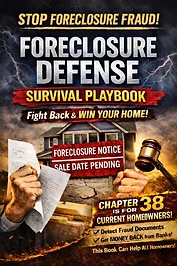
Order The Playbook
Get the Foreclosure Defense Survival Playbook
530 pages of structured, educational guidance covering mortgage documents, foreclosure procedures, evidence organization, and legal research — the same foundation this article draws from.