Foreclosure Defense
New 2025 Foreclosure Data: How to Use Mortgage Servicing Errors to Defend Your Home
Recent data shows the average foreclosure takes 762 days, giving homeowners crucial time to uncover mortgage servicing errors and fight back.

Disclaimer: The following article is for educational purposes only and does not constitute legal advice. If you are facing foreclosure, consult with a qualified attorney in your jurisdiction to understand your specific legal rights and options.
Facing foreclosure is one of the most stressful experiences a homeowner can endure. The constant letters, the fear of losing your sanctuary, and the confusing legal jargon can make you feel powerless against massive financial institutions. However, recent data and regulatory actions reveal a different story: homeowners have more time and more tools to fight back than they might realize.
According to recent reporting from January 2025, the average property foreclosed in the fourth quarter of 2024 had been in the foreclosure process for an average of 762 days [10]. That is over two years. This timeline is not just a statistic; it is a window of opportunity. It represents the time you have to organize your evidence, understand your mortgage documents, and mount a robust foreclosure defense.
Furthermore, federal watchdogs like the Consumer Financial Protection Bureau (CFPB) and the Financial Stability Oversight Council (FSOC) have recently highlighted severe vulnerabilities and abusive practices within nonbank mortgage servicing companies [3, 7]. By understanding these recent developments, you can identify potential flaws in how your loan was handled and use those errors to defend your home.
The 762-Day Advantage: Why Time is on Your Side
When homeowners miss a few payments, panic often sets in. The bank sends a Notice of Default, and it feels like the sheriff will be at the door the next day. But the reality of the legal system, especially in judicial foreclosure states, is much slower. The recent data showing an average foreclosure timeline of 762 days [10] proves that the process is a marathon, not a sprint.
This extended timeline exists for several reasons. First, federal law generally requires a 120-day waiting period after your first missed payment before a lender can even initiate a foreclosure [6]. This period is designed to give you time to apply for loss mitigation options, such as a loan modification, deferment, or forbearance [5].
Second, the courts are backlogged. In judicial foreclosure states like Florida, Illinois, and New York, the lender must file a lawsuit and prove their case in front of a judge [1, 5, 6]. If you actively defend the lawsuit—by filing an answer, demanding discovery, and challenging their evidence—you force the bank to prove every single element of their case. This takes time.
During these 762 days, you can remain in your home. You can use this time to save money, rebuild your finances, and meticulously review your mortgage documents for the fatal errors that banks and servicers make every single day.
Nonbank Mortgage Servicers and the Rise of Servicing Abuses
In recent years, traditional banks have stepped back from servicing mortgages, selling the servicing rights to nonbank mortgage companies (NMCs). These companies collect your payments, manage your escrow, and initiate foreclosures. However, they are often undercapitalized and prone to systemic errors.
A 2024 report by the Financial Stability Oversight Council (FSOC) warned that vulnerabilities in nonbank mortgage companies pose significant risks to the housing market [3]. Even more critically for homeowners, the CFPB recently declared that ineffective loan servicing can be classified as an "abusive act or practice" under federal law [7].
What does this mean for your foreclosure defense? It means that if your servicer failed to properly apply your payments, ignored your loss mitigation applications, or charged unauthorized fees, they may have violated federal law.
Common servicing abuses include:
- Dual Tracking: This illegal practice occurs when a servicer moves forward with foreclosure proceedings while simultaneously reviewing your application for a loan modification.
- Misapplied Payments: Servicers often place partial payments into "suspense accounts" rather than applying them to your principal and interest, artificially inflating your arrears and triggering unwarranted late fees.
- Fabricated Fees: Charging for unnecessary property inspections, inflated broker price opinions, or unauthorized legal fees.
If you can prove that your default was caused or exacerbated by the servicer's abusive practices, you can raise this as a powerful affirmative defense in your foreclosure case.
The Paper Trail: Assignments, Robo-Signing, and Bifurcation
To foreclose on your home, the entity suing you must prove they have the legal standing to do so. They must show they own both the mortgage (or deed of trust) and the underlying promissory note. Because mortgages are frequently bought, sold, and securitized on Wall Street, the paper trail is often broken.
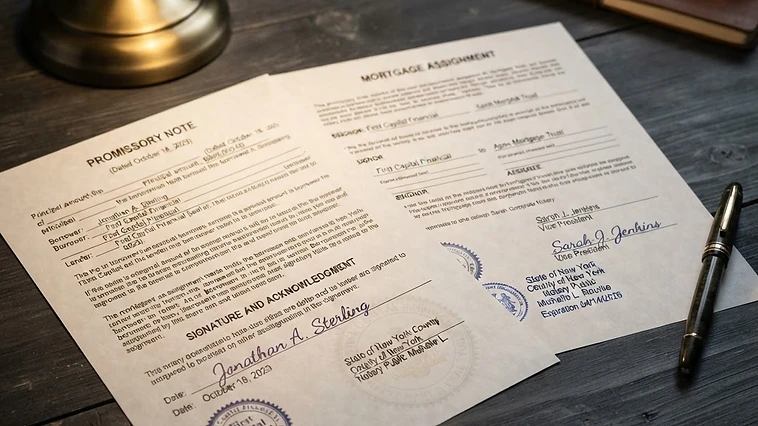 Close-up of mortgage assignment documents and a promissory note under a warm desk lamp.

One of the most potent foreclosure defense strategies involves challenging the validity of the mortgage transfer documents [6]. During the 2008 financial crisis, the industry was caught "robo-signing"—having employees blindly sign thousands of affidavits and assignments without verifying the information. While the industry claims to have cleaned up its act following the 2012 National Mortgage Settlement [8], document irregularities remain rampant.
When reviewing your foreclosure complaint, pay close attention to the Assignment of Mortgage. Was it signed years after the trust that supposedly owns your loan was closed? Was it signed by a known robo-signer?
Furthermore, you must understand the concept of bifurcation [1]. The U.S. Supreme Court has long held that the mortgage follows the note. If the promissory note was sold to one entity, but the mortgage was assigned to another (often through the Mortgage Electronic Registration Systems, or MERS), the relationship between the debt and the security instrument may be defective [1]. This bifurcation can weaken the lender's legal position and form the basis of a strong defense.
Navigating Loss Mitigation and Federal Protections
Before and during a foreclosure, you have federal rights under the Real Estate Settlement Procedures Act (RESPA) and CFPB regulations [5]. Mortgage servicers are legally required to provide you with written information about available loss mitigation options no later than 45 days after you become delinquent [5].
If you submit a complete loss mitigation application, the servicer must evaluate you for all available options, which may include:
- Loan Modification: Changing the terms of the loan (interest rate, term length) to make the monthly payment affordable [1, 6].
- Payment Deferral: Moving missed payments to the end of the loan term [5].
- Forbearance: Temporarily pausing or reducing payments due to a short-term hardship.
If the servicer denies your application, they must provide a specific reason, and you generally have the right to appeal. Documenting every interaction with your servicer—keeping logs of phone calls, sending letters via certified mail, and saving every notice—is critical. If the servicer violates these federal rules, their failure can be used to halt the foreclosure process.
Beware of Foreclosure Rescue Scams
As you navigate this difficult time, you must be vigilant against predators. The Utah courts and the CFPB warn homeowners to watch out for foreclosure rescue scams [9].
Warning signs of a scam include:
- Demands for upfront fees before any services are provided (which is illegal under the FTC's Mortgage Assistance Relief Services rule).
- Guarantees that they can stop the foreclosure or save your home [9].
- Instructions to stop communicating with your lender or your attorney.
- Requests to sign over the deed or title to your property [9].
Legitimate foreclosure defense relies on hard work, legal research, and a deep understanding of court procedure and evidence. There are no magic bullets, but there are proven legal strategies based on holding banks accountable to the law.
Why the Foreclosure Defense Survival Playbook Helps
Understanding the complexities of mortgage servicing abuses, bifurcation, and federal loss mitigation rules is overwhelming, especially when you are fighting to save your home. You need a comprehensive, step-by-step guide to level the playing field against the banks and their high-priced lawyers.
This is exactly why the Foreclosure Defense Survival Playbook is your must-have resource.
At 530 pages, this deeply educational manual breaks down the exact strategies discussed in this article. It teaches you how to:
- Audit Your Mortgage Documents: Learn how to spot fraudulent assignments, robo-signatures, and fatal flaws in the promissory note.
- Organize Your Evidence: Discover how to track servicer abuses, misapplied payments, and dual-tracking violations to build an impenetrable defense.
- Understand Court Procedure: Master the rules of discovery, learn how to answer a complaint, and understand how to force the bank to prove their standing.
- Conduct Legal Research: Empower yourself with the knowledge to find case law and statutes that protect your rights as a homeowner.
The banks are counting on you being too intimidated to fight back. They are hoping you won't notice their servicing errors or their broken chain of title. Don't let them win by default. Equip yourself with the knowledge to hold them accountable.
Order the Foreclosure Defense Survival Playbook today, take control of your legal battle, and fight for the home you worked so hard to build.


Order The Playbook
Get the Foreclosure Defense Survival Playbook
530 pages of structured, educational guidance covering mortgage documents, foreclosure procedures, evidence organization, and legal research — the same foundation this article draws from.