Foreclosure Defense
CFPB Targets Abusive Mortgage Servicing: How Homeowners Can Fight Back
Recent regulatory actions by the CFPB have classified ineffective loan servicing as an abusive practice, opening new avenues for homeowners defending against foreclosure.

Disclaimer: The following article is for educational purposes only and does not constitute legal advice. If you are facing foreclosure, consult with a qualified attorney in your jurisdiction.
For homeowners struggling to keep up with mortgage payments, the threat of foreclosure is a terrifying reality. However, recent developments in consumer protection law and federal regulatory enforcement are providing homeowners with powerful new tools to fight back against predatory lending and servicing abuses. The Consumer Financial Protection Bureau (CFPB) has recently taken a hardline stance against mortgage servicers, declaring that ineffective loan servicing is not just a customer service failure—it is an "abusive act or practice" under federal law.
Coupled with new data showing a decline in nationwide foreclosure activity in early 2025, homeowners have more reasons than ever to stand their ground, demand accountability, and force banks to prove their cases. This article explores the latest regulatory actions, common servicing abuses, and the procedural and substantive defenses you can use to protect your home.
The Current State of Foreclosures and Servicing Abuses
According to recent data published in January 2025, U.S. foreclosure activity has seen a notable decline. Reports indicate that foreclosure filings dropped by 3 percent month-over-month and 6 percent year-over-year, with bank repossessions continuing a multi-year downward trend [1]. While this macroeconomic data might seem encouraging, it offers little comfort to the individual homeowner who is currently staring down a foreclosure summons.
The reality is that many foreclosures are driven not just by missed payments, but by systemic errors, lost paperwork, and outright abuses by mortgage servicers. Servicers are the companies that collect your monthly payments, manage your escrow account, and handle loan modification requests. When they make mistakes—such as misapplying payments, charging unauthorized fees, or failing to process loss mitigation applications—homeowners are often pushed into foreclosure unnecessarily.
CFPB Targets Ineffective Loan Servicing as "Abusive"
In a landmark move, the CFPB recently issued a consent order against a major mortgage servicer, establishing a critical precedent: failing to effectively service loans constitutes an abusive act or practice [2].
In this specific enforcement action, the CFPB found that the servicer routinely failed to respond to borrowers' time-sensitive information requests and error notices. The Bureau argued that this failure undermined consumers' ability to protect their interests. Because homeowners do not get to choose their mortgage servicer, they are essentially trapped in a relationship with a company that holds immense power over their financial well-being. By ignoring inquiries and failing to correct errors, the servicer took "unreasonable advantage" of the consumers' inability to protect themselves [2].
While this specific consent order involved a reverse mortgage servicer, the legal theory applied by the CFPB has far-reaching implications for all types of mortgages. The argument that ineffective servicing is inherently abusive provides a powerful framework for homeowners defending against foreclosure. If your servicer has ignored your requests for information, failed to correct accounting errors, or stonewalled your attempts to secure a loan modification, they may be in violation of federal consumer protection laws.
Common Mortgage Servicing Errors That Lead to Foreclosure
Mortgage servicers handle millions of accounts, and their automated systems are prone to catastrophic errors. Understanding these common mistakes is the first step in building a robust foreclosure defense.
 Homeowner reviewing mortgage servicing documents for errors and abusive practices.

Misapplication of Payments
One of the most frequent substantive defenses in foreclosure cases involves the misapplication of payments [4]. Servicers may fail to promptly credit your payments, credit them to the wrong account, or improperly apply them to inflated late fees and corporate advances rather than principal and interest. This can create a false default, leading the servicer to initiate foreclosure proceedings even when you have made your required payments.
Dual Tracking
Dual tracking occurs when a mortgage servicer simultaneously pursues a foreclosure while negotiating a loan modification or other loss mitigation option with the homeowner [4]. This practice is strictly prohibited under federal rules established by the CFPB. If you submitted a complete loss mitigation application and the servicer proceeded with a foreclosure sale anyway, you have a strong substantive defense and potential grounds for a counter-suit.
Phantom Fees and Escrow Manipulation
Servicers often pad homeowner accounts with excessive, unauthorized fees for property inspections, broker price opinions, and default-related legal costs. Additionally, they may miscalculate escrow requirements, leading to sudden, unjustified spikes in your monthly payment. When homeowners cannot afford these artificially inflated payments, the servicer declares a default.
Procedural Defenses: Making the Bank Prove Their Case
When defending against a foreclosure, you do not just have to prove that the bank made a mistake; you can also force the bank to prove that they have the legal right to foreclose in the first place. These are known as procedural defenses [4].
Lack of Standing and the "Produce the Note" Defense
To foreclose on a property, the foreclosing party must have "standing"—meaning they must legally own the debt and have the right to enforce the mortgage. Because mortgages are frequently bought, sold, and securitized into complex Wall Street trusts, the paperwork transferring the debt (the assignments) is often lost, forged, or improperly executed.
If the foreclosing party cannot produce the original promissory note, or if the chain of assignments is broken, the court may dismiss the foreclosure action [4]. While banks have improved their record-keeping in recent years, standing remains a critical issue, especially in cases involving older loans or loans that have changed hands multiple times.
Failure to Provide Required Notices
Federal and state laws require servicers to provide specific notices before initiating a foreclosure. For example, under the Real Estate Settlement Procedures Act (RESPA), a borrower must receive notice of a servicing transfer at least 15 days before it takes effect [4]. Under the Truth in Lending Act (TILA), borrowers must be notified when their mortgage is sold to a new owner [4]. Furthermore, most mortgages contain a "Paragraph 22" clause (or similar provision) requiring the lender to send a specific notice of default and an opportunity to cure before accelerating the loan. If the servicer fails to strictly comply with these notice requirements, the foreclosure can often be dismissed on procedural grounds.
How to Document and Organize Your Evidence
If you are facing foreclosure, your best weapon is a meticulously organized paper trail. Because the CFPB has established that ignoring borrower inquiries is an abusive practice, you must create a record of your inquiries and the servicer's failures to respond.
- Send Qualified Written Requests (QWRs): Under RESPA, you have the right to send a QWR or a Notice of Error (NOE) to your servicer demanding information about your account or disputing errors. The servicer is legally required to acknowledge receipt within 5 days and conduct an investigation within 30 days.
- Keep Everything in Writing: Never rely on phone conversations with customer service representatives. Follow up every phone call with a certified letter summarizing what was discussed.
- Build a Foreclosure Defense Binder: Organize your original loan documents, payment history, correspondence, and notices into a comprehensive binder. This will be invaluable if you need to present your case to a judge or an attorney.
Why the Foreclosure Defense Survival Playbook Helps
Navigating the treacherous waters of mortgage servicing errors, CFPB regulations, and court procedures is overwhelming for anyone, especially when your home is on the line. The banks have teams of lawyers dedicated to taking your property, and they rely on the fact that most homeowners do not know their rights or how to fight back.
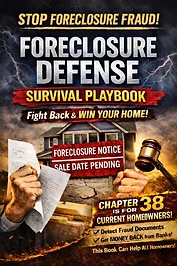
That is exactly why the Foreclosure Defense Survival Playbook is an indispensable resource. This comprehensive, 530-page educational guide is designed specifically for homeowners who are behind on payments or already in foreclosure. It breaks down complex legal concepts into plain, actionable language, teaching you how to:
- Audit your mortgage documents for fatal flaws and missing assignments.
- Draft and send effective Qualified Written Requests (QWRs) to trap abusive servicers.
- Organize your evidence to build a compelling procedural and substantive defense.
- Understand the rules of court procedure and legal research so you can confidently navigate the system.
Do not let a mortgage servicer's "abusive acts or practices" cost you your home. Equip yourself with the knowledge to hold them accountable. Order the Foreclosure Defense Survival Playbook today and take the first step toward saving your home and securing your financial future.

Order The Playbook
Get the Foreclosure Defense Survival Playbook
530 pages of structured, educational guidance covering mortgage documents, foreclosure procedures, evidence organization, and legal research — the same foundation this article draws from.